




Smartly constructed, self-growing mussel reefs at the boundary of the foreshore can reduce coastal erosion while making a positive contribution to biodiversity and the coastal ecosystem.
That’s the finding of The Coastbusters research project, involving partners DEME, Jan De Nul, Sioen, ILVO and VLIZ, with financial support from VLAIO.
”The cooperation with biologists is particularly enriching and has yielded new techniques for coastal protection. These techniques complement traditional methods, such as sand replenishment or dyke reinforcement,” said Tomas Sterckx, Coastbusters project coordinator (DEME).
“We now consider coastal zone management as a comprehensive approach to the entire coastal strip. Underwater biological protection lines prove to be a promising technique.”
Nature-based
Rising sea levels and possibly more frequent future storms make maintaining the basic coastline difficult in many countries. Governments must continually invest in dyke reinforcements, raising embankments and massive sand replenishments.
Conventional ways of coastal defence risk are becoming unaffordable. Nature-based, sand-saving coastal protection techniques are being developed and applied in many places already to include dune planting, artificial sandbanks of all kinds.
The Coastbusters project is the culmination of six years of experimentation and scientific observation at sea. During this time, VLIZ used its innovative monitoring techniques including underwater drones to closely monitor the evolution of the mussel reef, even during storm conditions.
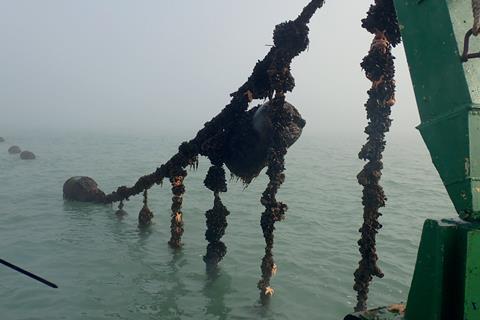
One of the innovative elements in it is the so-called mussel shaker. The new technique uses mussels to build a reef that acts as a biologically-reinforced dune-by-dike underwater, as the first hurdle against storm surges. Beach and dunes then become the second line of defence.
The biggest challenge during the project was to find how best to help biobuilders such as mussels and shell tube worms settle, under prevailing conditions.
As the North Sea is among one of the roughest seas, it can never be ruled out that materials may be damaged and enter the marine ecosystem. Within the Coastbusters project, Sioen succeeded in identifying bioplastics that slowly biodegrade under marine conditions.
The reef itself brings two potential environmental benefits, ILVO biomonitoring shows. Firstly, the research sites attract a lot of additional marine life and act to promote biodiversity. Secondly, mussels are filter animals that remove their nutrients from the water. So on net, the seawater becomes slightly cleaner.
A hypothesis to be further substantiated is the beneficial climate effect. Mussels absorb CO2 and store it for a long time in their shells in the form of calcium carbonate. This is a small form of blue carbon storage.
The partners said that they now have a promising concept for global application which is sufficiently market-ready to start working with in practice.