

Green shoots have begun to sprout in Indian ports as the government makes an ambitious push towards decarbonisation of port infrastructure, writes Ramadas Rao.
Greening of ports is a significant component of the National Green Hydrogen Mission of the government, which has earmarked Rs 197Bn (approx. US$2.3Bn) up to 2029-30.
Part of the outlay will be used to develop three major ports (those that are controlled by the Central government) to serve as green hydrogen hubs on the west and east coast. Guidelines are being framed for private and foreign investment.
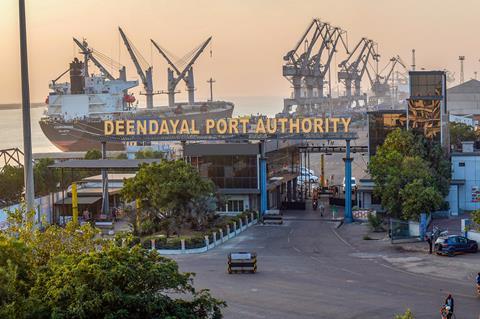
“Multiple projects, both on a pilot basis and commercial scale under the National Green Hydrogen Mission have been initiated,” Sushil Kumar Singh, chairman, Deendayal Port Authority (DPA), Kandla, tells GreenPort.
Alt fuel ecosystem
Kandla is located on the west coast in Gujarat State. Its new projects will develop an ecosystem for supporting production, storage, transportation, usage and bunkering of low carbon or zero/near zero emission fuels.
“The plug-and-play infrastructure being developed will support industry partners co-located within DPA (Kandla) jurisdiction to produce an estimated quantity of 5.4M tons of green ammonia per year by 2030-32,” Mr Singh explains.
He notes that Deendayal Port is the “first in the country” to have commissioned a mega watt scale indigenously developed green hydrogen production plant to produce 150 metric tons of green hydrogen annually. Works are on to scale up to 9 MW.
A pilot project for commissioning a five tonnes per day (TPD) bio-methanol plant is underway besides a 150 TPD e-methanol plant jointly with Assam Petrochemicals.
Essential infrastructure and regulatory clearances for handling methanol have been obtained, says Mr Singh and the port already handles grey methanol as cargo. Port readiness level for methanol bunkering has been assessed and verified by classification major DNV.
Bunkering and storage
The other two ports, identified under the country’s Green Hydrogen Mission are Paradip on the east coast in Orissa state and Tuticorin (V.O. Chidambaranar) on the south-east coast in the southern state of Tamil Nadu.
They will also be equipped with large scale bunkering and storage facilities for hydrogen, ammonia and methanol for the greening of industries in the hinterland.
Paradip and Kandla are top two major ports respectively in terms of annual cargo throughput, each exceeding 150M tonnes in fiscal year 2024-25 (01 April to 31 March).
Hinterland industries in Paradip include steel and fertiliser plants and the port is well placed for bulk hydrogen production and distribution. The port is working on a dedicated jetty for handling green hydrogen, ammonia and other liquid cargo, work for which was approved in February 2026.
Facilities will also include storage systems and pipelines. The Rs 8Bn (US$88M) jetty will have a capacity of 4M tonnes of hydrogen per annum and should be completed within 24 months.
Kandla is also geared up for green hydrogen and ammonia production plants. Being the western gateway, it is targeted as a hydrogen corridor to Middle-East and Europe.
Meanwhile, Tuticorin port in the southern state of Tamil Nadu is growing its container footprint handling close to 800,000 teu during fiscal 2024-25.
Global container port giant PSA of Singapore and Geneva headquartered Mediterranean Shipping Company (MSC) are among the prominent investors in container terminals here.
A green hydrogen valley cluster is being created aimed at supporting steel and cement industries nearby whereby green hydrogen, ammonia and methanol will be obtained using only renewable energy.
Tuticorin meanwhile has laid the foundations for a 750m3 green methanol bunkering and refuelling facility. A pilot project of 10 Nm3 (normal cubic metre) green hydrogen to power will streetlight scaling up the operation. Commercial scale development is slated for 2029.
All three ports will draw future energy from solar and wind farms.
In order to make the energy transition smoother for Indian ports, the International Collaboration Denmark Energy Agency has provided a funding grant to Energy Consortium at IIT Madras to devise training modules and deliver transition workshops in renewable energy, green fuels and energy efficiency, Nikhil Tambe, CEO, Energy Consortium told GreenPort.