

The UK’s seventh Contracts for Difference (CfD) Allocation Round (AR7) secured 8.4GW of new offshore wind capacity in Europe’s biggest ever offshore wind auction, restoring confidence after several challenging years for the sector, writes Andy Sloan, executive vice president, COWI UK & International.
In Scotland, AR7 delivered a material boost to the offshore wind pipeline. The award of a CfD to the fixed bottom Berwick Bank Phase B project will represent a significant addition to Scotland’s offshore wind capacity, while the Pentland floating offshore wind project off Scotland’s northern coast points to the next phase of development in deeper waters.
Building on the 40GW of potential capacity unlocked by ScotWind leasing round, AR7 reinforces Scotland’s position as a leading offshore wind nation. But capitalising on that position will depend on the strength of Scotland’s domestic infrastructure, particularly ports.
Without sustained investment, Scotland risks losing ground to international competitors at a time when other nations are rapidly scaling port capability.
Ports apart
Currently, Scotland’s role in offshore wind is largely limited to marshalling and logistics, with the manufacture, large-scale assembly and heavy maintenance of major components often taking place overseas.
For example, the floating platforms for the Kincardine project – which sits 15km off the coast of Aberdeen – were constructed in Ferrol, Spain, before being transported to Rotterdam for final assembly and tow-out. The same turbines are towed 700km back to Rotterdam whenever maintenance is required.
As one of the first of its kind, it was necessary to deliver the project within the constraints of the existing infrastructure and supply chain.
However, as floating wind projects become more commonplace, Scottish ports will require upgrades to equip them with the deepwater access, heavy-lift capacity and quayside space required if they are to support floating offshore wind across its full operational life.
Transformational investments taking shape
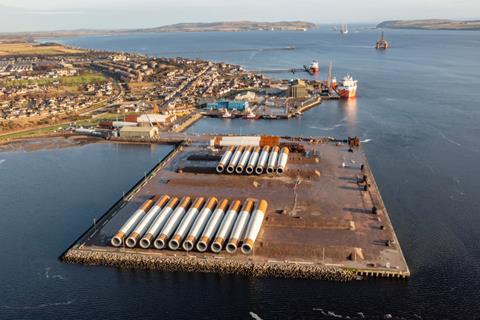
While investment has been slow to materialise, a wave of projects are showing the route forward. Take Ardersier in the Scottish Highlands for example, which is gearing up for floating wind by tackling long-standing barriers to cost reduction, scale and supply-chain efficiency.
Unlike traditional ports, it integrates on-land assembly and launch of floating structures, reducing weather risk and streamlining logistics.
Backed by unprecedented public and private investment, its bold redevelopment has broken the ‘chicken-and-egg’ cycle where ports wait for firm developer commitments before investing, signalling confidence in Scotland’s floating wind future and setting a new precedent for how infrastructure is built ahead of demand.
Meanwhile, The Port of Cromarty Firth has demonstrated what’s possible even with the hurdles of raising capital as a trust port; it successfully supports complex offshore energy projects and has detailed plans to expand its quayside capacity further.
That progress has now been recognised with a £55.7 million UK government investment to support this expansion, a clear signal of the critical role ports play in accelerating the energy transition.
The success of the Port of Nigg as a marshalling yard for Scottish offshore wind projects and the future potential brought by Scotwind played a key role in Sumitomo Electric locating their new HVDC cable factory adjacent to the site. This is the first large scale manufacturing investment in Scotland driven by the growth in renewables.
Why continuous investment matters
These industry leaders show what’s possible, but such examples remain too rare to meet Scotland’s floating wind ambitions. Too often, investment decisions are made season-to-season, driven by short-term needs rather than long-term strategies.
This lack of certainty makes it difficult for developers and port operators to plan effectively, scale operations and secure supply chains.
What Scotland and the UK urgently needs is a multi-year framework that provides visibility over future projects and funding, ensuring that investment flows continuously rather than sporadically.
In the Highlands and other coastal regions, ports can act as catalysts for broader regeneration, from job creation and skills development to housing and transport improvements. The ripple effect is wide-reaching.
As ports expand, they drive demand for housing, transport links, and local services, supporting small businesses and encouraging further private investment. For regions that have experienced industrial decline, this represents an opportunity to reverse population drift and foster vibrant local economies.
Securing Scotland’s offshore wind future
This is not a moment for complacency. Scotland has the natural resources, industrial heritage and skilled workforce to lead the global floating offshore wind market, and AR7 has reinforced that position by restoring confidence in the UK and Scottish project pipeline.
But turning momentum into delivery will require more than one-off announcements. It demands a multi-year framework that aligns future CfD rounds with sustained investment in ports, grid infrastructure and supply chains, giving industry the certainty it needs to plan and invest at scale.
AR7 has shown what is possible when the right signals are sent. With long-term certainty, Scotland’s ports can become the foundations of a globally competitive floating offshore wind industry for decades to come.