The upcoming ECA limit on sulphur in marine fuel was the driver behind the EU-funded TEN-T study into LNG infrastructure in Northern Europe.
The study, led by the Danish Maritime Authority and including partners from states, ports, LNG companies, classification societies and engine manufacturers, has considered distribution, storage and use of LNG as a fuel, including the hard side of the supply chain – the bunkering stations and infrastructure – and the soft side, regulations, industry standards, etc.
The first phase of the project has made a series of recommendations – including that the EU and national authorities should harmonise regulations and safety requirements for both land-based and sea-based bunkering activities, to attain a consistently high safety level and avoid making safety issues a competitive factor between different bunkering modes.
Authorities should avoid introducing new requirements for LNG bunker vessel traffic, which should be considered similar to other dangerous cargo vessel traffic, says the report, but it also recommends that guidelines should be developed specifically devoted to LNG bunkering – including emergency shutdown systems and tailored training of those involved.
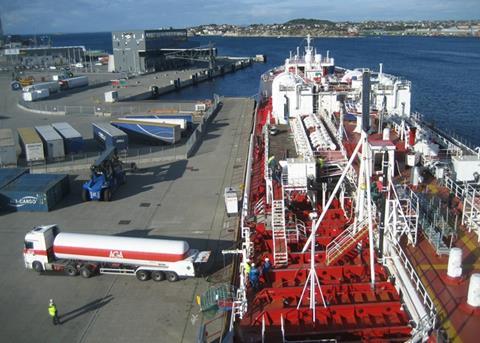
Tank truck solutions are manageable for many and provide flexible solutions for bunkering with small LNG volumes says the report, which recommends the truck-to-ship solution in all sizes of terminals, for vessel requirements of a few cubic metres up to 200 m³, while terminal-to-ship pipeline is recommended for all sizes and in terminals with available space for associated bunker facilities.
The next stage of the project is a full-scale pilot project deploying two new cruise ferries with LNG propulsion which will operate from the southwestern part of Norway to the northern part of Jutland and onwards to mainland Europe. The first ferry is due for delivery in April 2013.
“It is important to highlight that the partners in this project represent the whole LNG supply chain,” says project manager Mogens Schrøder Bech, head of division at the DMA. “We have looked at safety and at operational, economic and permit issues.”
The study has already concluded that LNG is a competitive fuel; a key recommendation is targeting the compatibility of systems with regards to safety, technical equipment and operational procedures, he adds.
Mr Bech believes shipping companies’ economic considerations will be decisive in the demand for LNG: “When that tipping point will be, it isn’t possible to say.”