
Steamy weather co-incided with steamy throughput for Virginia. Barry Parker reports
August 2016, hot and sultry along the US East Coast, saw the Port of Virginia set an all-time record for teu throughput at 235,511 boxes.
September’s flow, at 220,000 teu, marked the eighth straight month of flows greater than 210,000 containers.
John F Reinhart, the former Maersk man who became chief executive and executive director of the Virginia Port Authority in 2014, commented: “The peak-season cargo flow is steady – import teus were up 7%... our productivity across the operation continues to trend in positive territory.”
These recent gains, with Mr Reinhart looking for 2016 flow to exceed the 2.5m teu of 2015, are part of a multi-year turnaround story.
Mr Reinhart can be credited with leading a return to profitability for the port, successfully executing on a new strategy (which has included investment in new gates for trucks) while further reducing the congestion which had plagued the port, through attention to a myriad of details.
In this newly begun era of neo-panamax vessels calling along the US East Coast, geography is on the side of Norfolk, Portsmouth and Hampton Roads, where many of the Port of Virginia’s operations are located. The region features a natural harbour (with channels now dredged to 50 feet but with Federal authorisation to maintain 55 feet channels in place) that is linked to major motorways and railways.
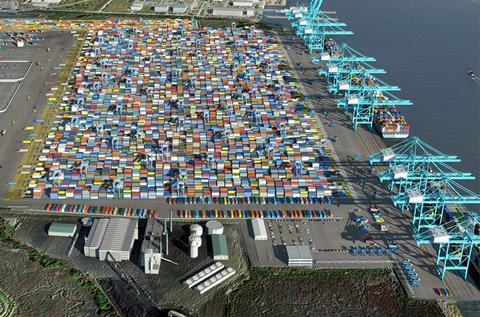
The Port of Virginia is synonymous with the Virginia Port Authority (VPA), part of the state government, The Commonwealth of Virginia. The VPA owns and operates four terminals, which it also manages through Virginia International Terminals. These are Norfolk International Terminals, Portsmouth Marine Terminal, Newport News Marine Terminal and the Virginia Inland Port, an intermodal transfer facility located in Front Royal, Virginia, about 50 miles to the west of Washington, DC.
Additionally, it operates under a lease that begun in 2010 and has now been extended out to 2065 the highly automated Virginia International Gateway (VIG), also in Portsmouth, and Richmond Marine Terminal (also leased) at the state capital, the western end of a thrice-weekly container on barge service on the James River linked to Hampton Roads.
VIG cornerstone
A big part of the turnaround story centers on VIG, which was previously APM Portsmouth; APM had brought the facility online at the height of booming trade shortly before the onset of the great recession in 2008. In 2014, four years after the VPA entered into an expensive long-term lease with APM Terninals - with a previous Virginia government - APM sold the facility to a group of private investors, led by infrastructure packager Alinda Capital in 2014.
Two years later, in September 2016, the Port of Virginia announced that it had signed a 50-year lease, where the terminal would be operated by the port and doubled in capacity over three years to 1.2m teu/year from the present 600,000. At nearby Norfolk International Terminals, capacity is also being increased, and truck access is being improved, by virtue of a $350m funding infusion from the Commonwealth of Virginia.
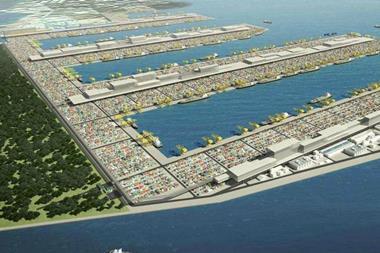
The announcement of the new leasing deal between the port and the Alinda-led investors also alluded to the future path, with John G Milliken, chairman of VPA’s Board of Commisioners, saying: “We have set our growth path for the next 20 years and built a bridge to our long-term future, which is a terminal on Craney Island.”
Financially, results have swung into positive territory, following losses of $15.5m and $17.1m loss in fiscal years 2013 and 2014, ending June 30. At a tactical level, the port has turned around what had been a bad situation (where stories of severe congestion abounded) into two years of profitability. Mr Reinhart talked about steps that were underway in late 2014, saying: “We have made significant progress in the last six months establishing the new organisational structure, making changes on the ground in terminal operations, establishing metrics to measure performance, implementing a new terminal operating system at NIT and making strategic capital investments to deliver improved results.”
Fiscal 2015 and now-ended 2016 saw profits of $13.6m and $4.8m (preliminary). Throughput for fiscal 2016 was reported at just under 2.6m teu.
Virginia hopes to build on its ongoing momentum; Mr Reinhart has emphasised the port’s aspirations: “The work we do in these next three-to-four years is truly going to chart The Port of Virginia’s course to the future. We are executing our growth plan to build a sustainable operation and make The Port of Virginia a primary gateway for global trade.”