

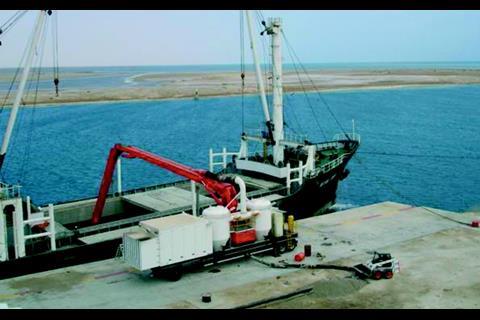
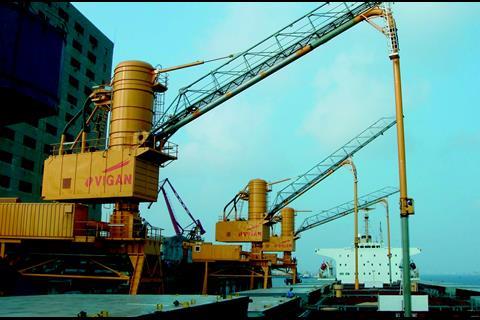
Manufacturers of pneumatic systems are becoming increasingly vocal when stressing the environmentally friendly nature of their products. But exactly how friendly are pneumatic unloaders? Alex Hughes went to find out.
Equipment produced by manufacturers such as Vigan and Neuero is perhaps best known for applications with notoriously dusty free-flowing materials such as grain, corn and fertilisers. So, how do manufacturers prevent this dust from escaping?
Those approached by PS point out that because pneumatic unloaders produce negative pressure in the conveying line, no special design work is required in that part of the equipment to prevent dust escaping. However, environmental factors are important in the chain or drag conveyor, which is used to transfer products from the airlock outlet towards the final destination, be it trucks, rail wagons or quayside conveyor.
As a result, at the outlet of this conveyor, several devices exist to prevent dust from escaping into the atmosphere. These include, for example, a special covering around the inlet hole, telescopic loading chutes with circular rubber bands that are deployed during truckfilling, and a special loading spout which prevents the dust from escaping from the loading point.
In fact, manufacturers claim that the amount of dust escaping from a sealed pneumatic unloader is virtually negligible. In contrast, grabs generate substantial dust and spillage. Significantly, while there should be little difference in theory between pneumatic unloaders and mechanical continuous unloaders, this is not really the case, especially with regard to operations in the hold itself.
Essentially, because non-pneumatic alternatives need auxiliary equipment to complete cleaning up operations, a lot more time is spent by pay loaders or bulldozers pushing remaining material towards the intake of the mechanical arm, which in turn creates more dust.
Furthermore, it is quite common during the final stage of hold cleaning for insufficient material to be swept into the path of the vertical arm. This results in the chain or screw "shaking" quite a lot of the material before it is lifted upwards, which can produce unnecessary dust emissions.
ZERO PERCENT DUST EMISSION Alain de Visscher of Vigan was asked to explain how his company's equipment could be improved to minimise dust emissions. He stressed that its pneumatic unloaders are already performing to the highest levels, so this is not seen as a major concern any more.
"We offer a guarantee that emissions from the turbo blower exhausts will be less than 10 milligrams per cu m which is possible thanks to the fitting of a highly efficient, self cleaning filter, " he emphasises. "Because of this, operators can expect to realistically achieve zero percent dust emissions, if they properly maintain the pneumatic systems and use appropriate devices when loading into trucks, wagons and/or quayside conveyors."
In terms of noise suppression, while manufacturers concede that mechanical systems tend to be quiet because of the low running speed of their moving parts, proper insulation of fan blown type pneumatic equipment can also very effectively reduce noise emissions and therefore allow pneumatic equipment to be used in urban areas.
In fact, Vigan has recently introduced a special design covering the suction and conveying pipes, which now have double walls with noise insulation material between them.
Vigan also insists that the longer hold clearing up times required for mechanical equipment means that there is little difference when comparing energy costs with pneumatic systems. Indeed, it is claimed that savings of up to US$32,000 can sometimes be made using pneumatic unloaders basis unloading 500,000 tons per year.
Unlike either Vigan or Neuero, Van Aalst sells its products to those stevedoring groups needing to unload non free-flowing material (cement, fly ash, gypsum, soda ash and so on).
Sales manager Hans van Est emphasises that the environmental aspects of pneumatic unloaders are often key to their adoption by terminal operators. He points out that grabs can undertake unloading much cheaper than their pneumatic alternatives, which are nevertheless more competitive in terms of lower noise output, reduced dust emissions and lower overall power consumption.
"Because pneumatic unloaders suck material directly out of a ship's hold and then blow it into the storage facility via a pipeline, no dust can effectively escape into the air. The only source of dust is the hold itself, which is open to the wind. However, when pneumatic unloaders are in use, they create a slight under-pressure in the hold, which means that less dust is likely to escape, " explains van Est.
He points out that the unloading technique with pneumatic equipment is for material to be discharged in layers which is made possible by the use of a highly flexible arm. In contrast, screw conveyors dig a hole in the consignment, which means that miniavalanches within the hold are common and allow dust to rise upwards into the air.
"Even with pneumatic unloaders you will get dust rising up out of the ship, " concedes Van Est. "Nevertheless, on smaller vessels, dust sheets are used to partially cover the open hold and therefore restrict the amount of dust that does get up into the atmosphere."
Asked to speculate on how even these emissions could be curbed, Van Est points out that it may well depend on redesigning hatch covers capable of partially opening only at the point where the pneumatic unloader enters the vessel at any given moment. He adds that only self-discharging vessels are ever likely to effectively cut dust emissions to zero.
In terms of noise pollution, pneumatic equipment supplied to the developed world operates with a maximum 85dBa noise level, measured at a distance of one metre from the machine. While 80dBa levels are often mooted, in Van Est's personal opinion this extra reduction will not become a mandatory requirement for at least ten years.
As to the debate over whether pneumatic unloaders or screw unloaders use more power, he explains that the sucking and blowing aspect of pneumatic machinery means that these actions are undertaken by the same piece of equipment. In contrast, screw-based equipment simply discharges material onto the dock where other modes are required to shift the material to storage or stockpile areas. "As a result, there is little difference in the power consumption of a pneumatic unloader compared to that of a screw unloader, " says Van Est, who nevertheless concedes that grabs still have the lowest power usage of all.
Related Companies
- Previous
- Next