
With thousands of fixed and rail-mounted slewing jib cranes around the globe nearing the end of their useful working lives,dry bulk terminals are seeking to replace them with more flexible units. Alex Hughes reports
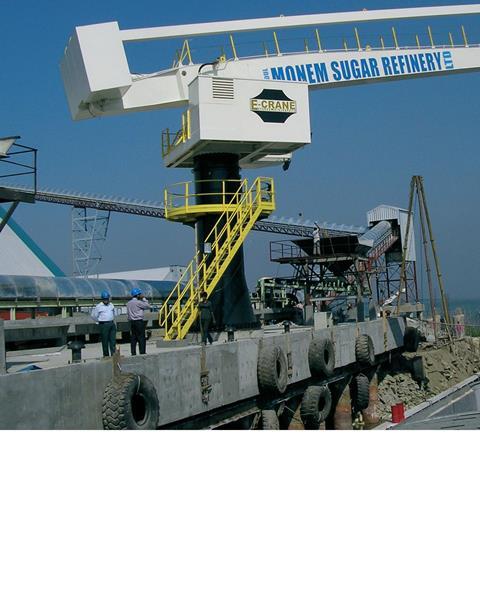
Each year in Europe, around ten Equilibrium- Cranes (E-Cranes) are sold specifically to terminals handling dry bulk products, while a further five are snapped up by handlers of scrap metal. This represents significant growth given that, five years ago, output amounted to just five to six units.
“Sales are continuing to grow,” notes sales manager Bas Tolhuizen. “We are not a huge company and produce each crane on a customised basis.”
He identifies the target market as perhaps a dry bulk terminal that also undertakes some break bulk handling. This type of stevedore can therefore operate from a dedicated site,or from several quays throughout a port; mobility is therefore a key component of the purchase-making process.
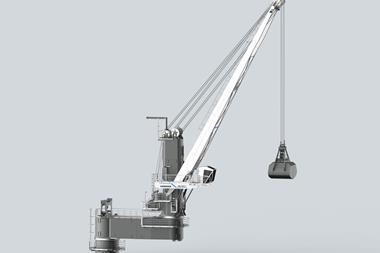
The current boom system on the cranes provides an outreach of 45 metres, which means any vessel up to 80,000 dwt (panamax) can be comfortably handled. Theoretically, an E-Crane could be built capable of handling capesize vessels, but this would involve incorporating huge cylinders and slewing motors, which might defeat the advantage of otherwise having a highly-simplified design.
E-Cranes are designed to work with a variety of grabs,which are easy to change since they are attached to the boom via a couple of hydraulic hoses and can be removed by opening four twist locks. Changeover of grabs should therefore take no more than ten minutes. Interestingly, while Mr Tolhuizen concedes that ECranes do not incorporate the sort of highly sophisticated equipment often associated with traditional mobile harbour cranes (MHC) as produced by Gottwald, Liebherr, Fantuzzi and the like, he nevertheless points out that the purchase price is very similar in terms of tons per hour output.
However, the operational costs of an E-Crane are significantly lower, since energy consumption is just 0.4kW per ton unloaded when used with material such as coal, grain, fertiliser, sand and limestone, although slightly higher if used on scrap metal handling duties.
“Equilibrium cranes have very low power consumption and incorporate few complicated components. Operation is also simplicity itself: the driver moves the crane using two joysticks; onboard equipment is limited to little more than a couple of hydraulic pumps and motors,”says Mr Tolhuizen.
Units can be manufactured to operate on crawlers, rails or even as fixed installations.The undercarriage of each crane is therefore always custom built, with the width and length of the crawlers being adapted to individual requirements.Rail span is also another highly individualised area.
As for projected lifespan, E-Cranes are built with two million unloading cycles in mind. Since an average terminal would operate a crane for around 2,000 hours a year, it would therefore remain in service for up to 20 years.Maintenance is easy because there are very few moving components, with only two/four cylinders and a couple of slewing motors requiring major upkeep.
Meanwhile, Finnish hydraulic crane manufacturer Mantsinen sells around 40 units a year to dry bulk and scrap handling terminals.“Our customers range in size from a two-crane operation in what might be a river terminal up to something much larger, such as the bulk terminal operated by the Mestre Group in Barcelona, where we have six of our units operational,” says area sales manager Asko Kinnunen.
Mantsinen focuses much of its output to customers in Europe, but is also gradually making inroads into the US,Africa,Turkey and the Russian Far East.According to Mr Kinnunen,its cranes can handle any type of dry bulk, ranging from grain shipments requiring 400 kg per cubic metre of lift, up to ferro-chrome and ferro-silicate, where the figure rises to 4,500 kg per cubic metre.
To make it easy for an operator to easily shift between products, a quick release and connection system enables various clams, buckets, grabs, hooks or spreaders to be replaced in around 10 minutes. In all, there are up to 25 different possible different attachments that can be used.
Despite the fact that the majority of Mantsinen’s cranes are supplied on caterpillar tracks, rail-mounted and rubber-tyred variants are also produced. The advantage of caterpillar tracks is that the operational unit is wholly independent of surrounding infrastructure and can move from one area to another in a reasonable time. So, if there is a bunker area, the machine can be deployed both there as well as on the quayside, thereby obviating the need to double-up on capital investment. This type of unit can even move short distances without any kind of instability while carrying a full bucket load.
In terms of cost, Mr Kinnunen concedes that Mantsinen’s cranes retail at similar prices to cableoperated MHCs. Nor does power consumption vary greatly. Nevertheless, he cautions that such comparisons are not really that accurate.“A cable crane can take up a greater tonnage per lift, but a hydraulic machine can handle greater tonnage per hour. But maintenance costs for our cranes are cheaper, since we don’t need to replace long cables or winch brakes.Also, a typical excavator mechanic can maintain a Mantsinen crane, which is a very well-understood design.”
The operating economics are attracting ever greater levels of interest from operators, many of whom are replacing obsolete rail-based slewing jib cranes with the company’s hydraulic units, won over to a certain extent by the increased operational flexibility. For this reason, Mr Kinnunen postulates that Mantsinen’s cranes should perhaps be seen as complementary to cable-operated mobile harbour cranes, rather than strictly competition to them.
He claims that hydraulic cranes have an economic lifespan of between 20,000 hours and 30,000 hours, with a typical dry bulk/scrap handling terminal using its cranes for no more than 1,500 hours per year. Sweden’s MultiDocker is another hydraulic cargo handler manufacturer which achieves significant sales to maritime dry bulk terminals. Its CH65 unit, for example, is used to handle logs,wood pulp,paper pulp, woodchip, pellets, big-bags, scrap, rocks, gravel and other bulk cargo. According to company director Egil Koch,MultiDocker cranes are seldom purchased just for handling one specific type of bulk material. Because of this, he says it is difficult to say exactly how many units are sold specifically for dry bulk handling only,although estimates that this figure is in the region of 15 cranes per year.
“Because the MultiDocker is highly flexible, it can be used for loading or discharging vessels of up to 9,000 dwt, in addition to other applications in both port terminals and industrial complexes. It is also a flexible scrap handling machine that can undertake virtually every task in yards involving this material, including stacking, loading, unloading and the feeding of fragmentation mills.” In terms of lift capacity,at an outreach of 20.4 metres a MultiDocker can operate with a weight of 8.5 tonnes, dropping to 6.1 tonnes at 24 metres. This, claims Mr Koch, gives the best lift capacity in the market for comparable machines. ”
The MultiDocker is sufficiently flexible to allow it to handle a variety of dry bulk products,”he says,pointing out that the crane’s boom can be adapted to work with a variety of tools depending on the commodity being handled.
“We believe that one of our units can continue in service for 10-15 years, although everything depends on how it is used and what material it is handling.With these caveats in mind, I would say that a return on investment is achievable within four to six years.”