APM Terminals looks set to take over the Apapa Container Terminal in Lagos, Nigeria but will this prove to be a double-edged sword? Mike Mundy reports.
Despite winning the bid for the Apapa container terminal concession in Lagos, Nigeria in March 2005, with a stunning bid of $1.06 billion, the Danish conglomerate AP Moller, which owns Maersk Lines, P&O Nedlloyd and APM Terminals, has not yet taken occupancy of the terminal.
APM Terminals, the division with direct responsibility for terminal operations, remains fairly tight-lipped on this state of affairs electing to say only that, "?the transition period is progressing as agreed."
Undoubtedly this brief answer is true but it is also clear that it is not the whole answer, this also, perhaps, being underlined by the considerable amount of speculation that has been going on in Lagos shipping circles as to precisely what is the reason behind APM Terminals taking over the Apapa terminal.
The situation is, however, now becoming clearer and there does appear to be a real prospect of APM Terminals taking up occupancy at Apapa in the near future.
CPCS Transcom, the Canada-based consultancy which is assisting the Federal Government of Nigeria (FGN) through the Bureau of Public Enterprises with the establishment of a Landlord ports system and the concessioning of 25 terminals, confirms that one reason for AP Moller not yet having taken over the terminal is that it is going through the transition period of six months agreed as part of the procedure for taking over the terminal from the Nigerian Ports Authority (NPA).
"The other key issue, " it says, however, "is resolving the Labour Unions' demands on the Severance Packages." It explains this at length saying: "Although as per the concession agreement executed on 19 September 2005, APM would have free access of the container terminal at Apapa during the transitional period, APM initially had trouble having proper access to the premises, mainly due to lack of cooperation from the Labour Unions and continued resistance from them. However, later on as the FGN commenced negotiation with the maritime labour unions, APM was being provided access to the port. Moreover, in order to resolve this issue, presently the Government of Nigeria through a Presidential Task Force headed by the Minister of Finance is in negotiation with the Maritime Workers Union of Nigeria (MWUN) and the NPA Senior Staff Association (NPASSA).
"Over the last two months, " CPCS Transcom elaborates, "they have held four rounds of negotiations including a recent one on the 6 January 2006. In addition to the President General of MWUN Comrade Onikolease Irabor, President of NPASSA Comrade Peter Abolarin and President of the Dock Workers Union Comrade Tony Nted, the last negotiation was attended by the President of the Nigeria Labour Congress Adama Aliyu Oshiomhole mni from the labour side whereas the Government side was chaired by the Minister of Finance Dr. Ngozi Okonjo - Iweala in the presence of the Minister of Labour and Productivity."
The next step, according to CPCS Transcom, is for a further meeting to be held later in January which is expected to resolve all the outstanding issues related to Maritime Labour and the NPA Workforce. This, in turn, it concludes, should give APM, "?a smooth transition in taking over the operation of the Apapa Container Terminal from the NPA."
THREE PHASE DEVELOPMENT On finally taking over the Apapa Container Terminal, which is universally recognised as presently performing very poorly and functioning with inadequate equipment and inefficient work practices, APM will implement a three phase development plan. The plan is highlighted in Table 1:
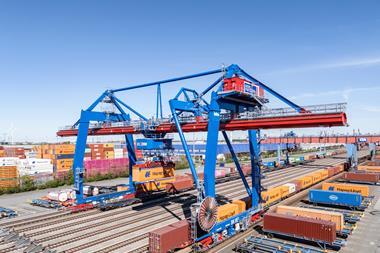
On equipment alone it is expected that APM will spend up to US$250m over the lifetime of the concession with this including up to 10 ship-to-shore gantries and 40 RTGs.
With the above sort of plans ready for implementation it seems that at long last Nigeria may soon have a container terminal in Lagos that provides at least reasonable service. Undoubtedly, achieving this will be a step-by-step process but it does now seem to be set on the right path to secure a significant uplift in operational efficiency, something that has long been required. If the proposed new Landlord style port authority with jurisdiction over Lagos responds positively to its role then hopefully other problems such as the lack of night navigation aids and towage will also be resolved providing further impetus to efficiency improvements.
QUESTIONS REMAIN Leaving these practicalities aside, however, some interesting questions remain as to the AP Moller Group's strategy in Nigeria, all of which have been voiced in the Nigerian media.
One is the price AP Moller has been prepared to pay for what is a fairly average container terminal by world standards - i. e. its US$1.06bn bid. Simply put, it is astounding for a facility of this kind and according to informed sources at the time it was announced it is simply not logical in that it basically means that the amount of rent offered to the authorities is 20% higher than the gross revenue that can be expected from the investment.
The next highest bid for the facility - another measure of just how high the bid is - was one from ICTSI for just under US$202m.
The price paid has led to speculation that AP Moller has a much bigger agenda in Nigeria than just securing the Apapa container terminal. One line of thought that has surfaced on numerous occasions is that with the control of the Apapa container terminal under its belt, this coupled with the interest it has in the Onne container terminal in Nigeria gives it effective control of a very large sector of the Nigerian container market - in both container handling terms and as regards liner shipping movements via its group companies Maersk Line and the recently acquired P&O Nedlloyd. In short, the fear is that AP Moller is moving towards a monopoly and will leverage its control of terminal capacity to increase its market share of key deepsea trades such as the European trade.
One fear at least, though, will not materialise, namely, that AP Moller will negotiate its way out of the fixed lease payment of just over US$1bn for the terminal. CPCS Transcom confirms that this arrangement is in place together with a per box royalty payment which will be made through APM Terminals Apapa Limited, a company incorporated under the laws of the Federation of Nigeria and a special purpose vehicle established by AP Moller Finance; a company incorporated under the laws of Switerland.
According to CPCS Transcom, APM Terminals Apapa Limited is 100% owned by AP Moller Finance S.A. , however, significant ownership by Nigerian Nationals "is expected."
PHASE ONE . Convert the existing yard operation into a dedicated RTG operation and build the necessary terminal buildings and superstructure.
. Acquire additional yard handling equipment . Reduce gate and road congestion by incorporating a Truck Waiting Area immediately outside the gate complex . Provide a dedicated area for Customs examination . Add a new stacking area of approximately 20 hectares . Pave and provide drainage and lighting to refurbished premises . Construct a new Maintenance and Repair Shed . Improve terminal security by providing high quality fencing . Construct a new gate complex
PHASE TWO Invest in further construction of terminal buildings to accommodate and improve the working environment for the government employees and Customs officials
PHASE THREE Invest in new ship-to-shore gantry cranes and refurbish the two existing gantry cranes
Table 1: APM Terminals Three-Phase Development Plan for the Apapa Container Terminal