




Liebherrs reachstacker rationale
Liebherr has been explaining the rationale behind its new LRS645 ‘ banana boom’ reachstacker. ” When LiebherrWerk Nenzing decided to enter the reachstacker market some three years ago, ” says the company, ” there were plenty of suppliers offering rather similar models which could fulfil almost the same jobs, i. e. reach containers at a certain height and row and stack these boxes onto a defined location at another place. The main difference – if any could be found – was the price. Knowing that Liebherr is globally well known for its high quality products – and that quality has its price – the goal was as clear as it was difficult: The Liebherr reachstacker would have to come out with some unique features which would score in an almost saturated market.”
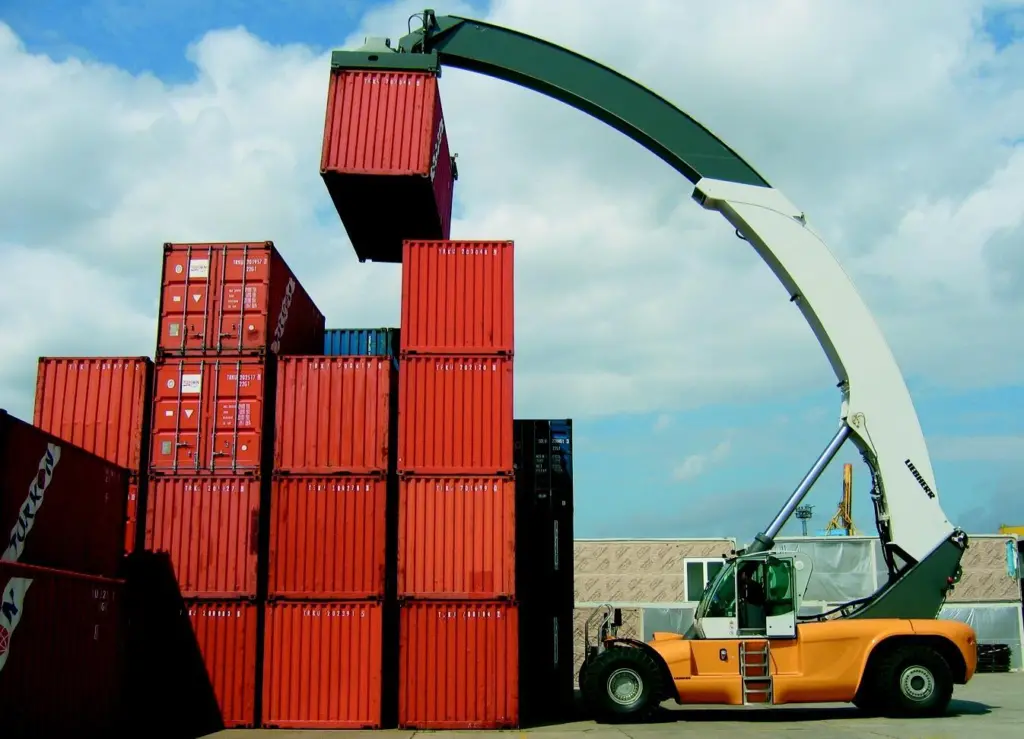
The curve-shaped telescopic boom offers so far unforeseen handling possibilities, says Liebherr. “In 4-high by 3-wide block stacks, LRS 645 removes the top container in the second row from either side without any necessary repositioning of the top container in the first row. In a similar example – with 3-high by 3-wide block stacks – the reachstacker driver manages to remove the top container in the third row without moving any of the boxes in the first or second row.
“Furthermore, the turning away from the straight boom concept allows the loading/unloading of containers from/to below ground level without special boom extension, offering highly attractive opportunities for the operation of barges and river vessels. And last but certainly not least, the curve-shaped boom eases the work of service and maintenance staff as no special lowering of the boom is needed for the regular service of the spreader – in fact, the spreader can easily be accessed from the ground.”
There are already 10 LRS 645s in operation or right before their ex-works date to a defined customer. “LiebherrWerk Nenzing has not only exceeded their expectations for the premiere year of the LRS 645, but looks also highly confident into 2005 where the set target is defined at 25+ machines.”
Related Articles
 EQUIPMENT
 EQUIPMENT