


1H 2023 China box volumes
China’s half year container throughput figures show an overall rise in containers of five per cent, but it’s a mixed bag of results for individual port performances. A J Keyes presents the highlights
Overall, container port growth in China for the first half of 2023 was “only” up five per cent over 2022. So which ports are pulling the average up and where is the average being pulled down?
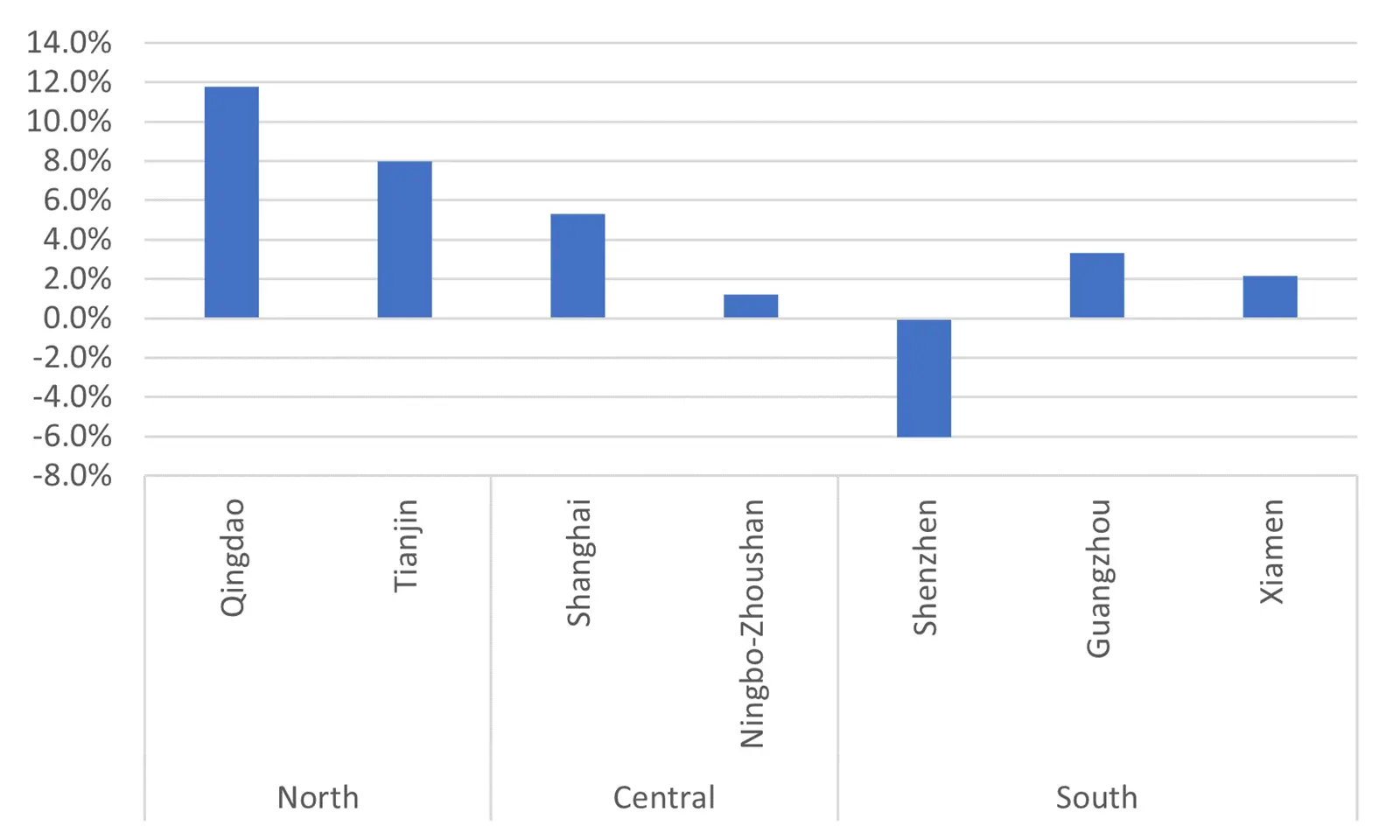
The regional split in China is shown in Figure 1 and it can be seen that the northern ports, serving the manufacturing powerbase, had the strongest growth in the first six months of 2023.
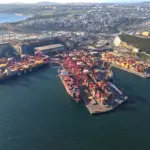
Qingdao in the north of China had a very strong first half of 2023, adding 1.47 million TEU over the comparable period of 2022, to record 13.94 million TEU by the end of June 2023. The second highest port growth was also in the north, at Tianjin, which recorded an eight per cent improvement from 10.52 million TEU in H1 2022 to 11.36 million TEU for the comparable period in 2023. In Central China, Shanghai led the way with a 5.3 per cent increase between the two respective periods, despite congestion and COVID-19 issues in Q1 2023.
MUCH LOWER
Growth at remaining facilities across the Central and South areas was much lower, for example at both Shenzhen (H1 2022 total was 14.40 million TEU, H1 2023 was down to 13.53 million TEU) and Guangzhou (H1 2022 was 11.74 million TEU, H1 2023 was up marginally to 12.13 million TEU).
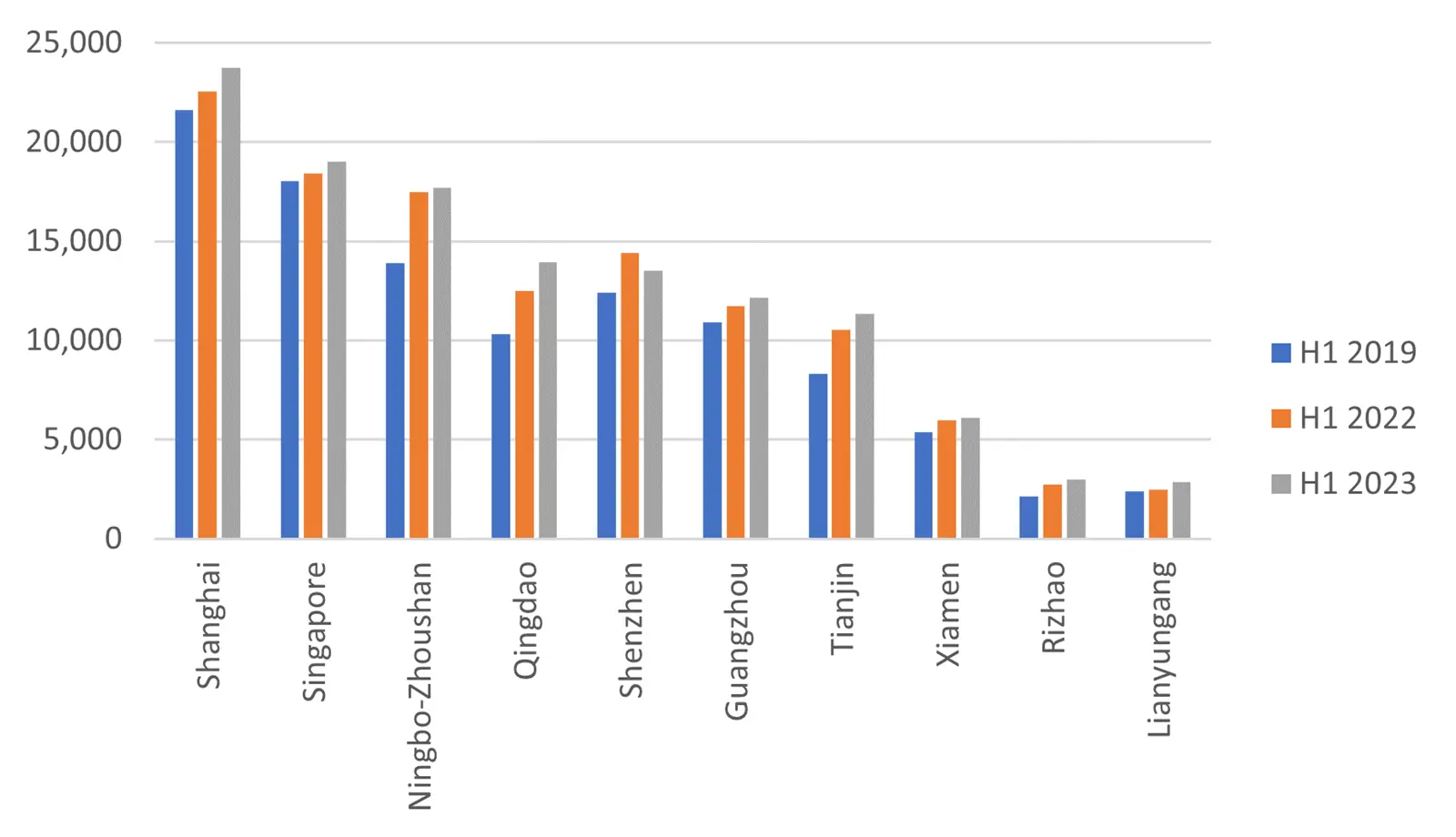
However, it is important to draw a comparison to the position in H1 2019. This was pre-COVID-19 and Chinese ports had been seeing tremendous growth. Yet, following the impact of the pandemic and subsequent rebound, it can be seen in Figure 2 that almost all of China’s ports handled more in H1 2023 than in H1 2019.
Nevertheless, things are changing, which appears in-keeping with manufacturing trends. Overall, China reported a 12.4 per cent decline in exports during June 2023, partly due to slowing global demand, but also partly due to companies moving their manufacturing outside China. According to specialist information provider, Data&, exports from the country have now fallen for 12 consecutive months to June 2023, with this figure the highest since the COVID-19 pandemic.
Despite the possibility of lower growth, port investment continues, with many operators targeting technology investment and green initiatives to improve efficiencies. There are various ongoing and known projects, at both large and smaller ports and terminals, including:
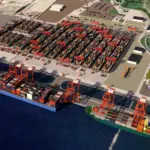
• Shanghai International Port Group is in the process of spending CNY51.3 billion (US$7.2 billion) to develop a new port and container terminal at the Yangshan Deep Water Port in Zhejiang province.The facility will have seven container berths, with a total annual throughput capacity of 11.6 million TEU. Construction commenced at the end of 2022 and is scheduled to be completed within an eight-year time period.
• Shandong Container Terminal (SCT), operator of the Yangshan Port’s fourth phase, which claims to be the world’s largest automated container terminal, is expecting to handle 6.6 million TEU in 2023, surpassing the design capacity of 6.5 million TEU, necessitating the need for more space. Jin Jian, General Manager of SCT outlined the strategy moving forward: “We are looking to make the terminal more intelligent and environment friendly as we increase its capacity to better serve the container liners. An annual capacity of more than 7 million TEU is targeted as we expand computing power and make proper logistics arrangements.”
• Tianjin Port is leveraging 5G technology, automation and renewable energy, as part of its ongoing transformation to use large-scale autonomous driving technology. It has also been certified as carbon neutral, powered with 100 per cent renewable energy provided from solar and wind sources on site. Operating as a smart port has reduced costs by about 30 per cent and reduced the on-site workforce to 200, compared to nearer 800 for a comparably sized traditional facility, while using automation to improve safety and working conditions for its workforce. Using automation has led to reduced berthing times by seven per cent, through quicker and more efficient vessel operations this year, according to the port.
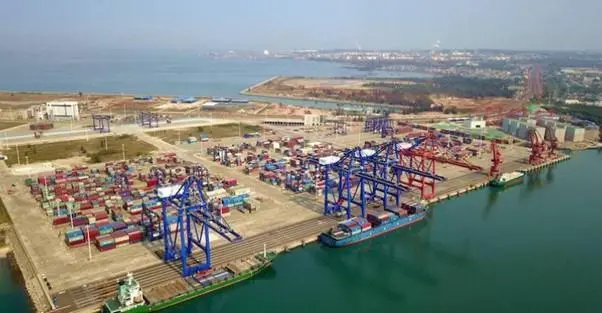
• Yangpu Port, located in China’s Hainan island, commenced its largescale expansion programme in January 2023. It is adding five new berths to the existing Xiaochantan Container Terminal, which has 830m of berth and eight ship-to-shore cranes. Four new berths will accommodate ships up to 24,000 TEU in size, with the remaining facility servicing ships up to 14,000 TEU. This project will raise the port’s total capacity from 5.5 million TEU to seven million TEU, annually. A key component of development at this port is a 2.35 Megawatt power plant that utilises the roof space of buildings in the port area, which has been confirmed as a model of “independent power generation for self-use with surplus power sold to the grid,” with more than 80 per cent of the green power generated consumed locally.
Investment in container capacity in China is, therefore, continuing apace, but trade uncertainties obscure the longer-term development of demand in a much more hostile geopolitical climate.
Related Articles
 OPERATIONS
 OPERATIONS
 OPERATIONS