




Avoiding russian roulette
A need to change strategy is required for Baltic Sea container ports due to lost Russian cargo. AJ Keyes looks at the situation and what some of the major ports are doing to meet the challenge
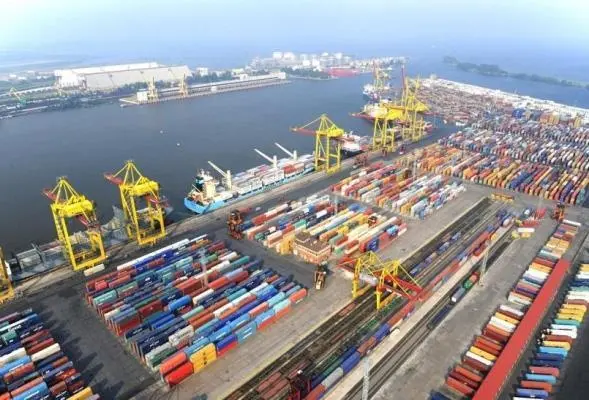
The role of Russia’s St Petersburg port as a Baltic Sea powerhouse has been declining in recent years, but with the tyrannical approach deployed by President Putin in the Ukraine this has effectively put the port on its knees. With volumes in St Petersburg seeing an 85 per cent decline this year, this is not just a problem, but a complete collapse. It additionally highlights the incentive for other regional ports to field alternate strategies to offset lost Russian cargo.
While the outcome of Russia’s invasion of Ukraine is not yet known, key Baltic container market trends are apparent and in particular the demise of Russia-linked transshipment. The period of reliance on transshipment into Russia, either directly via St Petersburg or transit via the Baltic States, has passed – at least for the present. Indeed, as long as sanctions continue on Russian cargoes no recovery can be anticipated.
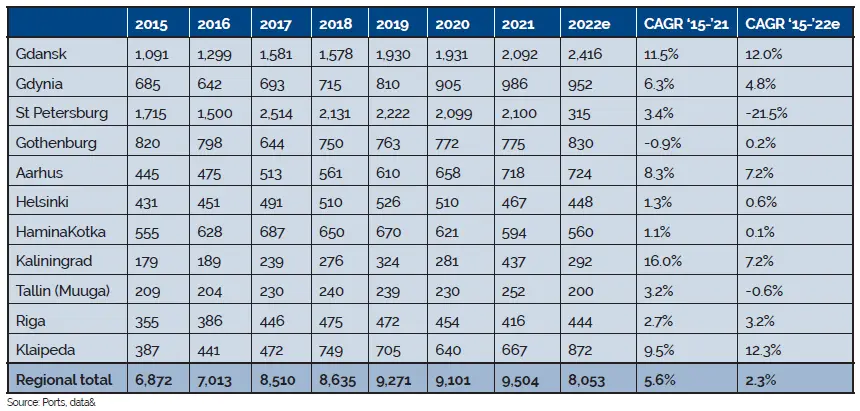
Prior to recent upheavals the Baltic container port market had grown by an average of 2.9 per cent between 2011 and 2021, rising from 7.14 million TEU to just over 9.50 million TEU. Using estimates for 2022, it can be seen in Table 1 how much the decline in Russian cargoes is expected to impact the region, with St Petersburg traffic decimated.
Among the other regional containerports, Gdansk is clearly the stand-out performer. For the Q1-Q3 2022 period the port has seen volumes rise 15.5 per cent over the same nine months of 2021, while increases can also be noted for Gothenburg (which saw a six per cent rise to end of Q3 2022 vs end of Q3 2021), along with Maersk Line-supported Aarhus, and Klaipeda.
Traditionally, the longer sailing time beyond the major north European hubs and more limited infrastructure, especially water depth, has meant that ports in the Baltic Sea region were not direct deep-sea calls, but instead part of a hub-and-spoke transshipment operation utilised by shipping lines. Indeed, the possibilities for routing the largest vessels into the eastern Baltic are very limited and port development programmes reflect this reality.
Overall, the collapse of the Russian transshipment and transit markets brings challenges – a strong alternate/new business focus for allied transshipment hubs and a heightening in the competitive temperature between ports/terminals overall.
DCT GDANSK REBRANDING
DCT Gdansk remains the fastest growing facility in the Baltic Sea region and its strong volume increases over the past decade have been due to its role as a transshipment hub port for Russia and the Baltic region, as well as reflecting the strong position of the Polish economy and resulting domestic demand growth.
However, this port is now re-focusing its primary role. The sanctions on Russia mean that the amount of transshipment traffic being handled by the port has dropped, at least for the short-term. Dean Davison, Head of Maritime Advisory, Infrata, explains further: “For 2021, transshipment at DCT Gdansk probably accounted for about 30-35 per cent of its (growing) total volume, but the fall-out from the situation involving Russia will see this figure fall to no more than 20-25 per cent. The benefit of an increased dependence on import/export boxes has sharply increased average revenue per move across the quay, so that is appealing.”
In recent years DCT Gdansk has been seeking to lower its reliance on transshipment activity and instead focus more on its competitiveness in serving inland markets, as Davison outlines: “While DCT Gdansk was originally planned as a transshipment hub port, volume growth is now occurring because of its dynamism in the Polish markets and transit activity to Central and East European hinterlands. This change will more than offset any losses caused by a fall in boxes moving via feeders to Russia.”
This is further evidenced by DCT Gdansk adopting its new branding of ‘Baltic Hub’ as part of what it describes as its ambition to be “THE hub for the region, both by land and by sea.”
While there are currently two terminals collectively offering 1300m of quay, 14 ship-to-shore (STS) cranes and a capacity of 2.7 million TEU per annum (putting utilisation at more than 80 per cent and increasing), the new T3 project, due by 2025, will add a further 717m of quay with 17.5m depth alongside, served by seven new STS units and 20 semi-automated Rail Mounted Gantry cranes (RMGs) in the yard.
To support its aims to grow hinterland markets and connectivity to Central and Eastern Europe, rail capacity is also being increased, from 750,000TEU per annum to in excess of one million TEU per annum. This will facilitate serving key locations such as the Czech Republic, Slovakia, Hungary, and Germany.
Of course, the real question is whether the Russian transshipment market can return and, if so, when? This simply cannot be answered at present, as the next move in the war in Ukraine and the strategy adopted by Putin (indeed, if there is an actual strategy) is completely unknown.
The continued success of DCT Gdansk will also likely further impact Hamburg, which has also traditionally been a major link to Poland. Indeed, the domestic hinterland success of Gdansk has been at the expense of the historic western Poland markets served by the German port.
Hamburg has increased and improved water depth and vessel access on the River Elbe for large container vessels but to increase its overall volumes, while offsetting the loss of traffic to Russia via feeders, means a need to increase inland competitiveness. Davison offers a conclusion on this subject: “Hamburg will need to lift its game for inland markets, but this raises the question, what can it do that is different or will set it apart from, for example, DCT Gdansk, and if it has a strategy, why has it not adopted it already?”
DCT Gdansk is not the only port in Poland’s Baltic market moving forward. With the Port Authority of Gdynia recently extending the port’s turning basin and entrance to 140m the Baltic Container Terminal (BCT) is now able to accommodate larger vessels and has recently handled MSC Gaia – 366m long and MSC Ivana MSC Ivana – 363m long. Also now just starting is the dredging of the approach track to the port to 17m and inner basins to 16m depth.
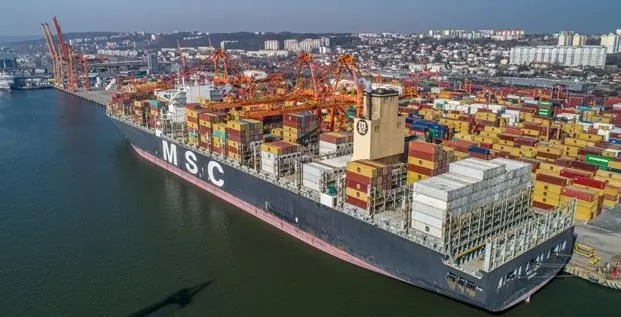
BCT is both a port for direct services and a feeder port moving cargo to/from the large West European hubs and as such it has felt no significant impact from the war in the Ukraine. Direct services include the recently added Scan Baltic – USA service which offers a 13-day connection to New York and other calls in Philadelphia and Norfolk. Additionally, MSC now offers the North West Continent to India-Pakistan service direct from Gdynia.
BCT’s versatility also adds to its strength with it regularly handling general and project cargo. The latter includes the specialised handling of military equipment for the US Army, stationed in Poland in conjunction with NATO’s enhanced forward presence, and the handling of inland wind farm components with BCT now recognised as the main hub for this activity.
For the smaller Baltic country ports, such as those in Lithuania, Latvia, Estonia, Finland etc., the big challenge is to replace lost Russian transit cargo. Local cargoes in these ports alone are insufficient to justify significant investment, unless there is an ability to diversify – as discussed in Russia triggers transition where opportunities in conjunction with offshore wind projects are considered.
Related Articles
 OPERATIONS
 OPERATIONS
 OPERATIONS