![PortStrategy[GreenPort]](https://www.portstrategy.com/wp-content/uploads/2026/09/PortStrategyGreenPort.svg)



The smaller picture
Iain and Dave MacIntyre explain why South Port underlines the relevance of the regions in New Zealand.
The relevance of regional gateways to the New Zealand freight market is being underlined by the success stories of several smaller ports.
Two ports, Timaru and New Plymouth, have seen their fortunes rebound from being in the doldrums a few years ago.
Back in 2009, both had been hit by the loss of dairy container cargoes. Prior to that, in the gloomy days of 2002-2003 when the Maui gas field reserves were downgraded and Maui was the only offshore field producing, the future of the oil sector looked grim and Port Taranaki’s fortunes were on the slide.
Yet the tide has turned. In the case of Timaru, the container investment/allegiance with Tauranga has been pivotal. Further north, Port Taranaki has turned in a record result with its bulk liquids trades, its oil and gas support activities and its log operations giving it a diversified and solid revenue stream.
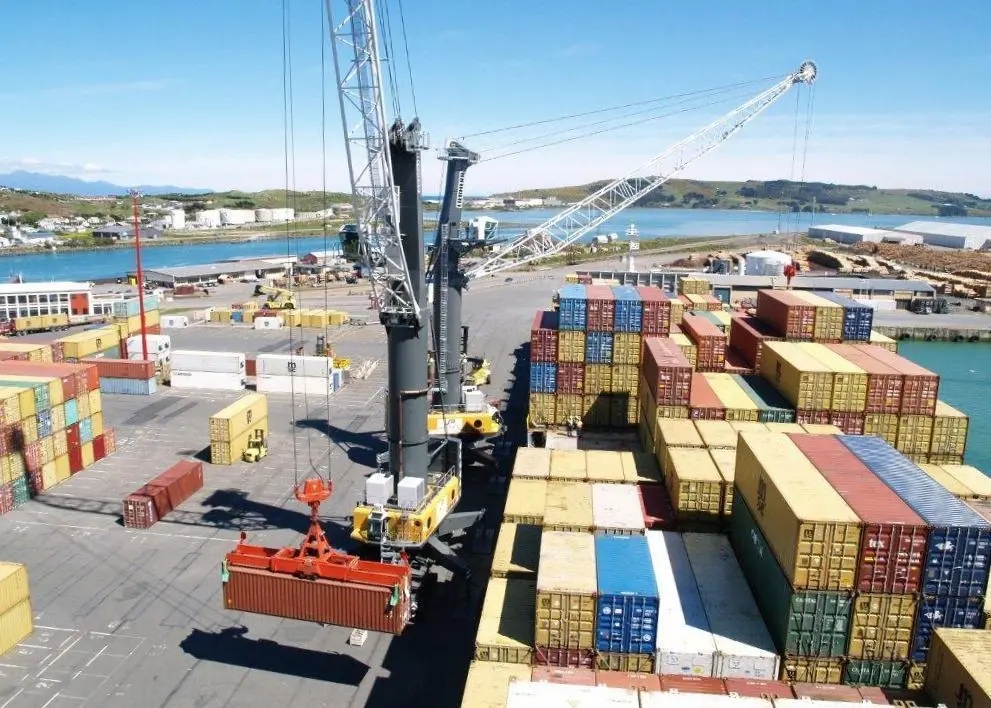
Now, South Port, located on the southern tip of the South Island, is adding to the story of “regional relevance” as it assembles a new Liebherr LHM 550 mobile container crane, moving to a two-crane infrastructure model to accommodate projected growth in regional containerised cargo over the next five years.
Additionally, South Port is taking delivery of a new heavy-lift container forklift, expanding its fleet to eight, and has increased its workforce.
The investment represents a major about-turn for the Bluff port over the last two decades.
In the 1990s the port had a container crane but as its box support dwindled, the crane was sold and essentially South Port lost its container focus. Later, the tide turned a little and a second-hand crane was bought.
That was eventually replaced and now comes the significant upgrade to a two-crane operation, which can be seen as having a dual purpose – protecting the container base it now has while providing the opportunity for future growth.
Reaching limits
The “defensive” play is essential because with a one-crane operation handling cargo exchanges on the MSC Capricorn service vessels in a 36-hour window, operational capacity is at or near its limit.
If MSC wants to continue to corner a growing Southland container market, the hardware has to be provided to move more boxes during the same or a reduced timeframe. The “offensive” play is that South Port is putting in the base for a 50,000-teu-per-year throughput, up from around the 32,000 teu-33,000 teu mark now.
There are three other “safeguard” elements that South Port can factor into its forward thinking.
One is that MSC has been the cornerstone of Southland box trade for six years and has an established customer support base that suggests it is committed to the region.
A second is that, even with the uncertainty that has gripped the market following the Kotahi-Tauranga-Maersk deal, throwing doubts over the future intentions of many carriers and services, Southland exporters and importers have reason to support MSC.
The loss of a direct call would very probably mean higher freight rates for them, due to inland or coastal feedering costs plus other carriers recognising a regional route is no longer an option.
The third safeguard element is that a mobile crane can, at the end of the day, be sold if the work is not there to justify it.
South Port is making its investment decision at a point of financial strength, having just posted a record net profit after tax of NZ$6.68m (US$4.98m).
That profit is underpinned, as with most regional ports, with a diversified cargo base –75% of its cargo volume is bulk.
In the background too looms the potential of oil and gas exploration activity in the Great South Basin. There is no guarantee that South Port would be chosen as the supply and operation base for these operations, but if a major gas find is located, one only has to look at the Taranaki case study to see what potential exists.
There are some challenges for South Port on the horizon. Logs have been buoyant but it is a cyclical market. The future operations at the NZ Aluminium Smelters plant at Tiwai Point remain clouded as the plant works through the implications of the revised power supply deal with Meridian Energy.
Taking into account all these factors, South Port is predicting a slightly lower level of profitability in the next financial year.
Overall, however, the picture is of another smaller port underlining the relevance of the regional port sector to the NZ freight market.
Related Articles
 BULK HANDLING
 CONTAINER & CARGO HANDLING
 CONTAINER & CARGO HANDLING