![PortStrategy[GreenPort]](https://www.portstrategy.com/wp-content/uploads/2026/09/PortStrategyGreenPort.svg)
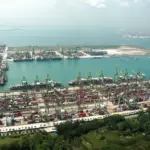





Ports, Ships and Fuels
Hallelujah, a Major Institution Shedding a Cold Bright Light onto Shipping’s Alternative Fuel Fantasy! One of the many interesting dimensions explored in the challenging new report, Ports, Ships and Fuels
The World Bank is not widely known for its helpful and practical contributions to the maritime sector. The undermining of LNG as a transition fuel being an act of self-harm to transition that should not be forgotten.
But it does appear to be trying to redeem itself in its latest venture into research and policy guidance in the maritime sector. The new Bank report, Ports, Ships and Fuels, is said to be a report focused on East Asia and the Pacific. It reads, however, more like a global statement on, “Maritime Efficiency, Safety, and Sustainability”, which appropriately happens to reflect half of its subtitle.
The report delivers 130 pages of big data driven analysis, problem identification and recommendations. Each of the three study areas, ports, ships and fuels, is addressed in the same depth and given equal billing.
The report has clearly been road tested with a broad spectrum of active industry decision makers. There appear to be few unrealistic assumptions and forecasts made within the document. This means it all sums to a groundbreaking but very relevant contribution to thought leadership in the sector. It is a must read for those committed to a “as fast as practical transition” in the maritime sector.
In praising the benefits and successes of the maritime sector the report provides some sunshine and joy into the sector’s difficult transition. Not for this report the savaging from NGOs obsessed with seeing evil in the sector.
So, congratulations to the report for mentioning that shipping is the world’s most fuel-efficient transport sector. Further, for understanding that port development and shipping have been the transformational service that has enable more poverty reduction and economic
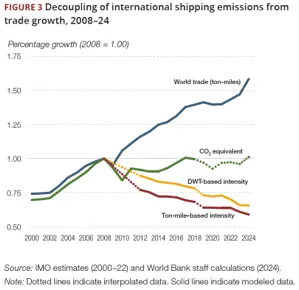
growth than ANYTHING else in history. Lastly, but certainly not least, for encouraging us all in the sector by delivering the analysis that shows the sector is the one, the only, economic sector to disconnect further sector activity growth from growth in emissions since the climate emergency was declared in 2008. Let us be clear, shipping emissions have flatlined without transformational changes in the fuel used.
Ships, big steps required
For ships, and despite the positive messages on progress, the report does re-emphasise that further progress towards zero emissions will require a transformational change in fuel. Forget conventional, eventually ships will all be alternatively fuelled. This is something the sector has studied, and worked very hard to avoid, given, as the report acknowledges there is no “ideal” technology choice.
The data that the team behind the report has acquired, analysed and presented suggests a sector working hard, performing well but still driving towards a cliff edge crisis. The fleet is ageing and every investment decision to stop this progress toward disaster has high technology and commercial risks. Though not stated clearly the implication of the report is that the aging fleet risks reversing the safety improvements achieved in some shipping sectors. Many politicians should perhaps also reflect, as they demand new clean ships, on years of failed industrial policy that mean the capacity to deliver the fleet renewal required is Chinese.
In the report the Authors’ have delivered to the sector a new model through which to see the development of the maritime sector. In this capacity it does seem to provide an engine through which to think through how effective regulatory, policy and technical options can be tested to identify those most likely to succeed.
“Efficiency, Safety and Sustainability,”
by interlinking these and analysing initiatives, policies, regulations, technology and investment it is possible to identify those options that will deliver change most effectively.
The example of the container as the transformational maritime technology that demonstrates the model’s effectiveness is perhaps an ambitious claim, and it was a little disappointing that the authors could not deliver a similar transformation idea or technology for today’s situation. But perhaps it provides the thought structure and data to help everyone else get to that critical idea!
In addressing Ports, Ships and Fuels, the chicken and egg situation of the sector in respect of the big transformation decisions is exposed by the report.
Ports: Making progress
Ports do seem to be the sub-sector most advanced through transition. The concentration of bunkering in Singapore and other large hubs clearly assists in providing key hubs for the delivery of alternative fuels to ships. Those hubs have the technical and financial capability to prepare. Indeed, these ports are preparing, for any and every choice the shipping sector considers.
The report doesn’t say it, but it does provide the evidence that suggests all talk of the opportunities for new bunker hubs and locations being created by alternative fuels are just that, talk! There may be some rebalancing between existing big bunker ports, but they will remain dominant the dominant fuel suppliers to ships for the foreseeable future. Two key reasons for this are identified:
- Data shows, first generation dual fuel ships have the same range as their competitor conventional fuelled ships, and
- It is much cheaper to move alternative fuels from where they are produced than to divert ships to where it is produced to collect bunkers.
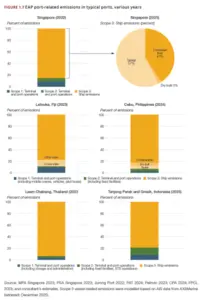
Concluding from data that port emissions are predominantly from sources other than port operations is helpful to port operators. The data driven demonstration that ships and hinterland transport dominate port emissions; making in some ports over 95% of emissions clearly highlights the difficult position of port operators. The port operators must encourage and assist their users to change; at the same time as attracting them to use their facilities by being competitive and helpful.
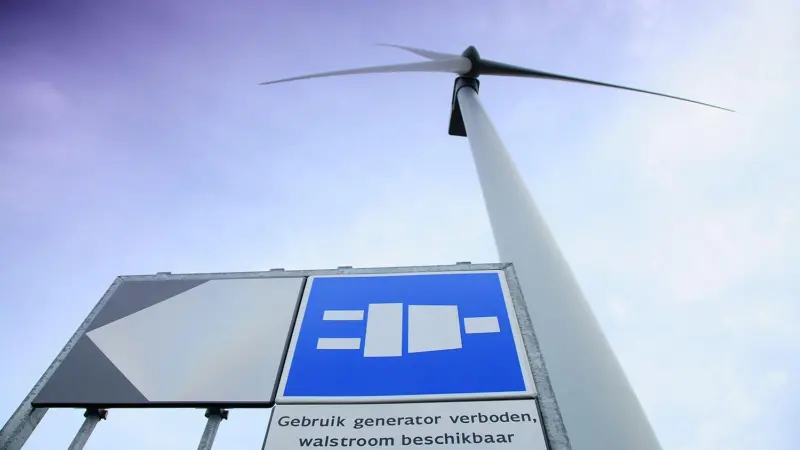
In the context of the above, the report is overly diplomatic about onshore power for ships, quote, “The commercial case for onshore power is perhaps unclear”. A less diplomatic organisation than the World Bank may have written, “if you don’t regulate for onshore power, it is not going to happen.” It is even more interesting to note that the Authors’ do mention that onshore power may not be the silver bullet for ship emissions in ports that many suggest it to be. In most ports, the evidence presented shows that the emissions made as ships move within port limits and at anchor can still represent over 50% of all port emissions; these emissions are not addressed by onshore power.
The report’s identification of the ability of ports and short sea shipping, especially ferries, to commit to electrification as a solution is a bold statement from the World Bank. The technical progress has indeed been considerable. The World Bank is clearly excited about being able to benefit from a clean maritime technology with low risk that really can deliver clean equipment within ports and ships for short sea shipping especially ferries and harbour craft. In doing so it will be at the forefront of a movement that will be transformational.
It is probably good that the Bank had something positive to say about electrification. The evidence presented in the report questions almost everything else on fuel pathways promoted strongly by NGOs, technology companies and sometimes countries. Methanol and Ammonia will be, based on the data presented, struggling for decades and not deliver a competitive solution for this generation of ships (and maybe not the next). Biodesel is covered in the report with production volumes and actual benefits questioned.
Be practical, keep working
So, reading between the lines, the World Bank doesn’t really see a solution to the maritime sectors chicken and egg problem. Being pragmatic it suggests, therefore, picking off the things that can be done and underlines that we should keep working to find the right answer. It is hard to argue with such pragmatism. We understand that further reports that focus on Ports, Ships and Fuel in ASEAN and finally in the Pacific are in the works. It is presumed that the situation of biofuels will be explored in rather more depth in the ASEAN report, Indonesia and Malaysia are the obvious major producers of these fuels. It will be interesting to see what the World Bank concludes.
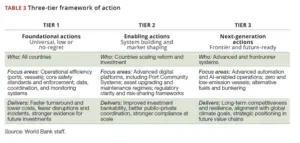
From attending the launch event online, it was encouraging to learn that the World Bank is intent on committing funds to address domestic fleet renewal in client nations. Further, it seems it has the appetite to address the efficiency, safety and sustainability issues of the worst domestic maritime sectors. There are good reasons why these areas have been challenging for decades so best of luck to the bank as it endeavours to move forward!”
The report, “Ports, Ships and Fuels” can be downloaded from the World Bank’s web site by following this link: Ports, Ships, and Fuels: Maritime Efficiency, Safety, and Sustainability in East Asia and Pacific
Related Articles
 GREENPORT CONGRESS
 PRODUCTS & SERVICES
 OPERATIONS