![PortStrategy[GreenPort]](https://www.portstrategy.com/wp-content/uploads/2026/09/PortStrategyGreenPort.svg)

Compete & collaborate
Rotterdam and Antwerp-Bruges are north Continent port powerhouses, AJ Keyes looks at how these two facilities are keeping pace with container demand and discusses where and why they are also working on a collaborative basis
Rotterdam and Antwerp-Bruges are behemoths of the north European container port market. Yet in addition to their own continuing (solo) efforts to maximise cargo throughput, these two ports are also now entertaining strategies in which collaboration can be a complementary approach that delivers future success.
So, what examples of collaborative strategies are in play? Well, first it is important to get a better context of these two container ports, their competitive positioning and individual investment plans.
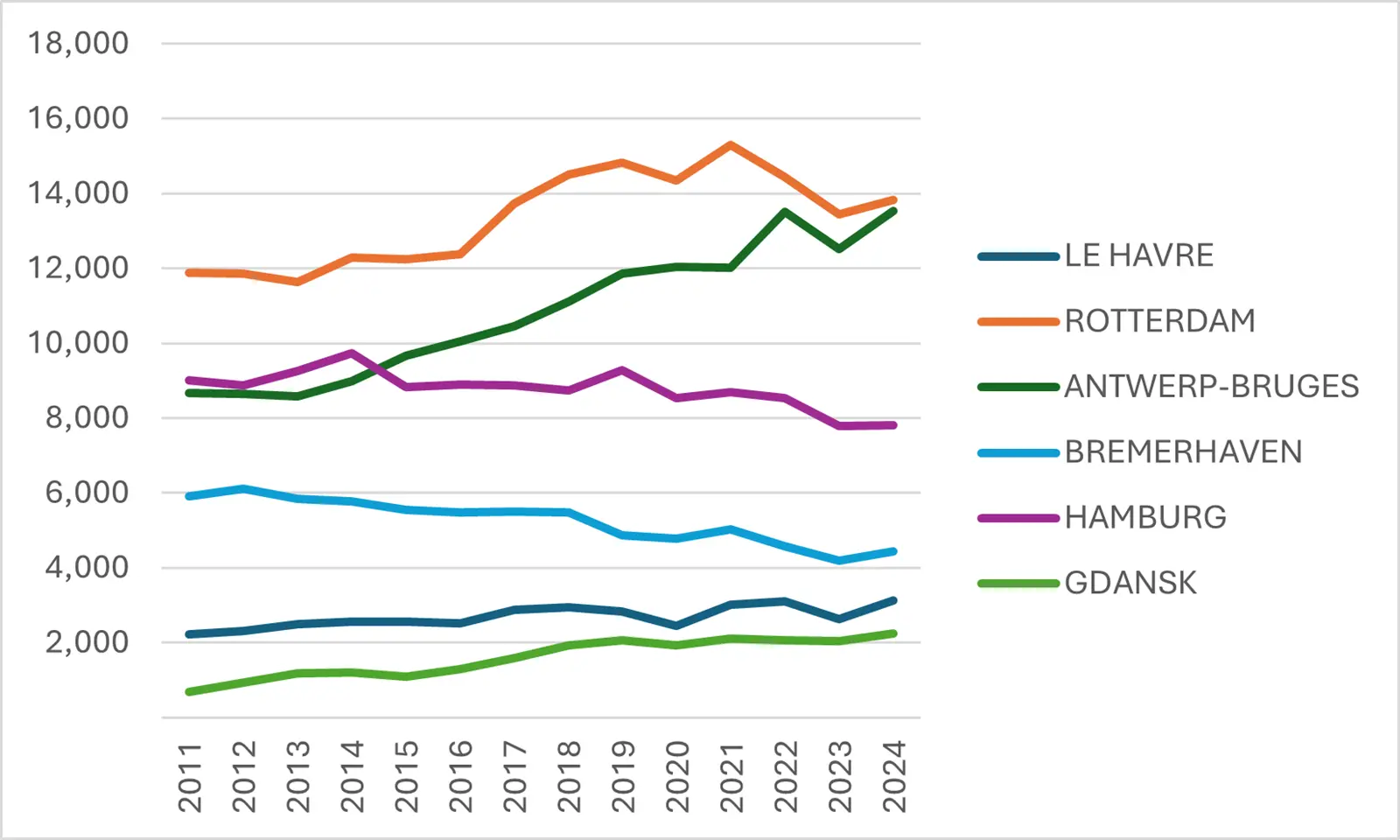
Figure 1 provides a summary of total container volumes of the major ports in the North Europe “Hamburg-Le Have region” region (with Gdansk included).
The leading volume positions of Rotterdam and Antwerp-Bruges stands out, with the two ports handling 13.8 million TEU and 13.5 million TEU, respectively, in 2024. The next highest placed port in terms of total throughput is Hamburg, at 7.8 million TEU, so some distance behind.
To put the position into further context, in 2024 Rotterdam had a share of the region of 30.7%, with Antwerp-Bruges achieving a share of 30.1%. Notably, Antwerp-Bruges has been particularly successful since 2011, increasing its share of this market from 22.6%, while Rotterdam has maintained a figure in the 30%-33% range. The closing of the gap between these two ports can be seen in Figure 1.
By comparison, both German ports of Hamburg and Bremerhaven have seen volumes and share of the market decrease over this assessment period. Hamburg’s total container traffic in 2024 of 7.8 million TEU reflected a share of 18.3%, down on the 2011 position of 9.0 million TEU and 23.5%. For Bremerhaven, the 2011 figure of 5.9 million TEU ( a share of 15.4%) had dropped to 4.2 million TEU (and 9.8%) by 2024.
Elsewhere, Le Havre has grown its volumes from 2.2 million TEU in 2011 to 3.1 million TEU by 2024, giving the port a growing share of 5.8% to 6.9% of the region, while the emergence of Gdansk through the Baltic Hub facility has resulted in total volumes of 0.7 million TEU reaching 5.0% over the assessment period. So, there has been growth outside of Rotterdam and Antwerp, with a range of ports gaining share of the market at the expense of German facilities.
Clearly, the status quo in the north Continent port range remains. Rotterdam and Antwerp-Bruges continue to dominate the region in terms of total container activity, with additional trends seeing Le Havre benefitting from limited competition for French hinterlands and Gdansk chipping away at Hamburg’s markets.
BIGGER AND GREEN IN ROTTERDAM
Continued growth for Rotterdam and Antwerp-Bruges brings pressure to ensure that sufficient space is generated. Investment is continuing for additional capacity, but also, importantly, environmentally friendly facilities.
In Rotterdam, expansion of the Maasvlakte II container terminal will increase capacity of the APM Terminals-operated facility by two million TEU as part of an investment of €1bn ($1.08bn). This project includes the construction of 51ha of container terminal land, with 1,000m of deep-sea quay, truck and rail transfer zones and the latest generation of Automatic Terminal Trucks.
With the use of emission-free Automated Guided Vehicles and fully electrified sustainable infrastructure, the terminal is ready for the future. It is expected to be completed in 2026. Connecting the vessels to the power grid at APMT MVII, will reduce CO2 emissions by almost 7,000 tonnes each year. It will also reduce nitrogen and particulate emissions. Vessels will use a total of about 13,000 MWh at the terminal annually.
At the same time, Rotterdam World Gateway (RWG) is increasing capacity by 1.8 million TEU, with the initial phase of the project operational by the end of 2025. The first berths are expected to be equipped with shore-based power from 2026 onwards, which puts RWG ahead of the new European regulations, which stipulate that all container, passenger and cruise ships larger than 5,000 gross tonnes in European ports must use shore-based power by 2030. RWG is opting to design, finance and build the shore-based power systems itself, reflecting fulfilment of the terminal’s ambition to operate fully CO2 neutral.
Another project coming to fruition, by a consortium of Hakkers, Van Oord and De Klerk, is construction of a tugboat quay in the Yangtzekanaal. It is part of the ‘Widening Yangtzekanaal’ programme. This covers 1400m of the Yangtzekanaal to the west of the existing Antarctica quay and will be implemented before 2030, and involves constructing a quay wall with ‘waiting’ berths for shipping vessels.
After dredging work to increase the depth, the extra space created will allow the Yangtzekanaal to serve increasing numbers of container ships that sail to and from the APMT 2 and RWG terminals in the Prinses Amaliahaven. It also means the access route is ready for the yet-to-be-developed latest generation of container ships measuring 430m x 66.5m
IMPORTANT STEPS IN ANTWERP-BRUGES…
…BUT CONCERNS EXIST
The Port of Antwerp-Bruges confirms that it “took important steps” in 2024 towards achieving its ambition of becoming a climate-neutral port by 2050, a priority that remains “central” in 2025.
In the maritime sector, the first methanol bunkering of a deep-sea vessel marked an important milestone in the development of Port of Antwerp-Bruges as a multifuel port.
Shore power projects in both Antwerp and Zeebrugge are reducing emissions and noise pollution, helped by installation of one of Europe’s largest public charging stations for electric trucks.
Spiralling costs for the port are, however, an issue. The anticipated cost for extending the port of Antwerp has reportedly increased to around €5 billion – significantly more than initial estimates of €3.1 billion.
Previous projections were as low as €1.8 billion, meaning the Inspectorate of Finance is questioning current estimates, indicating inadequacies to cover factors such as cost inflation and potential delays caused by environmental challenges. The expansion, known as the Extra Container Capacity Antwerp (ECCA) project, aims to boost the port’s capacity from 15 to 22 million containers each year, with plans set to commence in 2029. Central to the project is the construction of the Saeftinghe dock, a state-of-the-art tidal dock situated alongside the existing Deurganck dock on the left bank of the Scheldt.
However, the project is being marred by the need for new access roads to accommodate increased traffic flow, thereby increasing the project duration by several years.
Originally, the government planned to contribute €1.9 billion of the €3.1 billion budget but the Inspectorate insists that the port must now bear a larger portion of the burden.
COLLABORATION – A FOUNDATION FOR SUCCESS
Both Rotterdam and Antwerp-Bruges accept that they each have a key individual role to play in energy transition and international trade, acting as catalysts for strategic investment.
Yet cooperation is also proving to be an indispensable requirement too, and partnering with stakeholders to connect economic growth, innovation and sustainability is an essential link in the international logistics chain. Here, these two ports are actively collaborating and working together in calling on the European Commission to make large-scale investments in the competitiveness of industry in Europe. This comes ahead of the publication of the Competitiveness Compass and the Clean Industrial Deal, stating that ‘Europe’s strategic autonomy, energy transition and prosperity is at stake’.
The two ports further state that as they are both clusters of energy, logistics and industrial activity, they can play “an important role” in the implementation of the EU’s Clean Industrial Deal, which is targeting strengthening of the investment climate in Europe.
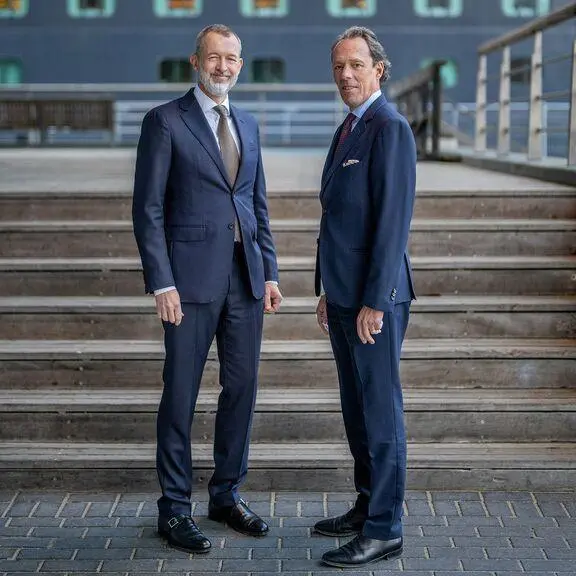
Jacques Vandermeiren, CEO, Port of Antwerp-Bruges, explains: “A systemic port cluster approach contributes to achieving Europe’s goals. The ports of Antwerp-Bruges and Rotterdam are unique sites where multimodal logistics, energy and industry come together. The transition to a sustainable economy demands cross-border cooperation and a sense of realism. As ports, we want to jointly contribute to anchoring European industry for the future.”
The Clean Industrial Deal is a big deal for North European ports because it represents a large and challenging area of diversification for ports such as Rotterdam and Antwerp-Bruges, although both ports are intent on tackling it collaboratively.
Related Articles
 EXPANSION & DEVELOPMENT
 EXPANSION & DEVELOPMENT
 EXPANSION & DEVELOPMENT