![PortStrategy[GreenPort]](https://www.portstrategy.com/wp-content/uploads/2026/09/PortStrategyGreenPort.svg)




Game changer
The densely populated US North Atlantic port region handles 20% of total North American box traffic. AJ Keyes investigates game-changing developments in this key gateway port region which is home to the major Ports of New York/New Jersey (NY/NJ), Baltimore and Virginia.
The North Atlantic port region is highly-populated and is the traditional location for serving US heavy industry (i.e. the “Rust Belt”) and key US Midwest markets. NY/NJ is the dominant volume port, and will remain so, but less than 200 miles further down the coast at Baltimore game changing developments are in play that will impact the North Atlantic port market.
There are a mix of different container ports in the North Atlantic region, but the largest (and primary) facilities based on volumes are Baltimore, NY/NJ and Virginia, with terminals at each port offering largescale infrastructure of long quays, deep water and a high number of larger cranes.
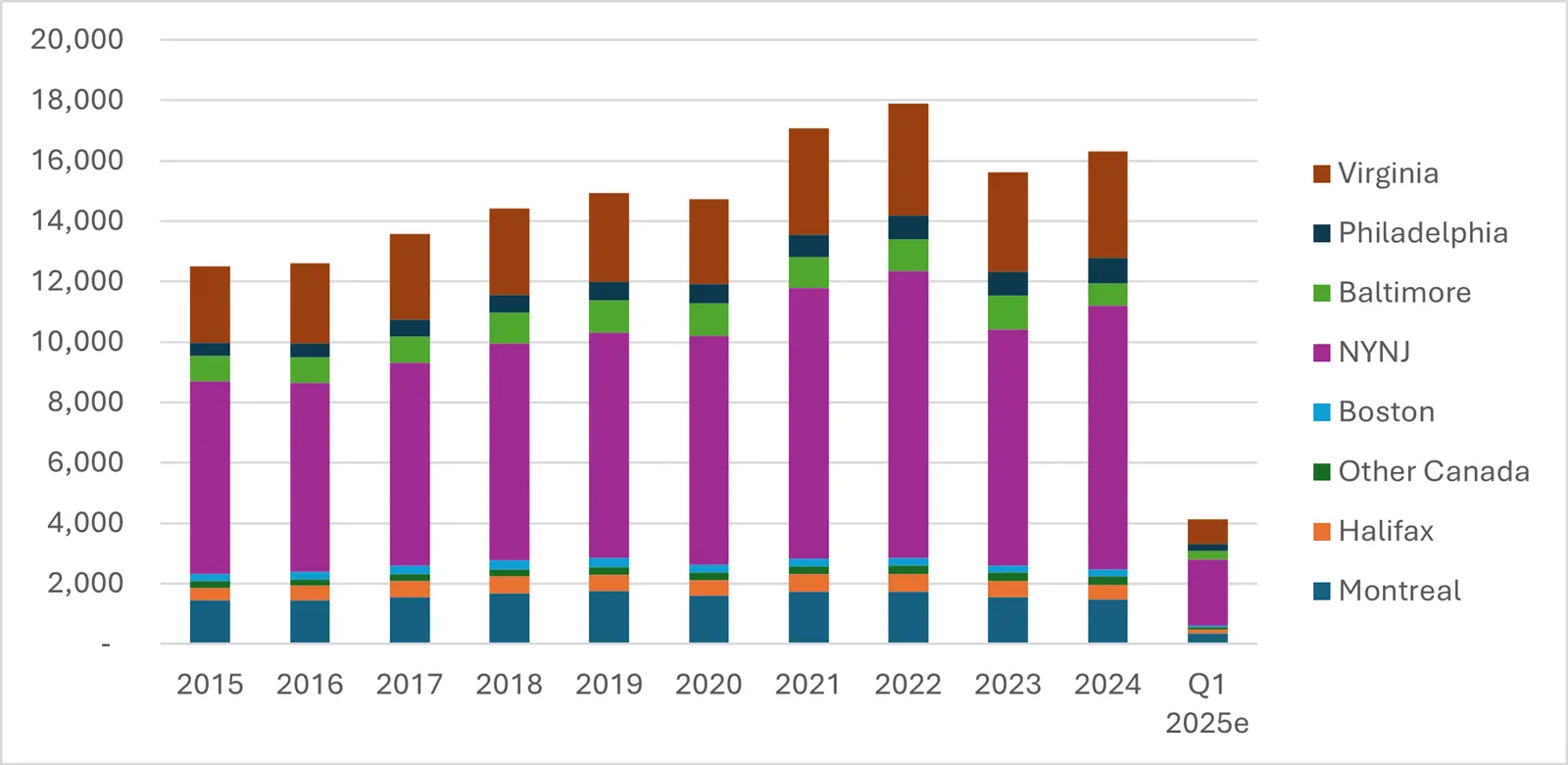
Figure 1 provides a summary of the development of total container volumes at ports in the North Atlantic region since 2015, with the 12.5 million TEU in 2015 rising to 16.3 million TEU by the end of 2024, reflecting growth of 3.0% per annum.
NY/NJ is the largest port by some considerable margin, handling 8.7 million TEU in 2024, followed by Virginia seeing 3.5 million TEU and Montreal with almost 1.5 million TEU. Philadelphia has seen the highest yearly growth since 2015, recording 7.8%, albeit from a relatively low starting total of 428,000 TEU. The next highest growth would have been Baltimore, bar the container ship, Dali, hitting the Francis Scott Key bridge in March 2024. The 2023 port total of 1.14 million TEU reflected annual growth of 3.9% per annum since 2015.
In terms of confirmed port expansion, there are a number of potential projects in the region, but few can be classified as tangible. Leaving aside the possible developments of Contrecoeur (Montreal), and Virginia’s long-term Craney Island plans, plus the myriad of North Atlantic projects off the coast of Canada, such as Novaporte (Sydney, NS), the main focus is really to be found at NY/NJ and Baltimore.
The current PANYNJ 2050 Master Plan assesses total container capacity across the six terminals (Maher, APMT, PNCT, NYCT, Bayonne & Red Hook) as nine million TEU. There has been investment since 2020, in which PNCT, Maher Terminals and APMT have all purchased new cranes with greater lift heights and outreach, enabling an increase in berth productivity and therefore berth capacity. In addition, since its purchase of the two GCT assets, CMA CGM has raised the cranes at Howland Hook/NYCT as well as continued with the Berth 3 project at Bayonne, which is operational in H2 2025.
These ongoing plans will see the current estimated annual capacity at NY/NJ of around 10.6 million TEU rising to approximately 12 million TEU by 2030. Dean Davison, Technical Director at Infrata, a DSS+ company, comments on the position: “In 2021 the port handled 9 million TEU and was severely congested. In 2022, this throughput rose to almost 9.5 million TEU, but as quick as the terminals are at adding more space it gets filled, endorsing the continued strength of the port’s “must-call” status. Yet while the existing master plan is targeting the best balance of the supply-demand position, it is clear more space is going to be needed in the near future.”
The drop in total throughput in 2023 (to around 7.8 million TEU) enabled some respite, but with 8.7 million TEU handled in 2024 the need to ensure that the anticipated 12 million TEU capacity is developed is a necessity, not an option.
BALTIMORE: GAME CHANGER
However, there is a “game changer” in the North Atlantic region on the horizon, according to Davison: “Baltimore is already an established gateway, but it will soon have doublestack rail access to the US Midwest, the existing Seagirt terminal is undergoing planned investment to maximise capacity and the new Sparrows Point Container Terminal project is underway. This will greatly enhance the port’s future competitiveness and will see container throughput, and its share of the North Atlantic port market, increase.”
Looking at the position in more detail, Baltimore already ticks many of the necessary boxes for competitive container terminals in the North Atlantic region – deep water, modern equipment and access to largescale consumption and industrial markets as the closest Atlantic port to major midwestern manufacturing centres, plus an overnight drive to 30% of all US households.
The addition of doublestack rail is crucial for inland access, but the development of the new SPCT facility and further investment in the existing Seagirt terminal, are major factors promoting Baltimore’s future container success.
The Maryland Port Administration and Ports America Chesapeake, the Seagirt Terminal operator, recently invested more than US$160 million in terminal upgrades, including the installation of additional cranes to handle larger ships. It is reasonable to assume further expansion will occur during the current decade as the operator maximises its existing facilities.
SPCT – MAJOR NEW MSC GATEWAY UNDERWAY
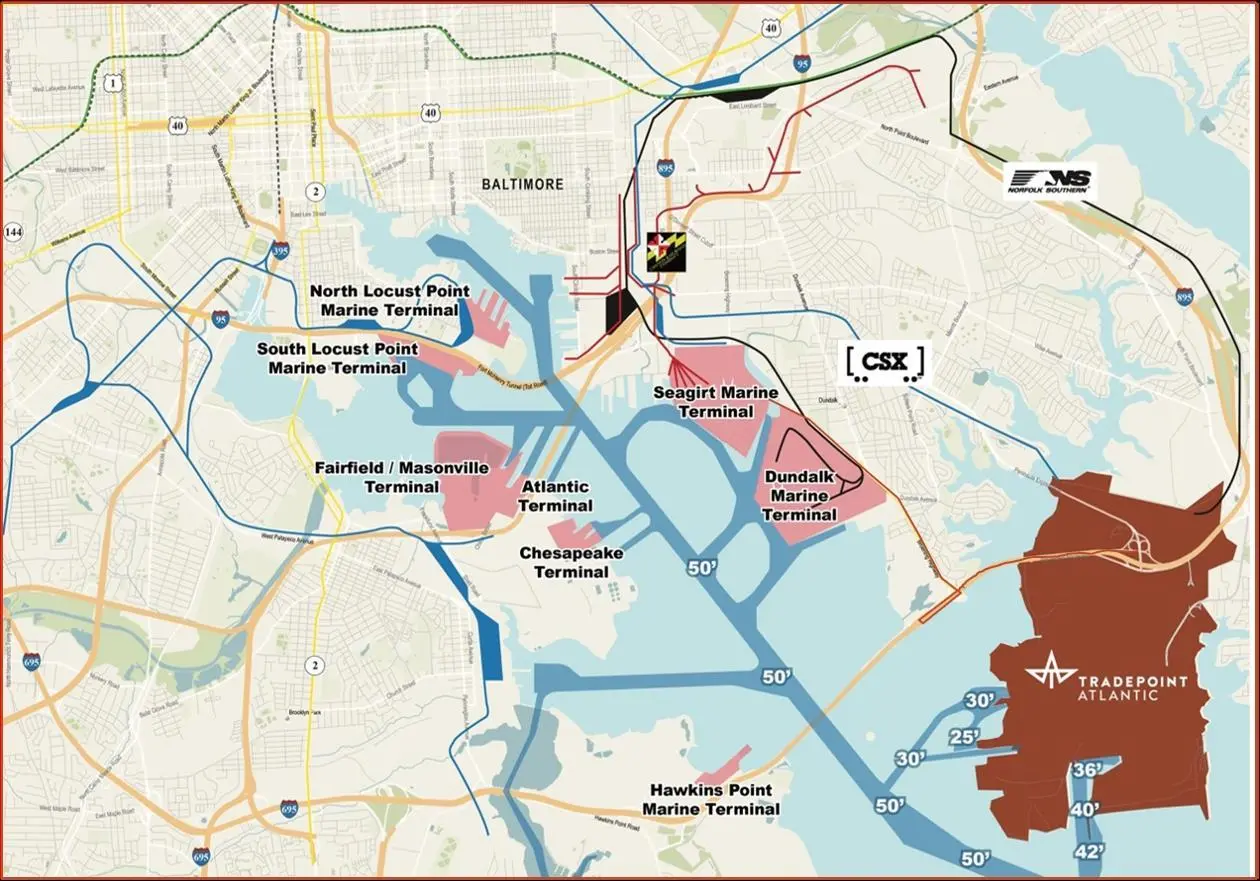
SPCT is being developed as a joint venture between Tradepoint Atlantic, developer of the 3,300-acre intermodal logistics development in Sparrows Point, and MSC’s terminal investment arm, TiL.
It will have 915m of berthing quay, 168 acres of container/rail yard, over 120 acres of container storage and 885m of rail loading space, collectively supporting the proposed capacity of two million TEU being developed in two phases. Current estimates foresee an initial opening in 2028 and the second phase in 2034, although these dates are subject to change depending on the speed of development.
This major new container terminal in Baltimore will certainly enhance the competitiveness of the port and, as a result, it is reasonable to assume that there will be a notable improvement in container traffic passing through this key North Atlantic port, as confirmed by the developers, TradePoint Atlantic and TiL: “The SPCT facilities would enable additional weekly vessel services to call the Port of Baltimore, services which currently call other East Coast ports due to lack of available berthing windows in the Port today, as well as due to the physical limitations of existing facilities.”
So, what is the likely strategy by MSC for the region? On this basis, it is clear that MSC is going to amend its North Atlantic port coverage. With the company retaining a share in the PNCT operation in NY/NJ, and a continued need to serve this port’s truck markets, then it can be assumed that NY/NJ will be unaffected. Likewise, the use of Boston port for serving the New England market will also not be impacted.
This leaves Philadelphia and Virginia as ports that could be the losers. Davison elaborates: “As an example, the EMUSA service offers over 5,500 TEU a week vessel capacity and currently calls to NY/NJ, Boston, Philadelphia and Norfolk, but switching to SPCT could replace both the Philadelphia and Norfolk calls. It is important to note that MSC is an existing Baltimore customer using Seagirt, so the shipping line is already using this port’s ecosystem.”

WHY IS THE HOWARD ST TUNNEL PROJECT JUST SO IMPORTANT?
The existing major rail facility for handling containers at the Port of Baltimore is the Intermodal Container Transfer Facility (ICTF), located adjacent to the Seagirt Marine Terminal. It handles a combination of both international and domestic containers across its four loading tracks, four storage tracks and a run-around (loop) track, with six trains leaving daily from CSX Transport.
Yet the challenge for the port has always been the lack of doublestack access to/from Baltimore – but this is now changing. The Howard St. Tunnel project consists of vertical clearance improvements along CSX’s I-95 Rail Corridor. These improvements ensure doublestack trains can move between Baltimore City (MD) and Philadelphia (PA) through the 1.7 mile-long railroad passage under the City of Baltimore and the 21 other clearance obstructions that currently restrict the ability to move double-stack trains along this section of CSX’s network.
The initiative improves the current vertical clearances that are presently up to 18 inches less than the 21ft necessary for doublestack. Importantly, it means that the entire CSX network is doublestack compatible out of Baltimore, which includes direct access from the port to US Midwest.
The project is scheduled for completion in mid-2026 and once operational, CSX out of Baltimore (Seagirt) to Chicago will offer the shortest and the quickest journey time of out of the port and railroad options for doublestack rail available at US North Atlantic gateways.
The 790-mile routing to Chicago is less than other options including NY/NJ’s 915 miles on the Norfolk Southern network, the 1043 miles from Virginia via CSX and over 1600 miles on the Canadian National system from Halifax. Based on confirmed train operating velocities, these distances equate to time, and therefore cost, savings using Baltimore.
Related Articles
 EXPANSION & DEVELOPMENT
 EXPANSION & DEVELOPMENT
 EXPANSION & DEVELOPMENT