![PortStrategy[GreenPort]](https://www.portstrategy.com/wp-content/uploads/2026/09/PortStrategyGreenPort.svg)




Let’s talk sense
One of the most startling aspects of worsening relations between the US and China (for the port sector) has been moves by the Biden Administration to ‘ban’ Chinese container cranes from US ports.
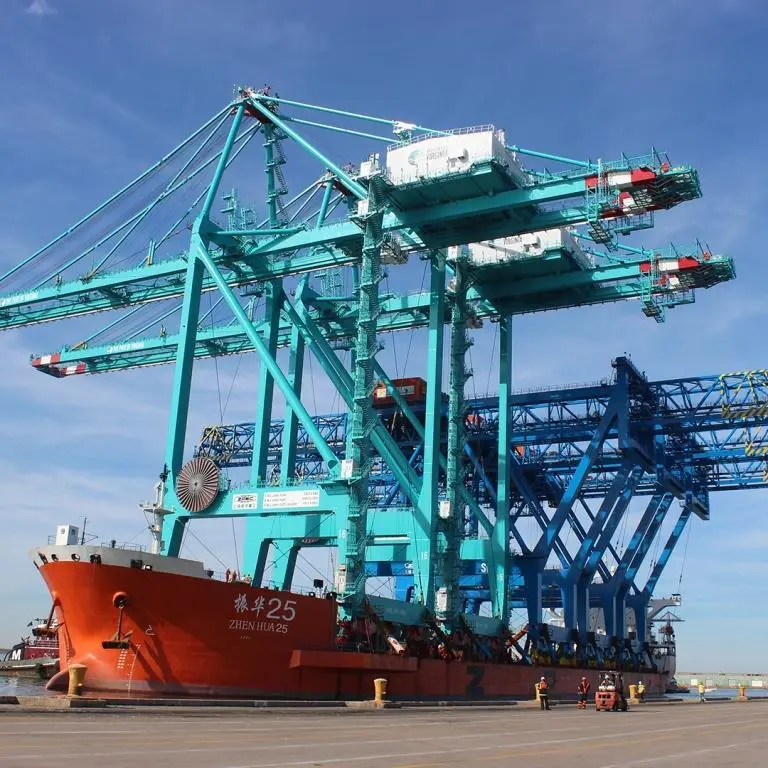
What has happened and what does this really mean? Biden signed an executive order on 21 February with the aim of radically transforming cyber security at US ports. The centre of concern has been container cranes manufactured by state-owned Shanghai Zhenhua Heavy Industries (more often known as ZPMC). The highly automated cranes have been found to have systems that can spy on trade flows and even – potentially – could disrupt or stall crane operations. Of course, ZPMC denies these accusations.
Despite these strong denials, US congressional committees continue to question the Chinese state-owned company’s work on cranes installed and bound for the United States. The controversy has deepened with the committees also scrutinising ZPMC’s installation of Swiss engineering group ABB’s equipment onto US destined ship-to-shore cranes. In January congress asked ABB executives to attend public hearings to clarify its relationship with ZPMC, which they said had raised “significant concerns”.
WHAT NEXT?
How this will play out remains unclear, but the expansion of the enquiry to include ZPMC’s suppliers is significantly complicating the situation.
All this is not simply election year hype from Biden as a special budget of US20 billion has been allocated to ‘replace’ Chinese-built port equipment with cranes manufactured in America, Japan, or the United States itself. On the surface at least, this has the potential to massively disrupt container trade not just between China and the US but could also disrupt capacity calculations at US container ports in general.
So, what does this all mean in reality? How many cranes are involved? How realistic is it to replace them with alternative suppliers and how quickly could this be done?
It is estimated that ZPMC accounts for over 70 per cent of the global market in container gantry cranes. The US Coast Guard estimates that there are over 200 Chinese-made cranes at US ports, or ‘nearly 80 per cent’ of the total. The driving force for this has been the low cost of production at the massive factory located on Changxing Island in the Yangtze River estuary. Estimates on costs vary but this has been a clear example of subsidies from the Chinese government. The strategic potential cannot be overstated.
If followed though as currently described the scope for disruption is enormous. The American Association of Port Authorities (AAPA) have played down the implied risks and state that no known security breaches have been identified to date but that moves to encourage production in the US are to be welcomed.
So where would the cranes be produced? The main beneficiary would be the PACECO Corporation, a US-based subsidiary of Japan’s Mitsui E&S (and a pioneer of container crane development), and the US Government has signed up an agreement with the company to build up manufacturing capacity for such equipment. It is clear that replacement of these cranes (and allowing for new capacity as the market expands) would be a herculean task for even the most integrated company. In fact, it’s simply not realistic – assuming a highly optimistic production run of ten cranes per month this looks like a three-to-five-year programme just to replace existing capacity.
No one can deny that tensions between the US and China are worsening dramatically and that there are many key points where Chinese influence has the potential to cause major disruption to the US – and global – economy. However, its very important that headlines are distinguished from reality and realistic proposals are defined based on real deliverability.
In this instance, it’s unclear just what the threat is and this needs to be defined. Also, the ability to deliver on the proposed approach is highly uncertain. We can expect much more of this in the next six months, and in the longer run there will be some major global readjustments, but in the meantime lets have some sensible proposals, please.
Related Articles
 TERMINAL OPERATIONS
 DIGITAL
 DIGITAL