![PortStrategy[GreenPort]](https://www.portstrategy.com/wp-content/uploads/2026/09/PortStrategyGreenPort.svg)



TOO MUCH OF A GOOD THING
Mae West once said: ” Too much of a good thing can be wonderful.” But as the North American West Coast ports are finding out, too much of a good thing can also mean big trouble. Michael Rosenfeld reports on what may come to be seen as lessons in both easing supply chain congestion and tackling port-related environmental issues.
The good thing in this case is cargo. Last year the major West Coast ports – Long Beach, Los Angeles, Oakland, Tacoma, Seattle and Vancouver – handled nearly 20mTEUs, an increase of more than 10% over 2003. Nearly all these containers came in filled with consumer goods including TVs, computers, shoes, toys, apparel and all kinds of other gadgets manufactured in Asia. While most of the containers that were shipped back to Asia were empties, some did contain contents such as paper and cardboard to be recycled, as well as agricultural products from California, Oregon and Washington. But that’s another story.
As US trade with China continues to grow unabated, West Coast container imports are expected to increase at least 12% over last year’s figures according to predictions from shipping company sources.
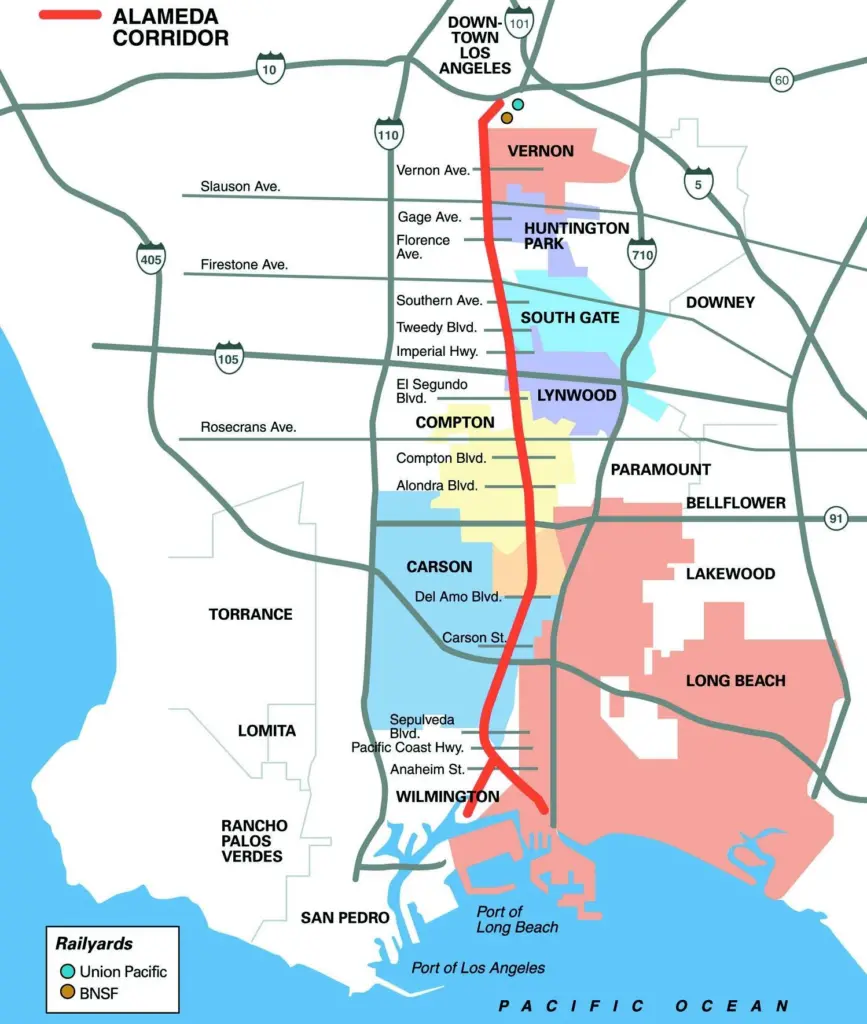
In terms of actual container volumes, Southern California’s combined Los Angeles and Long Beach port complex lead the major West Coast ports, followed by the ports of Oakland, Tacoma, Seattle and Vancouver.
But the percentage increases tell a slightly different story with Seattle, Oakland and Tacoma showing the greatest gains. The explanation:
carriers are redeploying some of their services to the northern West Coast ports to avoid the congestion in Southern California.
In spite of this, trouble continued to dog all the West Coast ports – terminal congestion, rail delays, environmental concerns and community protests over growth and expansion.
The peak traffic season for US retailers began earlier than usual last year – in fact, some say that volumes never let up after 2003’s pre-holiday rush. Busier than expected traffic reportedly caught the two big railroads serving the West Coast off guard, and the container stacks were consequently extra-high at the ports of Los Angeles/Long Beach.
Both railroads – Union Pacific and Burlington Northern Santa Fe – have been beefing up their crews and adding rolling equipment to catch up with the service demands, starting last year and anticipating a continuation of volume growth in 2005.
Longshore gangs have increased as well. In late July last year, groups representing the marine terminal operators and longshore labour reached an agreement to add 3,000 dockworkers in Los Angeles/Long Beach, which are the nation’s busiest container ports and that together handle about a third of U.S. international and container traffic.
STRATEGIC CHALLENGE The episode brings into focus the strategic challenge of developing ports and the overland transportation systems to accommodate a projected double- or triple-digit rise in cargo volume during the next 20 years. The challenge is nationwide, because importers of Asian goods are routing increasing percentages of their East Coast-bound shipments via the Panama Canal.
“June last year was busier than (the previous) June. It seems to have leveled off in July, ” says Bob Glover, vice president for imports at Coppersmith Inc. , a logistics and freight intermediary firm in Redondo Beach, California.
In terms of receiving shipments: “We haven’t seen any tremendous delay, except getting containers worked at the ports because of the (longshore) gang shortages, ” he says. “Ships are getting worked better now.”
With major shipping lines having implemented a general rate increase last May and a peak-season surcharge that took effect in July, many importers brought in as much merchandise as they could between the two dates, Glover explains.
“Our cargo volume has been strong throughout the year, ” says Hubert Wiesenmaier, executive director of the American Import Shippers Association, whose members import clothing, footwear and fashion accessories. “Trans-Pacific carriers eliminated some vessel space in 2004, vessels continued to run full and rates are “the same or a little higher” this than last year, ” he asserts.
“The peak definitely started early, ” according to James Galligan, North American vice president of pricing and security officer for MOL.
The traffic flow the first quarter of this year has been especially strong, and “volumes are expected to just grow and grow” between April and June, ” he believes.
Of course traffic out of China particularly has been increasing rapidly, and “there are things going on with China at the WTO that might impact the volume later this year, so I think there’s some rush to get (merchandise) out right now, ” he stresses.
Railroad congestion, stack-ups of container at West Coast ports, and railroad and dock labour shortages are also prompting retailers to bring their goods in earlier than usual, Galligan says.
The all-water, trans-Panama Canal service in which MOL, APL and HMM co-operate “is oversubscribed. There’s no space available, ” he insists. The carriers are tightly managing their equipment flows, concentrating on matching eastbound volumes with westbound loads and empties, and have not had much of a problem in that area, says Galligan.
Omaha-based Union Pacific (UP) was overwhelmed by an unexpected surge in volume in 2003, but “I think we’re holding our own, ” company spokesman John Bromley said last year. Volume was surprisingly flat during the final quarters of 2001 and 2004, “so our volume projection was conservative into 2003, and that led to a manpower shortage, ” he said. “Our system has been unquestionably strained the past year or so.”
Related Articles
 EXPANSION & DEVELOPMENT
 PORT & TERMINAL NEWS
 PORT & TERMINAL NEWS