![PortStrategy[GreenPort]](https://www.portstrategy.com/wp-content/uploads/2026/09/PortStrategyGreenPort.svg)




Riding the dry bulk wave
Australian ports are steaming ahead with expansion plans as cargo throughput surges.
Australia’s ports are riding the dry bulk wave and have committed to development to further enhance their standing. But congestion continues to dog some ports as volumes swell.
Coal has been the favourite driver, with record amounts passing through Queensland and Newcastle last year.
Queensland exported a record 144m tonnes of coal in the calendar year 2005, a 3.5% increase over 2004, while in Newcastle total coal throughput in the 2005/06 financial year amounted to 80.3m tonnes, an increase of 2.6m tonnes and the first time the 80m tonnes mark has been exceeded.
Demand for Queensland coal, currently worth A$8bn a year in exports, is expected to grow by between 5% and 13% per annum through to 2009/10, driven by demand from China, India, Japan and Brazil. As a result, the Queensland Government is pouring A$825m into port and rail infrastructure for the coal trade, positioning it to handle up to 210m tonnes of coal each year by 2010.
Among the major recipients are Gladstone’s RG Tanna Coal Terminal which will receive funding for a third ship loader, extra stockpiles and the third rail loop; a third rail loop at Dalrymple Bay Coal Terminal and expansion at Abbot Point coal terminal. Queensland Rail will be given A$274m for 35 new coal locomotives and 1,150 coal wagons, as well as upgrading 84 locomotives.
Preliminary engineering works have begun for the proposed new coal terminal at Wiggins Island in the Port of Gladstone. Should the project prove feasible and contract commitments from coal exporters 21be forthcoming, stage one of the new terminal could be completed by 2010.
Meanwhile at Hay Point, dredging work will be completed with A$32m to be spent over the next 12 months. The Hay Point project will mean about nine million cubic metres of material being removed to allow larger ships to be loaded to maximum capacity Hay Point is the largest coal export port in the world having exported 85.5m tonnes in 2004/05, surpassing its traditional rivals – Newcastle, New South Wales and Richards Bay in South Africa.
In Newcastle, on the east coast, the record highs are somewhat tainted by ship congestion, with the waiting time for coal ships to load rising to 8.94 days in mid-July, more than five days longer than they were a month before, according to Newcastle Port Corporation data.
Seeing over 20 vessels waiting offshore is not uncommon at Newcastle, where loading can be affected by diverse factors such as production rates at the mines, railway maintenance and rises in demand from offshore buyers in countries such as Japan, Taiwan and South Korea.
Hunter Valley-based Coal & Allied says coal capacity at the port of Newcastle is still an issue, with rail and port infrastructure stretched.
To improve this infrastructure, the Australian Rail and Track Corporation plans A$375m worth of rail upgrades in the Hunter to accommodate for growth through to 2011.
In Western Australia, iron ore is now comfortably moving through the Port of Geraldton, after loads moved through the port in 2004 for the first time in 30 years. According to the Western Australian Government, the resumption of iron ore shipments from Geraldton is a direct result of its A$103m Port Enhancement Project, completed in late 2003. The project included deepening the harbour basin and access channel, to service bigger ships.
To cater for future demand, a new, dedicated iron ore berth at Geraldton has been approved by the Western Australian Government to service up to seven mining projects. An estimated A$35m will be spent upgrading Berth 5 to prepare for increased iron ore exports, which are expected to boom when all seven projects are in full swing.
Each has identified Geraldton as its preferred export point. Included in the upgrade package are a new shiploader at Berth 5, with a design capacity of 5,000 tonnes per hour, new interlinking conveyors for Berths 4 and 5, associated electrical upgrades, and additional marine works at Berths 5 and 6. The project is expected to be completed late in 2007.
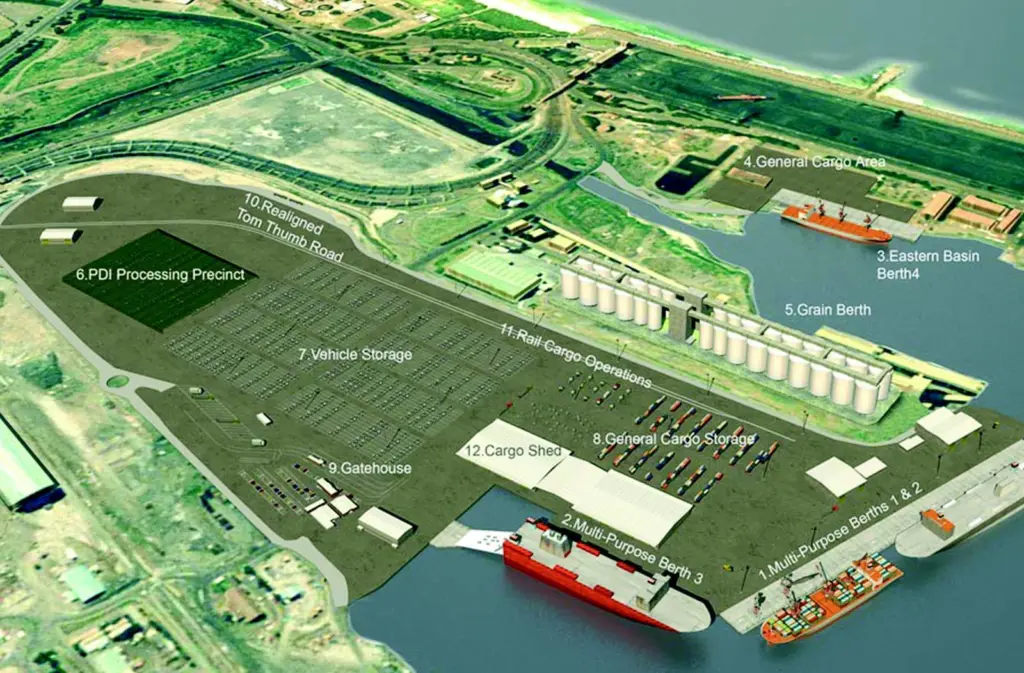
Elsewhere, the New South Wales Government’s Ports Growth Plan and two major projects that are pivotal to the A$140m transformation of Port Kembla’s Inner Harbour are just getting into swing. Transfer of the vehicle trade and general and containerised cargoes from Sydney Harbour to Port Kembla will be complete by 2008. This requires the A$45m development of a multi-purpose berth No. 3 to accommodate roll-on, roll-off vehicle-transporter vessels and general cargoships. Its completion will complement last year’s A$16m extension to multi-purpose berths 1 and 2, and allow three large ships to use the multi-purpose berths simultaneously.
Australian Amalgamated Terminals is also about to start construction of its cargo-handling facility adjacent to Multi Purpose Berth No. 3 to service the introduction of vehicle and container trades. The first stage will include a paved area for containers and general cargo, a 15,000m sq cargo shed, stevedoring amenities and offices, new entrances and exits, closed circuit television security and boundary fences. Work started in April and should finish in March 2007.
Related Articles
 WORLD
WORLD
 PORT & TERMINAL NEWS
 PORT & TERMINAL NEWS