![PortStrategy[GreenPort]](https://www.portstrategy.com/wp-content/uploads/2026/09/PortStrategyGreenPort.svg)




Chancay – high risk?
Significant new capacity is due on stream at the port of Chancay, Peru. For this to succeed as an investment it will require the alignment of several key factors. Andrew Penfold takes a look. What are the lessons for other southern port developments?
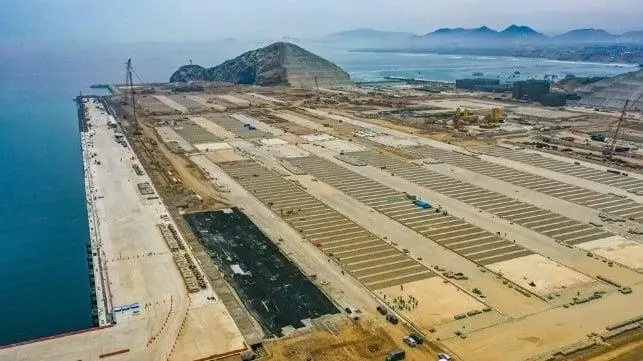
The new port at Chancay in Peru is due on-stream by the end of the year for bulk handling and will expand to become a front-rank container handling terminal over 2025-2026. The new US$3.6bn terminal is being formatted to handle 18,000TEU vessels and clearly represents a major push to integrate the South American West Coat trades with China and other East Asian markets. The initial phase of development should provide around 1.5m TEU of capacity from 2025-2026. The driving force behind this is China’s Cosco Shipping and it clearly represents a major aspect of the – now somewhat uncertain – Belt and Road Initiative (BRI). Cosco’s share of the project is placed at 60%.
Although the terminal will be well formatted to meet current and future needs the entire project is controversial, both from geopolitical and container shipping perspectives. In the former category are US concerns about the influence of Chinese interests in South America, with the scale of the project raising concerns in Washington and being directly responsible for nascent US programmes to step up investment in the region. The degree to which these factors will shape the trade and port sector in coming years remains uncertain but attempts to raise real hard finance for such major projects on the open market would clearly prove much more difficult than under the soft financing available from the BRI.
The role of Chancay has been a matter of some dispute of late. The original idea was that the container facilities at the port were to be exclusively operated by Cosco. Recently, the Peruvian government sought to backtrack on this arrangement – possibly under US pressure – and to redefine the role of operation of the terminal on a non-exclusive basis. This did not last long, however, with political pressures from China (ahead of the Peruvian president’s visit to China) seeing this attempt to rewrite the position reversed.
The primary goal of the port is to operate as a hub offering services to multiple lines, not just Cosco.
Perhaps of more immediate (and readily quantifiable) interest is the degree to which such large-scale projects can be effective catalysts in the introduction of the largest vessels into the southern trades. Is the local demand there to justify regular (at least weekly) direct calls by Ultra Large Container Ships? Is the ship size advantage over currently deployed vessels sufficient to radically alter the structure of the trades and is it realistic to move from large scale feedering via northern ports In Mexico to/from East Asia to direct services? All these points need to be considered in order to adequately test the axiom ’build it and they will come’.
THE PERUVIAN MARKET
Total Peruvian container port demand has increased rapidly since 2018 by 14.8 per cent to reach a 2023 total of 3.1m TEUs – a CAGR of around 2.8 per cent. Trade and the Peruvian economy are dominated by the greater Lima region which is currently served by the two terminals at Callao operated by APM Terminals and DP World. Table 1 summarises demand development at Peruvian ports since 2018.
The focus of demand is generated by Lima, and this is also where national distribution centres are located. Only Paita enjoys a significant and different local hinterland primarily based on northern reefer commodities.
Total national demand, as noted above, reached 3,1m TEU last year, of which Callao accounted for around 87 per cent. This role has not and will not change. In addition, there is a limited role for transshipment at Callao with this reaching 0.7m TEU in 2023. This has increased marginally but remains a limited aspect of the national demand profile.
The current capacity of APM Norte is placed at 1.3m TEU and DP World offers 2.7m TEU of capacity. The combined capacity of the port is placed at some 4m TEU, which provides some significant headroom to accommodate anticipated growth. It should be noted that APM is fast filling up and the proposed development at Chancay is a major factor in determining optimum development for the company regarding its expansion plans at Callao. With demand anticipated in the region of 2.5-3 per cent per annum there is a clear danger that the introduction of the first phase of Chancay (1.5m TEU from 2025-2026 with scope for rapid further expansion) will deliver overcapacity for the greater Lima area.
There is no effective difference in the costs of current delivery of containers to the Callao terminals to/from the hinterland in contrast to Chancay – indeed, there are indications that trucking costs to the new terminal will be slightly higher from the major DCs. On this basis, only the ability of the new terminal to berth larger vessels will have a significant impact on transport cost structures. A review of current facilities confirms a water depth advantage of just one metre between Callao and Chancay – given tidal ranges and the level of part-loading on the trades this is a very limited advantage.
CHANCAY’S COMPETITIVE POSITION
A review of the rationale for the terminal confirms only a limited water depth (ship size) advantage and inland costs are broadly comparable. The primary advantage stated by the promoters is that the new port will significantly reduce transit times Transpacific. How realistic is this? At present the link between Peru and the broader West Coast is provided by transshipment at northern terminals primarily in Mexico and to a much lesser extent at Posorja (Ecuador) and Buenaventura (Colombia). The concept is that direct services will be offered, thus reducing both costs and delivery time for Asian cargoes.
There are problems with this scenario. Firstly, the deployment of 18,000TEUs on a minimum weekly service would generate an annual capacity of up to 1.9m TEU. The penetration of such a new – presumably Cosco – service would account for over 70 per cent of the greater Lima market. This is an unrealistic level of demand to be secured and will require steady and rapid expansion of the national market over many years to be realistic and also exceeds the Phase 1 capacity of the port. The promoters emphasise that demand can be made up by increased transshipment from other West Coast ports via Chancay, and indeed such a policy is seen as essential if the largest vessels are to be regularly filled.
Similarly, the cost advantage of stepping up from 14,000TEU vessels that can currently be handled at Callao to the 18,000TEU class is not that great in the overall scheme of things – perhaps around US$50-65 per forty-foot container. With inland costs being higher and the existing terminals enjoying the potential to reduce stevedoring charges this could soon be negated.
The basic idea is to substitute direct services for containers feedered via northern ports. The problem is that this could also be delivered by the largest vessels that could in theory) call at Callao. The advantage would be limited to the scale economies from the larger vessel. This represents an adjustment not a game changer.
It can also be asked why, if the position for direct services is as described, they have not already been established?
ALLIANCE CONSIDERATIONS
The position is further complicated by the position of the major lines at Callao. Given the investment of APMT at the port it seems certain that Maersk will maintain volumes at their own terminal – at least until capacity is reached. Hapag Lloyd’s volumes under the new Gemini alliance are also likely to go in this direction. Cosco will obviously be the anchor tenant for Chancay. There is little scope for redirection of other lines’ business away from DPW.
Overall, the outlook is one of overcapacity (unless truly heroic assumptions are made with regard to demand growth) and that there will be limited scope for Chancay to redirect business from other terminals on the basis of only marginal cost advantages.
| 2018 | 2019 | 2020 | 2021 | 2022 | 2023 | |
|---|---|---|---|---|---|---|
| Palta | 0.27 | 0.30 | 0.35 | 0.35 | 0.35 | 0.31 |
| Callao APMT | 1.05 | 0.95 | 0.92 | 0.99 | 1.02 | 1.09 |
| Callao DPW | 1.32 | 1.40 | 1.38 | 1.51 | 1.48 | 1.61 |
| Others | 0.05 | 0.05 | 0.05 | 0.06 | 0.06 | 0.09 |
| Total | 2.70 | 2.70 | 2.70 | 2.90 | 2.90 | 3.10 |
| – of which Callao | 2.38 | 2.35 | 2.30 | 2.49 | 2.49 | 2.70 |
| – of which transshipment | 0.49 | 0.43 | 0.32 | 0.46 | 0.46 | 0.68 |
BROADER IMPLICATIONS
Of course, the introduction of large-scale new capacity into a local port market is always disruptive, but the case of Chancay – and the risks identified – has a broader resonance. In southern trades there is great pressure to introduce (much) larger vessels into the trades with this being driven as much by anxiety on the part of the lines as to where they will actually deploy their ULCS investments as by any identified unit cost advantages.
It is certainly clear that without the carrot of low cost of capital input under the Chinese BRI the development of such massive new capacity would have been difficult to bank. The long story of the development of the project, which was first mentioned in 2007, and the recent re-examination of fundamental contractual issues for the project underline that financial feasibility must be questionable. A much more limited approach – probably focused on the expansion of the existing Callao terminals – would have generated a stronger ROI.
Attempts to short circuit port development on the basis of superficially cheap development costs risk unsettling geopolitical ramifications and also very difficult financial implications. The concept of the ‘debt trap’ that has been associated with some BRI projects is not always the case, but it is certainly true that attempts at out of scale port development driven by not strictly commercial investments have the potential to severely prejudice existing well planned projects.
It may be the case that demand increases at an extremely high rate in Peru and that this offers scope for Chancay’s projections to be realised. It may also be the case that these demand changes will be sufficient to catalyse the development of direct Asian services for the South American West Coast. Also, maybe the existing players will ‘sit on their hands’ while this change takes place – although why would they?
Chancay is an example of the risk of out of scale port investment based on a hope of the emergence of required conditions. Proper risk analysis is essential however superficially attractive an investment may be. This is always the case but in the southern trades the risks are much higher – these are fundamental questions for the next generation of port developments.
Related Articles
 EXPANSION & DEVELOPMENT
 CONTAINER & CARGO HANDLING
 PORT & TERMINAL NEWS