![PortStrategy[GreenPort]](https://www.portstrategy.com/wp-content/uploads/2026/09/PortStrategyGreenPort.svg)

Congo River: Time to dredge
The implementation of dredging works in select stretches of the Congo River can deliver major benefits in terms of cost and overall efficiency to the Democractic Republic of Congo’s importers and exporters.
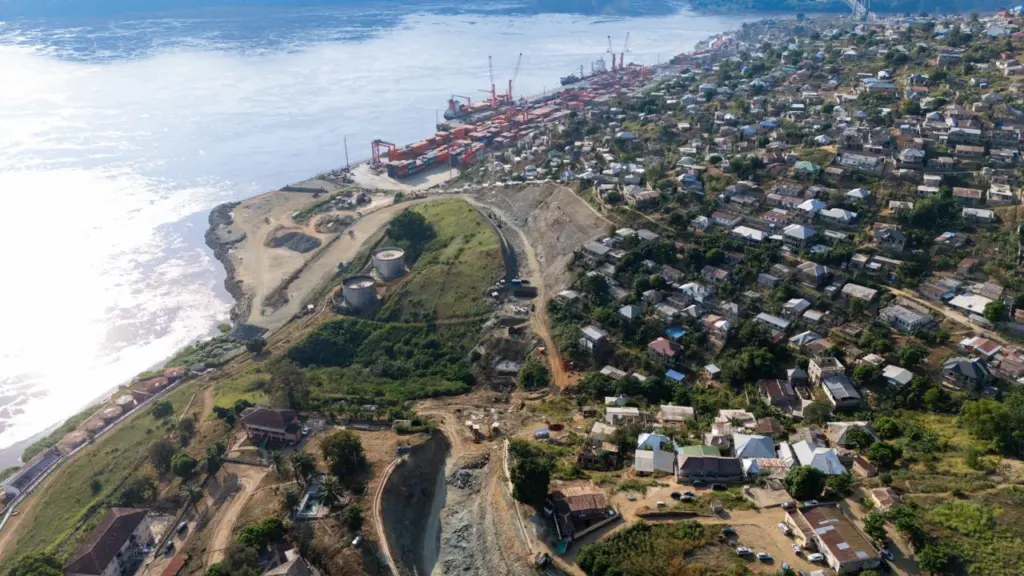
Dredging the river in select locations, notably between Boma and Matadi, will provide extra draft and therefore load capacity to container services, opening up economies of scale.
The port element of the container system has undergone a major transformation in the last decade with investments made by International Container Terminal Services Inc. (ICTSI) and local partners in the Matadi Gateway Terminal (MGT).
Today, MGT functions as a modern container terminal with handling power over the quay provided by state-of-the-art mobile cranes and eight rubber tyred gantries providing the backbone of landside handling power.
The challenge today is to overcome a lack of funding and to reinstate dredging services on the river with these preceded by studies to determine the viability of deepening draft from 26ft to 33ft. In fact, these studies were already underway when due principally to objections raised by Compagnie des Voies Maritimes (CVM) at a local level the studies were shelved.
CVM is the national Congolese Maritime Authority responsible for hydrographic and bathymetric surveys, dredging, buoyage and pilotage with the remit to ensure safe navigation on the Congo River.
The studies flowed out of a commitment by MGT to provide funding in conjunction with a PPP scheme to be set up and administered jointly with CVM, targeted specifically at improving the shipping channel from the mouth of the Congo River at Banana to Matadi. Matadi is the main container hub on the Congo River, situated 150 kilometres upstream from the Atlantic Ocean and fulfilling the role of the natural gateway to Kinshasa, the DRC’s fast growing capital city.
The PPP scheme as proposed was a highly organised effort with its main characteristics as follows:
- MGT to provide initial funding for the necessary studies with no obligation on CVM to reimburse funding if the studies proved inconclusive.
- CVM to cooperate with MGT in the provision of technical expertise.
- Establishing an ad hoc committee, made up from all interested parties, to examine the technical and economic aspects of the project.
- Delegates to be appointed by each stakeholder including the ministries involved.
- Establishing the rules of procedure governing the ad hoc committee.
- Agreeing Terms of Reference for the project.
- Drafting a Memorandum of Understanding between the parties to be submitted to the Minister of Finance and the Minister of Transport, Communications and Public Works for approval.
- The appointment by consensus of a qualified consultant, proposed by CVM, to carry out the required technical and economic studies.
The consultancy HAEDES was selected by CVM to undertake the required technical and economic studies as a precursor to the dredging works but its project involvement was cut short by the objections raised by the CVM Boma agency and as a result the chair of the Board of Directors of CVM suspended the study work in September 2023.
BACK ON TRACK
The impediments to getting the project back on track – the objections raised – weighed against the material benefits that will flow from its implementation are visibly minor. Given the required studies generate a positive result and the project is implemented this will deliver sizable economic and system benefits to importers and exporters.
These stand significantly taller than the objections raised and as such there are strong grounds, on a national scale, for the project to proceed with this to be kick-started by sensible dialogue. The architecture of the project remains in place and can relatively easily be actioned into live mode. The impetus to get things back on track is even stronger given that there is minimum financial risk to CVM and the government as a whole.
Various ideas have been proposed for the recovery of the funds required for the capital dredging with these comprising:
(a) an ANAPI scheme – Under the supervision of the Ministry of Planning and Development Aid Coordination, the National Agency for Investment Promotion (ANAPI) is the public institution responsible for improving the business climate and facilitating investment in the Democratic Republic of Congo,
(b) The introduction of a temporary toll or,
(c) A combination of (a) and (b).
Certain parties that wish to maintain the current situation for competitive reasons have also floated the idea that setting up a joint venture between MGT and CVM will lead to the dissolution of CVM. On this point MGT is emphatic this is not the case:
“It is nonsense that our proposed joint venture with CVM under a PPP arrangement will lead to the replacement of CVM or an erosion of its powers. On the contrary, we are stepping in to bolster its capabilities and help drive a project forward that will deliver major positive economic impact at both a local and national level,” underlines Timothée Jeannin, Directeur General, MGT.
In this context, it is also relevant to take into account that the dredging project will only have a short duration, just 12 months is estimated. Also significant in giving credence to the project’s viability is the acceptance of its goals and methodology by the shipowners using the river. They have stated their willingness to accept a user pays toll-based system, a concept proven in other areas of the world such as the Paraguay-Paraná Waterway where vessels transiting the Argentine section of the waterway are subject to a toll.
Additionally, there is no possibility of competitive service being offered by road. To-date there are no functioning container port services at Banana at the mouth of the Congo River – they are planned but development works remain at an early stage – and in any case the road journey from Banana to Kinshasa, which routes via Matadi, is not a viable journey due to the condition of what is a very primitive road between Banana and Matadi.Furthermore, the extremely high cost of road transport in the DRC is yet another major limiting factor.
The deepening of the Congo River will also not negatively impact the Banana containerport project which is targeted at much higher capacity mainline vessels rather than the smaller capacity feeder vessels that offer service along the Congo River. Indeed, when Banana is operational it could benefit from the deepening in conjunction with transshipment operations to feeder vessels.
BEST ALTERNATIVE
There is no question that the all-water journey to Matadi on the Congo River is by far the best alternative to servingKinshasa. This will be further underlined as Kinshasa’s population, today estimated at circa 20 million, continues to grow at a rapid pace and as an emerging middle class drives demand for higher-end imported goods.
“The Congo River forms part of a very important supply chain. It is essential to optimise its capacity, for today and tomorrow and especially with Kinshasa enjoying the status of one of Africa’s fastest growing mega-cities and ranking among one of the largest populated urban areas in Africa,” emphasises Jeannin.
This position will also be capitalised on when complementary supply chain developments take place. Notably, the improved road links to MGT and the railway corridor being established between new Matadi and Kinshasa ICDs which are now under development. Multiple benefits will ensue ranging from further reductions in logistic costs and faster cargo movement to improved supply chain resilience and environmental positives.
Related Articles
 EXPANSION & DEVELOPMENT
 CONTAINER & CARGO HANDLING
 PORT & TERMINAL NEWS