![PortStrategy[GreenPort]](https://www.portstrategy.com/wp-content/uploads/2026/09/PortStrategyGreenPort.svg)

IAPH WPC 2025: Highlights
Seventy years on from its formation IAPH held the World Ports Conference 2025 in Kobe, Japan. The conference programme underlined IAPH’s emergence as the key representative body for the global ports industry
The IAPH World Ports Conference, held recently in Kobe, Japan addressed a range of subjects central to the forward development of the international ports sector.
It was also a renowned occasion as it marked 70 years since IAPH’s formation, a special moment in the organisation’s evolution which today, through a growing number of Working Groups, Committees and work with governments and NGOs as well as generally the robust efforts of its core team headed up by Patrick Verhoeven, Managing Director, IAPH, reflects an organisation with genuine influence able to speak with authority on behalf of its core port authority membership.
This influence was marked in Kobe by the size of the delegate body (circa 650 delegates), the senior calibre of the delegates attending and the global spread of the countries from which delegates originated, spanning the developed and emerging world.
An exhibition area operated alongside the Conference programme. There were also ample opportunities for networking at various functions run in conjunction with the Conference, not the least of which was the IAPH Gala Dinner which also incorporated the IAPH Sustainability Awards 2025.
There were a number of keynote ‘setting the scene’ presentations included in the plenary sessions of the Conference programme.
Sessions with a specialist focus spanned both the plenary and breakout sessions with the programme augmented by site visits and technical workshops and the networking elements of the programme.
The opening keynote speech came from Masato Kanda, President, Asian Development Bank (ADB) with a central theme of his presentation being energy transition and the need to mobilise private sector finance to close the funding gap to facilitate progress in this area. He put under the spotlight the fact that the task of selecting new clean fuels is still in a state of evolution. Specifically, he identified methanol, LNG, shore power and other options as all still having challenges associated with them including the important aspect of funding arrangements.
His keynote speech was preceded by welcome addresses by a number of dignitaries: Jens Meier, President of IAPH; Hiromasa Nakano, Minister, Ministry of Land, Infrastructure, Transport and Tourism, Japan, Kiso Hisamoto, Mayor, City of Kobe and Masami Kubo, President, Japan Harbor Transport Association.
The keynote speech on Day Two came from the client side of the port business i.e. from Hitoshi Nagasawa, President/Chairman, Japanese Shipowners’ Association/Nippon Yusen Kabushiki Kaisha (NYK Line). Again, clean fuels came into the discussion, sustainability goals overall and the then thorny subject of tariffs and port performance.
SPECIALIST PRESENTATIONS
Among the specialised presentations there was considerable discussion of the implications and routes to meaningful climate change and associated with this energy transition, both subjects identified as an area of ongoing challenge.
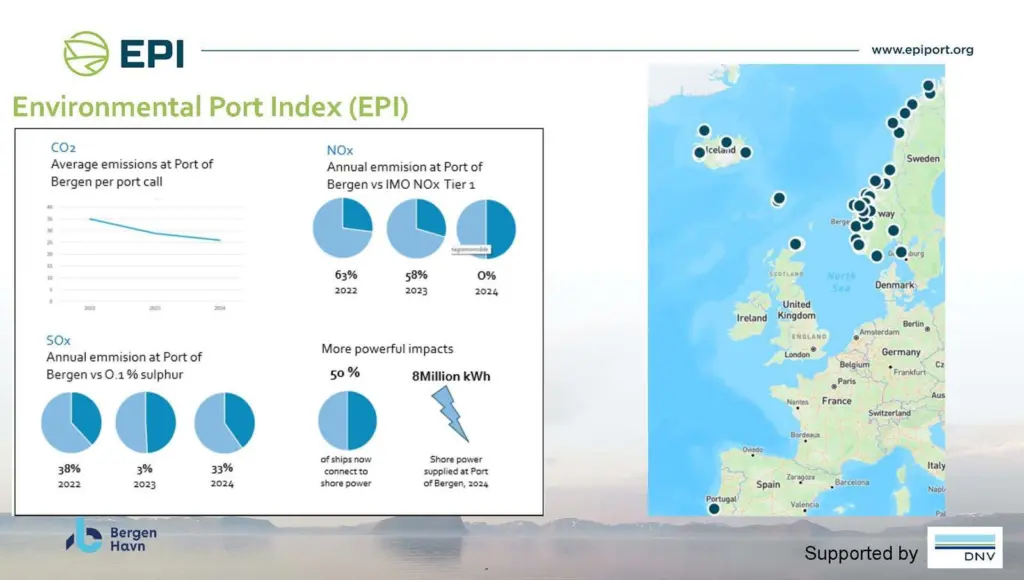
The then proposed IMO Net Zero Framework came in for much discussion. In a specialist session on the subject Edward Molitor, Head of International Public Affairs, Gothenburg Port Authority and Michael Forland, Port Director, Port of Bergen, debated the likely consequences of the proposed Framework, which encapsulated technical and economic measures and the big question, will ports benefit? They drew into this discussion their own environmental experience based on their respective organisations – a case in point being Michael Forland presenting the port of Bergen’s interesting Environmental Index, which in one context shows the progress the port has made with decarbonisation – Figure 1.
The ensuing discussion on the Net Zero Framework not surprisingly highlighted the general feeling about the proposed measures – both positives and negatives were identified. There was no overwhelming confidence that the pending vote on the measures at IMO would be voted through. And, as we know, this proved to be the case – the initiative was delayed for a year with a vote of 57 in favour, 49 against with 21 abstentions. IMO member states plan to keep working on the framework with a view to another vote taking place in 2026.
Most of the discussion in the above referenced session and others in the conference programme was centred around the specific economic and technical measures proposed. By way of an added perspective, this edition of PS carries an article that discusses the negotiation tactics employed by IMO, how these differed from past practice and seemingly had a bearing on the outcome – see IMO MEPC landmine.
The Day One morning sessions also included a focus on marine fuels and the associated opportunities with ports. It was acknowledged in this respect that the demand picture will be clearer for larger ports and on the other hand somewhat murkier for medium to small size ports.
The afternoon of Day One saw two sessions that delved into the modern day problem of volatility in supply chains with notably the question of tariffs coming up and the thorny issue, at the time, of the Red Sea ‘blockage’ factor. Lessons were taken from both sessions about how to handle such extraordinary events. Eugene Seroka, Executive Director, Port of Los Angeles, was particularly notable in citing the rollercoaster effect of such events and the challenging nature of managing under these circumstances.
Also prominent in the Day One afternoon sessions was the focus on the newly-launched 3rd edition of the World Bank’s Port Reform Tool Kit, a product that IAPH had significant input into. Jan Hoffman, Global Lead, Maritime Transport, World Bank and Patrick Verhoeven, Managing Director, IAPH, talked through the content of the tool kit, highlighting its modular format and the edition’s new sections which spanned: environment and sustainability; change management, digitalisation and cyber risks as well as the updated sections on regulation, governance and private sector involvement.
DAY TWO – FINANCE FOCUS
Day two of the World Ports Conference had a strong focus on finance and satellite subjects associated with this. The morning saw David Wignall, Manging Director, David Wignall Associates and Jean-François Belzile, Harbour Master and Director of Marine Operations, Port of Montreal, explore the topic of the current investment climate for ports. This session was followed by Port financing and risk: what ports need and banks want?, a topic introduced by Jamie Simpson, Economic Consultant, Triple Line Consulting and Ms Yesim Elhan-Kayalar, Adviser, Office of the Chief Economist, Asian Development Bank. Following on from this came the session, Energy Hubs: can investment be de-risked?, introduced by Stuart Neil, Strategy and Communications Director, International Chamber of Shipping and Rico Salgmann, Transport Specialist, The World Bank.
In summary, the main points raised across these and other finance related sessions such as the session Maximising the Value of Port Land Through Smarter Cessions were as follows:
- Geo-political factors are reshaping trade patterns and port financing strategies. Trade patterns are likely to shift towards the growing importance of intra-Asia trades as well as more trade between the Far east and Africa and Latin America. Alongside this G2G governance arrangements are becoming more prominent in ports, both with port authorities and operations. Some argue a slow retreat from international competitive bidding for EPC and PPPs is underway.
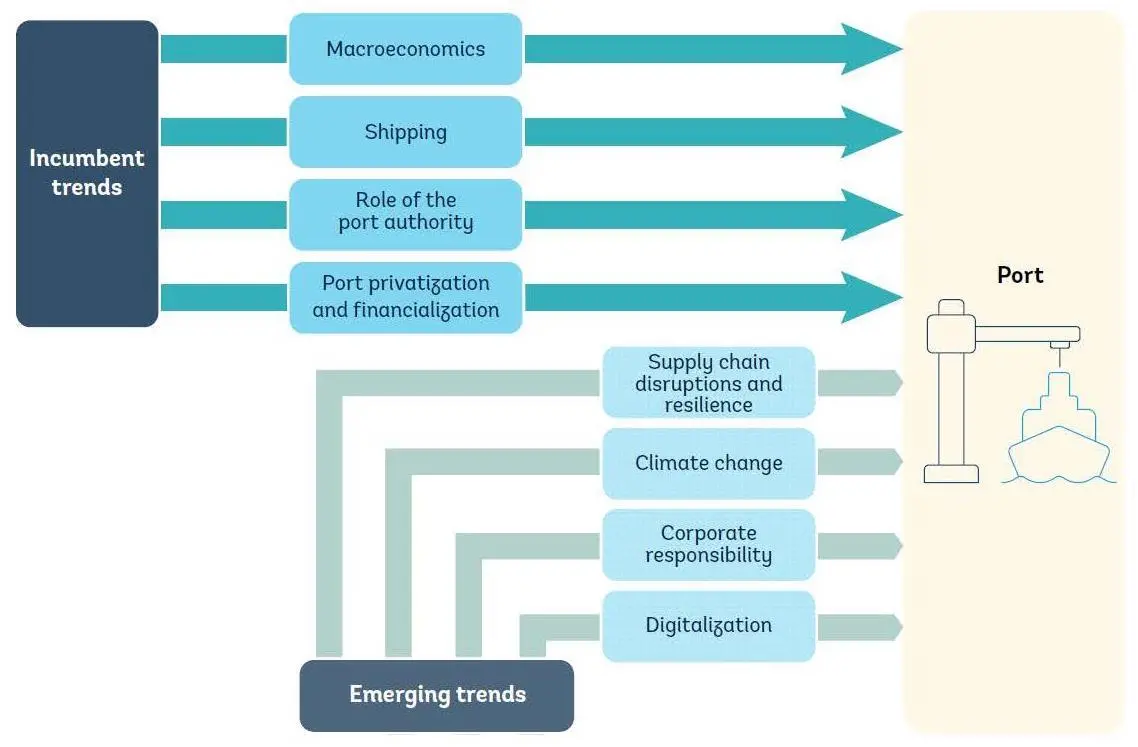
- Emerging market port authorities, serving small national economies, are facing many of the same disruptions as larger ports – climate risk exposure, digitalisation, cyber – security, ship and cargo handling technology changes – but are struggling to put in place plans to manage these disruptions.
- Pressures to embark on a green transition and net zero pathway are especially problematic in smaller ports; not least as technology choices around fuels and landslide power are still nascent in much of the world.
- The financing challenges facing smaller emerging market ports are materially different from larger more mature markets; there is often a higher exposure to risk and less capacity to manage these risks. Thus, there is a need for new approaches and instruments to de-risk investments and to transfer risks where possible. The needs of these smaller market ports should be better provided for and should be elevated within the IAPH community.
- Port financing investment criteria and risk assessments vary significantly depending on the scale and types of port (containers, bulks, multi-purpose) and brownfield vs greenfield. Further complexity is added when port authorities are often tasked with managing both inside and outside the port gate infrastructure requirements and externalities that impact on operations and returns.
- Access to concessional port financing increasingly depends not only on the strength of fundamental – ROI and cashflow – but also contributions to wider economic benefits such as job creation and other ESG considerations.
- You can start with distinct goals in concession arrangements, such as maximising land values, but invariably it is not one but a combination of benefits that wins the day. There remains significant scope for upgrading tender procedures and bidding arrangements as well as procedures governing concession extensions or retendering.
Related Articles
 EXPANSION & DEVELOPMENT
 CONTAINER & CARGO HANDLING
 PORT & TERMINAL NEWS