![PortStrategy[GreenPort]](https://www.portstrategy.com/wp-content/uploads/2026/09/PortStrategyGreenPort.svg)

PNW investments progress
Ports in the PNW region of Seattle-Tacoma, Coos Bay, Vancouver (WA), Prince Rupert, and Vancouver (BC) each have plans to invest in their facilities. Dean Davison assesses these projects and the forward competitive position
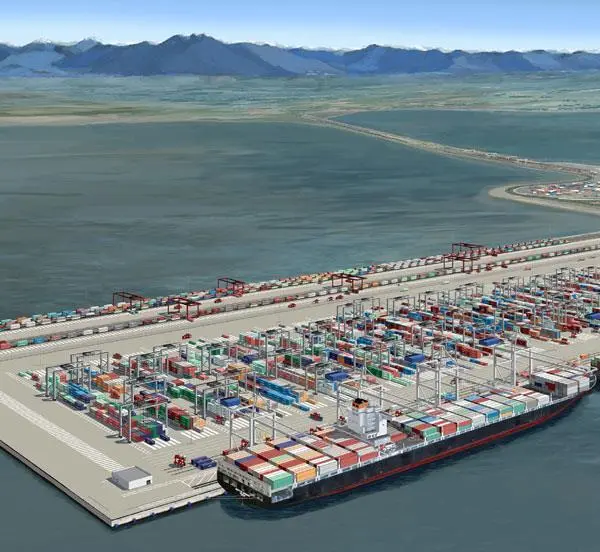
“At the Vancouver Fraser Port Authority (VFRA), our purpose is to enable Canada’s trade by being reliable and innovative, while protecting the environment. The Port of Vancouver is Canada’s gateway to diverse markets, enabling trade of approximately C$350bn every year with 170 countries. C$1 in every C$2.50 of Canada’s trade outside of North America moves through the port,” explains Devan Fitch, Roberts Bank Terminal 2 Program Director at the VFPA, speaking exclusively to Port Strategy.
On the basis of these comments from Fitch, the importance of the long-running Roberts Bank 2 container project to Vancouver (BC) is undeniable. “Roberts Bank Terminal 2 is a transformational, nation-building project set to build new industrial land, unlock C$100 billion of container trade capacity annually, and create tens of thousands of jobs. It is a direct investment into Canada’s economic resilience and future, which will increase Canada’s west coast container capacity to trade with the rest of the world by more than 30%.
“Located at the core of western Canada’s largest economic region and well positioned geographically relative to competitors on all principal transpacific trade routes (up to two days sailing time advantage from Shanghai compared to competitors in the San Pedro Bay port complex). The terminal will benefit from comprehensive, resilient, and cost competitive rail access through three Class 1 railways (CPKC, CN, and BNSF) and direct access to a robust local network of off-dock container handling, transload, and other trade supporting facilities.”
WHEN WILL IT HAPPEN?
So, while the project itself has seen a number of delays over recent years, what is the current position and, when will it be built? Fitch is upbeat here. “In July 2025, we started the search to find the best qualified team to progress construction planning and build the landmass and wharf component of the Roberts Bank Terminal 2 Project—a key milestone in advancing the project, before adding a crucial update on timescales. We will work with our construction partner and First Nations to obtain remaining permits in 2026. Construction mobilisation and early works are expected to occur in 2027, with major land reclamation works expected to begin in 2028.”
On this basis, VFPA is now actively pushing ahead with the project, with Fitch also giving more details on the specific timetables: “Our current expectation is that the terminal concession to select the operator that will build, equip, and operate the new terminal will take place in the late-2020s, with the operator selected around 2030. Terminal operations are set to begin in the mid-2030s.”
Based on previous growth levels and periods of congestion, this positive traction will be good news for Canadian shippers and BCOs using Vancouver.
T-5 NEEDED IN SEATTLE
“Investments in Terminal 5 are critical to remain competitive in the shipping industry,” announced the Port of Seattle when confirming its intention to redevelop this facility to keep pace with the need to handle larger container vessels.
The need for this enlarged terminal has certainly been felt at the port, as it explains: “With a modernised T-5, the NWSA’s containerised cargo is estimated to reach nearly seven million TEU annually in 2050………without the T-5 investments, containerised cargo is expected to be 5.3 million TEU in 2050, a difference of 1.6 million TEU. This estimated reduction of total TEU results in reduced economic impact, including more than 6,000 fewer jobs and US$2bn in lower direct business output.”
Construction commenced in 2019 and by Q2 2024 Phase 2 had opened, supported by an investment of more than US$500 million from SSAT/ST – a joint venture between SSA Terminals and Terminal Investment Limited (TiL). “The major part of the Terminal 5 redevelopment is complete (completed last year) but there is still some work ongoing, including increasing reefer capacity and expanding capacity for on terminal truck queuing though a major truck gate reconfiguration,” confirmed a port spokesperson.
COOS BAY – REPLICATING PRINCE RUPERT?
In June 2025, the proposed Pacific Coast Intermodal Port (PCIP) at Coos Bay in Oregon gained tangible traction, with funding of US$100 million confirmed. This investment from the State authorities joined US$58 million gained in federal transportation grants for infrastructure from Infrastructure for Rebuilding America, Consolidated Rail Infrastructure and Safety Improvements, and Railroad Crossing Elimination awards.
The terminal is being designed as a ship-to-rail hub, moving containers from ocean vessels onto the Coos Bay Rail Line for a 134-mile run to Union Pacific tracks in Eugene. From there, freight can reach largescale US Midwest markets – in essence, not only would it be the first facility of this type in the US, but it could also be argued that it is seeking to replicate what has been achieved in Prince Rupert, Canada.
PCIP is located on Coos Bay’s North Spit and is planning a strong green agenda. Its use of rail will remove trucks from the highways, while providing port capacity without a corresponding increase in greenhouse gas emissions. The Port will be fitted with electric power plug-ins that will power ships at berth during the process of unloading, which will eliminate ship engine emissions. All vessels will be unloaded using electrified ship-to-shore gantry cranes, further reducing greenhouse gas emissions.
PCIP has confirmed a US$2.3bn total construction cost, with a five-year project timeline (of which three years is anticipated for construction, following all necessary environmental permits being secured). With berths for two ships, the terminal would offer capacity of 1.2 million TEU initially, (800,000 containers), with capacity subsequently increasing to 2 million TEU annually.
Commenting on the project, Melissa Cribben, Executive Director, PCIP, confirms: “This project reflects the kind of bold, future-focused investment that Oregon needs. For too long, rural communities like those on the South coast have been left behind. This project gives us a path forward — one grounded in good jobs, sustainable freight infrastructure and long-term community stability.”
PRINCE RUPERT DIVERSIFYING
Prince Rupert is continuing to develop through the further diversification of new terminal and logistics capacity in order to build greater resiliency against market fluctuations.
The Canada Infrastructure Bank provided a C$150 million loan for the first phase of CANXPORT, a large-scale export logistics and transloading facility, to be operated by Ray-Mont Logistics. The planned capacity is 400,000 TEU per annum, primarily for forestry, agricultural, and resin products as part of a rail-to-container transloading operation, with Canadian National Railway also a partner in the project.
Prince Rupert remains a facility serving Asian imports entering Canada and the US. Fairview Cove capacity was increased in 2022 from the previous 1.4 million TEU to 1.8 million TEU and a further rise to 2.1 million TEU is already on the agenda.
The Prince Rupert Port Authority has confirmed that a second terminal is part of the overall port masterplan for the port. It will add at least two million TEU of additional annual capacity, with existing terminal operator, DP World Canada, expected to participate in the project. Current estimated completion date is 2030-2031.
With the development of projects such as CANXPORT and significant future capacity potential, Prince Rupert offers longer-term potential to support Canadian supply chains, drive trade and economic growth, especially with Indo-Pacific markets. A more distant geographic location to the north of BC, is appealing for imports but a lack of localised export volumes remains.
Vancouver (WA) targets soda ash
A newly designed Terminal 2, Berth 7 facility is being constructed at the Port of Vancouver (WA). The project will redevelop the port’s existing Vancouver Bulk Terminal mineral operation into a larger export facility, with the ability to handle more than 3 million tons of soda ash annually once fully operational.
Soda ash has many uses, including for manufacturing glass and lithium-ion batteries, while natural soda ash is a key ingredient for toothpaste, baking soda, powder, and detergents. The expanded terminal capacity is expected to support expansion of Solvay’s Green River, Wyoming, soda ash operations.
Alex Strogen, Chief Commercial Officer, Port of Vancouver, confirms that this project involves demolishing old existing infrastructure and replacing it with modern facilities featuring expanded storage space, upgraded rail unit train access and state-of-the-art cargo handling systems. It will include a new ship loader and a conveyer system. “It will have the most advanced dust mitigation on it,” Strogen underlines.
The project is a joint venture between Nautilus International Holding Corp. and Neltume Ports, the Port of Vancouver and Solvay, a leader in soda ash. The total investment cost is approximately US$80-US$90 million, with construction to continue through to Q3 2026, with operations commencing before the end of 2026.
Related Articles
 EXPANSION & DEVELOPMENT
 CONTAINER & CARGO HANDLING
 PORT & TERMINAL NEWS