![PortStrategy[GreenPort]](https://www.portstrategy.com/wp-content/uploads/2026/09/PortStrategyGreenPort.svg)





Puerto Bahia up for sale
The next major phase of expansion of unit load traffic in the hub port of Cartagena will be at Puerto Bahia, the new dry cargo port. And the burning issue of the moment is which terminal operating company will oversee the forecast expansion.
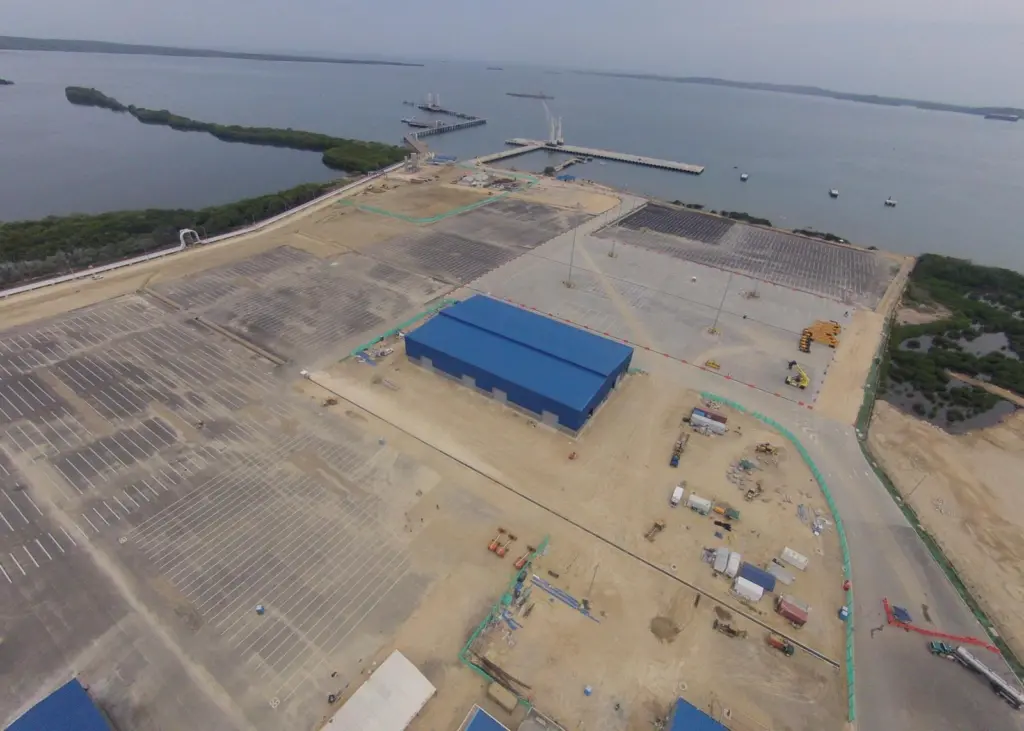
Pacific Infrastructure, which is the 100% owner of the Puerto Bahia dry cargo port, is at the beginning of a sale process for the dry cargo port which sits adjacent to the liquids terminal it has also developed on Isla Baru in the south of Cartagena Bay.
Jorge Fonseca, head of corporate finance, Pacific Infrastructure, notes: “We have put a tremendous amount of work into Puerto Bahia and we believe we are bringing it to the market at just the right time. It is clearly a great opportunity. We know that deep-water container handling capacity in Cartagena is already being squeezed and this will accelerate with the opening of the new Panama Canal locks now under a year away.
“Puerto Bahia has a 16m draft alongside the 300m of quay we have built and we have laid the foundations for another 300+m. The quay has been designed to accept super post-panamax gantries. The yard area has been developed with hard standing and Isla Baru is just a two kilometre drive from the main highway connections to Bogota, Medellin and other key inland points.
“Do we have something to sell yes we do. It is a first class asset. Why do we want to sell? We are infrastructure developers not dry cargo port operators. We have developed the site that so that it is ready for an international terminal operator to walk right in and get to work – no delay.
He continues: “The site is working today, employing two heavy duty Gottwald mobiles and supporting landside equipment, but its real potential will be realised when it is fully developed for high capacity container handling operations and auto handling, storage and pre-delivery inspection activities commence. This twin track approach has already proved very successful in Cartagena and Puerto Bahia is well placed to do this – the terminal has a sizable land bank and we are already set up for vehicle operations in terms of purpose-built hard standing and so on.
“We can see the payback in these activities is good and we are very confident that the right operator can enjoy the upside of this hence we are now commencing a sale process,” he said.
Pressure Building
There is no doubt that pressure is building in Cartagena with regard to deep-water container handling capacity. The only terminal now able to handle the biggest ships in the East Coast South America trade is the Contecar terminal which belongs to the same group as the SPRC terminal, the other high capacity container terminal but without the ability to handle the bigger ships. The Contecar terminal is geared to accept vessels of up to 13,000 teu, those that will soon be able to transit the Panama Canal (like Puerto Bahia) but the SPRC terminal is focused on vessels of around the 5000 teu mark. Contecar presently handles vessels in the 6,000 teu-9,000 teu range.
Hamburg Sud is the prime user of the Contecar terminal, to the point that it is rapidly becoming the exclusive user of the facility as it rides a wave of growth. It is expected to see its throughput in Cartagena increase by 25% this year. This follows on from a rise in container traffic in Cartagena of 18.4% in 2014 and highlights how deep-sea container handling capacity in Cartagena is rapidly being eaten up.
APM Terminals has, of course, only recently bought into the Compas Terminal in Cartagena and is known to have formulated an expansion plan for it. But it is a relatively small facility and could be restricted on its ability to accommodate larger ships.
Puerto Bahia could well be where the future lies for container handling in Cartagena, both for gateway trade and transhipment. The twin impetus of trade growth and the progressive introduction of large vessels in East Coast South America trade will dictate this. Only recently Hamburg Sud, the major line calling Cartagena, christened the third of three vessels of 10,600 teu capacity, the Cap San Vincent, which like her sister ships will operate in the Asia-South America East Coast service.
Related Articles
 INSIGHT & OPINION
 INSIGHT & OPINION
 INSIGHT & OPINION