![PortStrategy[GreenPort]](https://www.portstrategy.com/wp-content/uploads/2026/09/PortStrategyGreenPort.svg)





Unfinished business
Seven years on from port privatisation in Nigeria port congestion remains a significant problem and is the focus of growing attention.
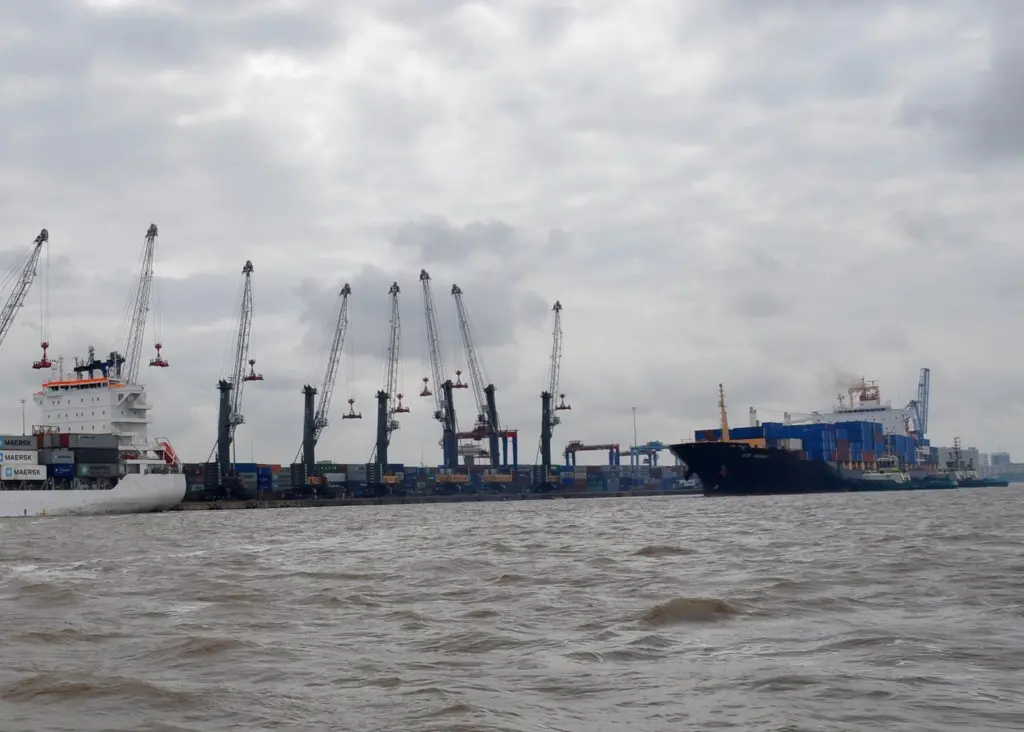
Considerable investment has been undertaken by the private sector in terminal facilities with this especially noticeable at APM Terminals Apapa Container Terminal in Lagos, which handles around 70% of the country’s annual container throughput.
In mid-2013 APMT estimated the total investment made by it at Apapa to be in the order of $230m with this rising to $330m with the completion of phase III development works in 2014. A similar tale can be told at the Lagos Tin Can Island container terminal facilities which have also been significantly upgraded.
Nigeria Ports Authority has additionally played its part in raising port efficiency, pushing through measures such as dredging of port access channels and night navigation in the port of Apapa.
There is no question that the reforms introduced by the extensive port privatisation programme implemented seven years ago have had a positive impact. Further, they have created a climate for new investment as witnessed by the extensive new port facilities to be introduced at Lekki, east of Lagos, and at Badagry situated 34 miles west of Apapa.
International Container Terminal Services Inc will operate new container terminal facilities at Lekki and APM Terminals at Badagry, although both ports will also possess bulk, general cargo and other terminal facilities.
Despite the extensive progress made so far at container terminal facilities at Lagos there is a growing body of opinion that more can be done to further raise efficiency and alleviate container congestion, especially in the container sector.
Several solutions have been proposed and a number implemented in order to try and alleviate the situation. And within this process there has not always been agreement on the main causes of congestion.
Leke Oyewole, senior special assistant to the President on Maritime, for example, recently identified terminal operators not having adequate equipment available to position containers for scanning as a significant problem area. Customs also jumped on this bandwagon with Abdullahi Inde Dikko, comptroller of General Customs, threatening on one occasion to close down the Apapa Container Terminal as a result of inadequate resources for Customs personnel to perform their duties properly.
Customs concern
APM Terminals, however, strongly refutes the accusation that its activities in conjunction with container scanning are a primary cause of congestion. It emphasises: “Scanning is the responsibility of Cotecna and Customs. APMT only intervened by taking over the logistics to bring about efficiency in the system.” And adds: “We voluntarily took over the responsibility of providing the logistics for scanning because the previous arrangement was not working well. Less than 60 containers were scanned per day and trucks were forced to wait up to three days to complete the scanning process.” Today APMT undertakes to process 200 trucks per day.
There is in fact plenty of evidence from cargo shippers, consignees, industry representative bodies and other interested parties that it is Customs and other government agencies which have a big influence over the congestion issue. It is pointed out, for instance, that when a vessel arrives at the Apapa Container Terminal the terminal operator has to wait between five and six hours to obtain clearance from Customs and other government agencies before it can begin working the vessel. Similarly, Yehuda Kotik, Managing Director of the Tin Can Island Container Terminal while participating in a recent meeting with the Nigeria Ports Authority aimed at solving congestion problems highlighted poor clearing and customs processes as the main reasons for the backlog of containers at the terminals.
Generally, signs are that while the shift from a public to private operated port system has delivered many benefits in Nigeria there are further significant efficiencies to be secured through new institutional reforms and in particular reforms aimed at the role government agencies play in the cargo clearing process. As government has already acknowledged, there are grounds for both scaling down the number of agencies that need to be involved and placing primary agencies such as Customs on a more modern footing.
Related Articles
 INSIGHT & OPINION
 INSIGHT & OPINION
 INSIGHT & OPINION