![PortStrategy[GreenPort]](https://www.portstrategy.com/wp-content/uploads/2026/09/PortStrategyGreenPort.svg)




Hydrogen: the answer?
Where does hydrogen fit into the port sector’s push to decarbonise? Andy Tam, Global Vice President Energy Management at DP World, spoke to Felicity Landon about the opportunities around hydrogen – and the need for both commercial and technical viability
As ports increasingly go for electrification as the quick route to decarbonisation, they need to bear one thing in mind, says Andy Tam, Global Vice President Energy Management DP World. “We are not the only industry electrifying – there are many other stakeholders outside the gates. Collectively they are going to demand more and more capacity from the local utilities, which will not be able to keep up with the connection requests – there will be transmission and distribution constraints, not just generation constraints.”
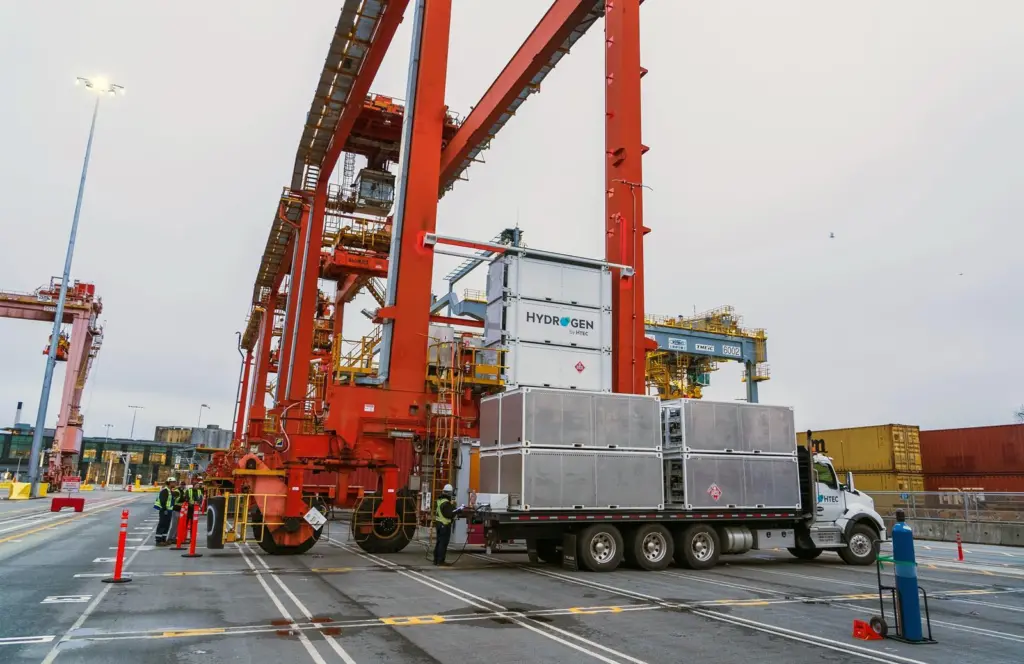
Is hydrogen the solution? DP World first initiated a group hydrogen strategy in 2021: “We identified at that time that the price of hydrogen was too high and too volatile to justify any significant investment in the hydrogen space,” says Tam. However, DP World Canada embarked on a pilot project in 2023-24, retrofitting a diesel RTG at Vancouver port with an integrated solution consisting of a hydrogen-electric generator (HEG), battery energy storage system, hydrogen storage module, regenerative energy capture, and integrated control and safety systems. A one-year field trial, tracking hydrogen consumption, energy generation, regenerative energy capture rates and other parameters, was successfully completed earlier this year.
“We have been investing in the technology there and keeping our head to the ground to see where else hydrogen can be used in ground handling,” he says.
ACCESS AND PRICE
The biggest challenges – getting the hydrogen, and the price. To strengthen the business case for using hydrogen in the port environment, “you need multiple revenue streams”, he explains.
Tam says there are a number of use cases for hydrogen in this context – not least, in locations where electrification isn’t an option at all because of inadequate local power infrastructure. “We can still decarbonise if we are able to access green hydrogen in areas where we can’t electrify.”
Second, energy hubs can be built around ports, to include hydrogen infrastructure. Ports are generally strategically placed to be at intersections, he points out – bringing together, for example, industrial operations that could be off-takers for hydrogen; infrastructure land where electrolysers could built to produce hydrogen and with space for compression and storage, allowing for distribution including by pipelines; and the possibility to enable hydrogen import/export infrastructure and bunkering infrastructure.
“It is about resilience – customers want to decarbonise within their value chain, so having green hydrogen services may attract more shipping lines and tenants,” says Tam. “In order to make it financially feasible, you need multiple revenue streams.”
Hydrogen and renewables are uniquely coupled, he notes – “realistically we are not fully decarbonising unless the energy source is making green hydrogen.”
And of course, it will all come down to price. “The cheapest is grey hydrogen, which is in the US$2 per kg range, while blue hydrogen is $3-4 per kg. Green hydrogen is $4-7 per kg and even that varies drastically depending on geography. Those costs don’t bake in fully the infrastructure required to deliver to the end user.”
A BIG PUSH
Tam believes that the industry needs a big push from the policy and regulation side to enable the advance of hydrogen and other technologies. “Also, it is really important to get all the stakeholders on board, to ensure that there is a viable commercial, not just technical, case for the industry to move forward with hydrogen applications. We have seen an example in Canada where we have been able to push forward our unique hydrogen RTG offering. We were able to leverage some provincial subsidies and work with local partners. The local innovation and regulation was already in place to enable it to happen. So, we need to find all the ingredients first, and then be the catalyst.”
Batteries as part of a whole energy hub concept are essential tools for resilience, he adds, and the industry needs to exploit power management concepts such as peak shaving and demand response in order to be more intelligent energy users – but “electrification will only get us so far.”
He predicts a move to hydrogen usage will be “similar to the electrification journey we have seen – through partnerships, pulling together stakeholders to drive down the cost of electrical equipment. We strongly believe that partnership is one of the tools that will help to drive forward this transition, especially with hydrogen.”
PROSPECTS BUT CHALLENGES
Tam says he is “fully confident” that hydrogen will be a mid to long-term decarbonisation tool, not only for ports but for all industries. However, the hydrogen must be green, there must be off-takers and regulation is required to enable it all, he says. “And the main overarching point – we need to see the price of hydrogen drop to the $2-3 per kg range in order for that to make a big difference.”
Related Articles
 TERMINAL OPERATIONS
 DIGITAL
 DIGITAL