![PortStrategy[GreenPort]](https://www.portstrategy.com/wp-content/uploads/2026/09/PortStrategyGreenPort.svg)

Time to get a move on
Shoreside power is needed across the international port industry, and demand is increasing as the impact of shipping further contributes to global GHG emissions. Dean Davison looks at current trends and challenges
“The shoreside power industry is busy and there is a lot going on, especially as we move towards the 2030 deadline (for sustainable development),” explained Chris Poyner, Head of Shore Power, ABB Marine & Port.
According to Igus Shore Power, the definition of shoreside power is a simple one – it is the “method of supplying electricity to a vessel at berth so that the onboard diesel generators can be turned off.”
Siemens offers a more in-depth explanation in its “Shore Connection Power Supply System for Ships: SIHARBOR” document: “Shipping is booming continuously, and more and more vessels are docking in the ports. This, of course, poses a challenge for port operators, as the ship also needs to generate electricity for on-board operations while it is berthed. This means that the vessel’s diesel generators must also run permanently, generating large amounts of CO2, NOX, and hazardous particulate matter.”
So, what is needed in the port industry to support shipping’s requirements?
Well, according to Sjoerd de Jager, CEO and co-founder, Port-Xchange, the first step is to cast the net wide enough to fully understand the position and the challenge involved. “Ports play a critical role in supporting the transition to net-zero emissions,” he explains, adding: “Shipping’s contribution to global GHG emissions is 2.89% today, but will be 17% by 2050.”
So, a big increase is anticipated from shipping, but the size of the challenge is even clearer by understanding the scale of the infrastructure needed. According to leading information services provider, Data&, there are an estimated 6040 ports worldwide and around 37,150 berths servicing shipping and trade demand. Hence, developing shoreside power on a global basis is a truly substantial infrastructure challenge.
DOUBLE-DIGIT GROWTH PROJECTED
Based on current projections, there is ongoing and planned investment across the port industry. According to MarketsandMarkets™, which describes itself as a blue ocean alternative in growth consulting and programme management, the shoreside power market is projected to grow from US$1.78bn in 2025 to US$ 3.03bn by 2030, reflecting compound annual growth of 11.2%.
This is a view endorsed by Mordor Intelligence, which offers similar growth figures in suggesting the global shore power market is expected to increase from US$2.40bn in 2025 to US$3.94 billion by 2030, reflective of a 10.4% CAGR.
On a regional basis, Mordor Intelligence says that Asia-Pacific is a key driver of shore power adoption, supported by strong government mandates and port electrification programmes across China, South Korea, Japan, and India.
However, while policy support and funding are accelerating deployment, infrastructure readiness, particularly grid reliability remains a key challenge in parts of the region. By comparison, Europe “stands out” for its mature regulatory framework and coordinated rollout of shore power across major ports. There is strong policy enforcement, public funding, and early adoption in Nordic countries too.
Muhammad Usman Ashraf, Sales Specialist – Decarbonization, ABB Marine & Ports, further confirms this position: “Europe has major activity in this area due to the favourable legislation, while the UK retains strong political desire to reach existing targets.”
However, there is still much to do. Ports in Europe have installed or contracted only 20% of the onshore power supply (OPS) connections required by mid-2025, according to analysis from transport and logistics insurer, TT Club, as it confirmed in January 2026.
Brussels-based NGO Transport & Environment (T&E), which commissioned a study in 2025 covering 31 European ports, concluded that most European ports are lagging in installing the shore-side electrical infrastructure that is needed for ships to switch from highly polluting marine fuel to cleaner electricity while docked.
The analysis confirms that just one in five of the required power supply connections have been installed or contracted so far, with slow uptake across most ports. Of the ports considered, only four had installed or contracted more than half of the connections needed ahead of the 2030 deadline.
MarketsandMarkets™ suggests that North America could hold the second-largest market share by 2030 due to strong regulatory enforcement, significant federal and state funding, and early adoption by major ports. This is because authorities in the US and Canada are implementing stringent emissions-reduction policies targeting port and maritime pollution, driving the deployment of berth-side electrification systems. As a result, major ports, including Los Angeles, Long Beach, Seattle, Vancouver, and New York/New Jersey, are investing heavily in shore power infrastructure to meet clean-air mandates and community pressure.
Additionally, robust utility networks, advanced grid integration capabilities, and collaboration with leading technology providers remain crucial factors supporting the transition.
CRUISE LEADS THE CHARGE!
The NGO European study also highlights significant disparities between ship types. While 38% of the required OPS connections for cruise and passenger ships are in place, container vessels are notably underserved, with only 11% of the needed connections installed or contracted.
“Given their regular and predictable routes and the proximity of cruise passenger terminals to busy city centres, cruise ships should be prioritised for earlier OPS deployment and uptake,” the study confirms. These are comments endorsed by Poyner at ABB. “The cruise industry is leading the charge!” he states.
The cruise industry pushing ahead with shoreside power can likely be attributed to cost factors according to a former cruise terminal operator, who wished not to be named. He explained that a cruise line can add a “green” fee to passenger charges, and then maximise a positive perception for embracing environmental concerns – “Reputation is king,” he explains, noting that cruise operators can then point to their “green credentials” as part of their marketing efforts, while levying fees to their customers.
Poyner raises another challenge. “Power availability is a big challenge for shoreside power. In the UK, for example, to meet the 2030 target will see considerably more power being needed from the national grid, but this will be occurring at the same time as new AI data centres are also coming on line,” he explains, which in turn begs the question, “Will there be sufficient power available?”
FROM GRID TO PROPELLOR
There is no doubt that the companies supporting shoreside power know what is needed as part of their service offering. “ABB’s purpose is to enable a more sustainable and resource-efficient future through its leadership in electrification and automation technologies,” explains Paul Jeffs, ABB, adding, “Our approach can be summarised simply – from grid to propellor.”
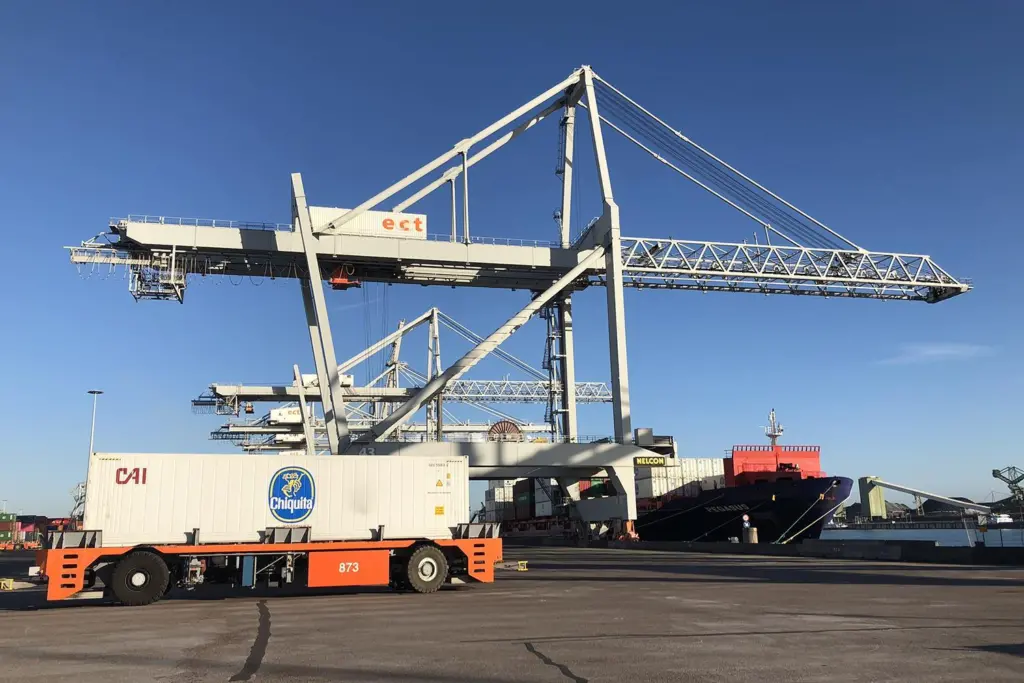
This means providing shore-to-ship power solutions to enable container terminals to supply vessels directly from the port grid, reducing emissions, noise, and fuel costs while helping terminals comply with international standards and regulations. The company has just secured contracts with Rotterdam Shore Power (RSP), a joint venture of Port of Rotterdam and Eneco, to engineer and construct shore power systems comprising multiple installations for the Port of Rotterdam.
ABB is responsible for the design, delivery, installation, commissioning and on-site testing of the shore power systems, plus provision of its supervisory control and data acquisition (SCADA) system, which will monitor and control the system and track energy usage for accurate customer billing.
These custom-designed solutions will deliver power for three container terminals at the port through 35 connection points across APM Terminals Maasvlakte II (APMT) facility and Hutchison Ports ECT Delta and Hutchison Ports ECT Euromax terminals. As a result, ABB’s shore power systems will be able to charge up to 32 container ships simultaneously during loading and unloading operations, with operations scheduled in the second half of 2028.
“Port of Rotterdam can save 2500 tons NOx by applying on-shore power across terminals,” says de Jager.
Siemens, by comparison, states it has a “focused approach” in which digitalisation, automation, energy transition, and infrastructure, cater to the increasing demand for electrification solutions, including shoreside power, via integrated solutions. Its SIHARBOR product offers a power supply solution for eco-friendly ports that allows ships to draw reliable, clean power from the onshore grid when berthed. Here, Totally Integrated Power (TIP) comprises comprehensive power supply portfolio of software and hardware products, holistic systems for all voltage levels, as well as energy management solutions, while the converter system SIPLINK is adapted for network applications. It can connect two or more medium-voltage AC networks with different volt ages, phase angles and frequencies.
The SIHARBOR system enables parallel operation, allowing two vessels to be supplied with shore power at the same time. The port of Kiel is taking advantage of this process by making the supply of onshore power to two vessels in parallel available.
“We calculate this system will save a total of 12,000 metric tons of CO₂ per year. With this project we’ll ultimately be able to provide onshore power to 50-60% of the ships that put into harbour here,” states Dr. Dirk Claus, Managing Director, Port of Kiel
NO TIME TO WASTE
Andy Tam, Global Vice President Energy Management, DP World, stated at TOC Europe 2025 that the shore power lead time range including installation is two-to-four years. With 2030 just four years away, there really is no time to waste.
Muhammad Usman Ashraf at ABB agrees: “There is a real push to the 2030 target, but I do not think it is likely that all ports will reach it. Projects take time, so ports need to already be on the pre-work now, not just studying the process.”
Related Articles
 TERMINAL OPERATIONS
 DIGITAL
 DIGITAL