





SMART BUOYS
The role of buoys is being extended beyond safe navigation, even the provision of off shore power to vessels is within reach. A J Keyes reports
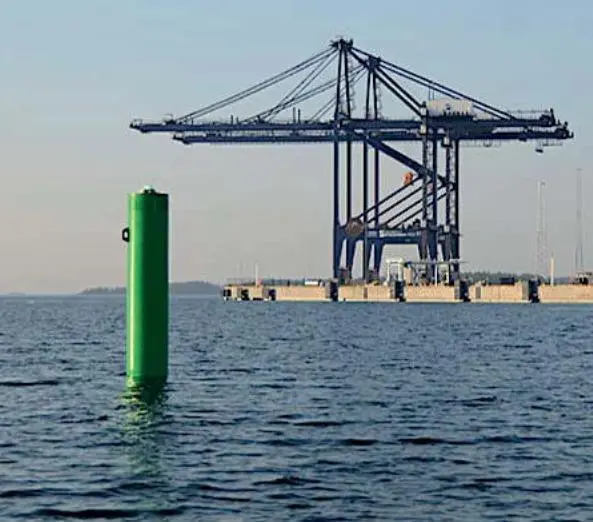
According to maritime technological solutions provider, Arctia, smart buoys are more than just a maritime safety device and furthermore this type of equipment is now attracting the interest of the world’s biggest container shipping line too.
So, what exactly are smart buoys and why are they so important to the shipping industry?
Arctia explains that the significance of smart buoys is to improve navigational safety in waterways. For example, pilots and vessel tracking systems (VTS) can adjust the light output of beacons, as well as the rhythm of lights to support the traffic of goods, but crucially “the light output can be adjusted in real time centrally by the VTS centre and, if necessary, even with a tablet used by the pilot.”
In addition, the ability to utilise remote-controlled signs means information can be made available about key areas of interest such as functionality of the light, the condition of the power supply and the actual location of the sign.
Consequently, Arctia states that the navigability of the fairway is improved, along with an increase in maritime safety. The other crucial component in the modern shipping world is also addressed – modern technology now in use reduces the carbon footprint, while location inspections of signs can be successfully undertaken more efficiently.
This is an output that is also endorsed by the UK Government’s Centre for Environment Fisheries and Aquaculture Science (CEFAS), which explains the benefits of collecting marine environmental data.
A spokesperson points out there are different areas in which the information can be used. These include how evidence can be used for eutrophication assessments (i.e. richness of nutrients in a lake or other body of water, frequently due to run-off from the land, which causes a dense growth of plant life), improved understanding of environmental variability, new insights into ecosystem function, monitoring change in marine biodiversity, improved model validation and testing and confirming satellite imagery of the sea (“ground truthing”).
SCANDINAVIA LEADS
In terms of the new technology being developed, Arctia offers a good synopsis: “The main idea behind our smart buoy concept has been to utilise the current maritime buoy infrastructure so that there could be measuring devices owned by several different parties inside the buoy, the data produced can be filtered and distributed to several different user bodies if necessary,” the company explains.
There are also virtual AIS (Automatic Identification System) buoys available too. These are different from traditional buoys as the equipment itself does not exist physically in the water and is only visible on the ships’ navigation equipment.
As proof of the level of demand that is known to exist for smart buoys and specialist maritime equipment, Arctia has previously installed 34 smart buoys in in the Saimaa deep fairway, which is the busiest waterway in Finland, to support an EU-led initiative to improve navigational safety (in the Baltic region).
Finland is not the only location in Scandinavia taking advantage of smart buoys, with shipping routes in Kattegat and Skagerrak, Denmark, recently seeing the implementation of this equipment to finally oversee a long-standing issue of safe access through previously mined routes from World War II. Now the routes are using smart buoys to guide and separate shipping traffic.
In late 2021, tests commenced for new solar-powered smart buoys in the Stockholm fairway as part of the Intelligent Sea EU project, project, intended to utilise navigational systems offering improved service efficiency and maintenance characteristics.
Arctica is running the project together with the Ports of Stockholm and the Port of Naantalia and has developed new smart buoys, equipped with solar cells for charging the buoys’ batteries with this, following installation of similar items of equipment at Stockholm Norvik Port.
Fredrik Lindstål, Chair of the Board at Ports of Stockholm notes: “We hope that the solar cells, in combination with the fact that the buoy is remotely controlled, using 4G, will make service and maintenance more efficient….a cold, hard winter tests the buoy in severe weather conditions.”
This smart buoy is certainly unique because the solar cells are integrated into the buoy and the batteries are specially constructed to be resilient to icy winters. The rechargeable batteries are highly sustainable, with an operational lifetime of between 7-10 years, in comparison to the current normal one-year lifetime. The buoy design is also configured for remote monitoring of its batteries, solar panel, light signal and position.
The EU Intelligent Sea Project runs from 2018 until 2022. The project is funded by an EU grant from the Connecting Europe Facility (CEF) programme.
“QUIET POWER” FROM MAERSK
Shipping giant, AP Moller Maersk is launching a new company that will install offshore vessel charging stations, to extend the benefits of shore power to sea and support the use of batteries and electric power on ships.
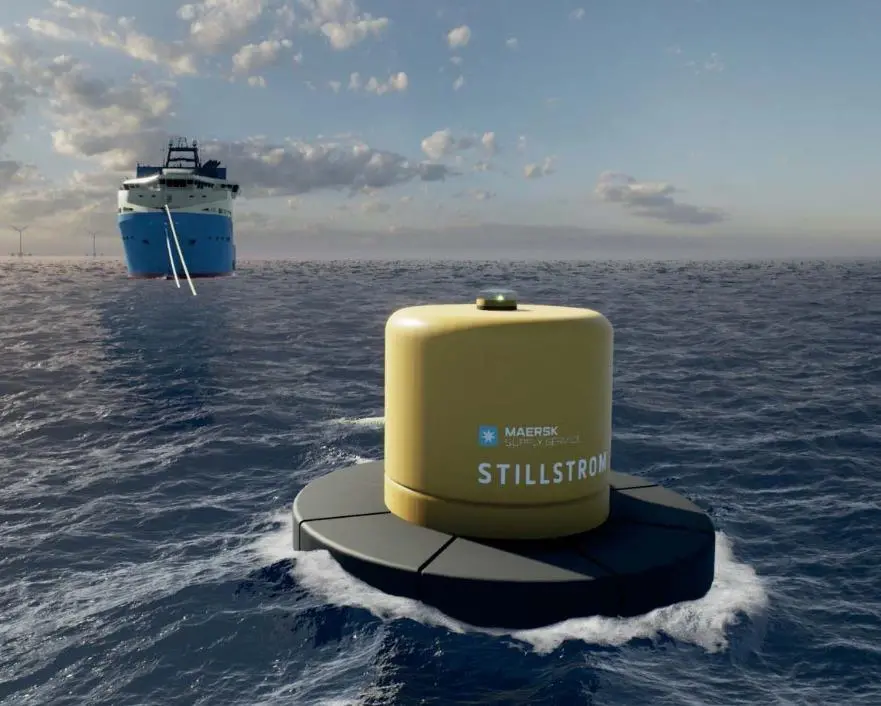
As part of the Danish company’s Maersk Supply Services brand, new “platforms” that look like, and act like, an ordinary ocean buoy are due for demonstration later this year for use with vessels calling at an offshore wind farm operated by Ørsted.
The new company is called “Stillstrom”, meaning “quiet power” in Danish – it is an early-stage technology spin-out. The company claims it is the first-to-market in offshore charging, enabling idle vessels to power from clean electricity.
Sebastian Klasterer, Manager, Stillstrom, said the goal is to install between three and 10 buoys at up to 100 ports by 2028. Ørsted plans to start the testing and demonstration of the buoy in the third quarter of this year. According to the companies involved, the new technology will be able to supply overnight power to one of Ørsted’s Service Operations Vessels (SOV).
Testing of the power buoy is expected to last for six to nine months, with the company confirming that the first full-scale charging buoy will be demonstrated in Q3 2022, to support Ørsted’s target of climate-neutral operations by 2025.
It is clear that the new smart buoy under development from Maersk Supply Services is being targeted to offer more than just a navigational aid to ships.
Indeed, Stillstrom is confident that the same approach can be scaled-up and adapted to supply power to larger vessels, enabling ships of all sizes to turn off their engines when lying idle. “Offshore charging for idle vessels is critical to facilitating the decarbonisation of the maritime industry since it allows vessel owners to replace fossil fuels with electricity while being safely moored to the charging buoy,” the company states.
There is also a clear vision to enable vessels lying at anchor outside ports to be able to switch to these buoys so that the use is the same as shore power while in ports.
Steen S. Karstensen, CEO of Maersk Supply Services, explains how the development of the new smart buoys represents an important step in achieving fundamental goals. “Stillstrom is part of our commitment to solving the energy challenges of tomorrow. By investing in this ocean cleantech space at an early stage, we can help lead the green transition of the maritime industry. Stillstrom has been developed within Maersk Supply Services and the timing is right to create a venture that will be focused on delivering offshore charging solutions.”
MORE THAN JUST NAVIGATION
The new smart buoys and the technology being progressively incorporated show that this equipment is able to offer more than simple navigational assistance to shipping and ports. The base functions and optimising the efficiency of these remain important but the effective expansion of the role of buoys and the value-added services resulting open the doors to a greater contribution to maritime efficiency. As the Stillstrom project highlights, a smart buoy could soon be doing much more to support shipping – and doing so while making a positive contribution to meeting to energy challenges and other environmental considerations.
Related Articles
 OPERATIONS
 OPERATIONS
 OPERATIONS