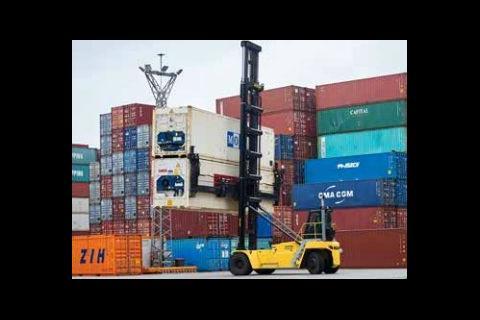
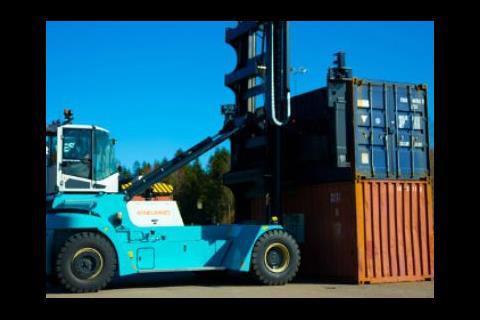
Backed by strong demand, design innovation with empty container handling FLT product lines continues apace. John Bensalhia investigates.
There has been consistent demand for empty container handling Fork Lift Trucks (FLTs) from the ports sector in 2020, with strong interest being driven by current operating circumstances as Richard Root, EMEA Big Truck Director, Hyster, explains.
“Demand for container movements remains strong and many of our customers are seeing an increase in container volumes. However, in some regions, more containers are imported than exported, causing an imbalance and an excess of empty containers. This is driving the usage of empty container yards, where these containers can be stored, inspected or repaired. This is especially true for reefer containers, which require cleaning and thorough inspection before they can be re-used.”
Root further notes that intertwined with this positive demand trend is a need for improved handling efficiency which, in many cases, is supported through double container handling with a Hyster Empty Container Handler.
Konecranes also notes the continuing requirement for empty container handling FLTs. “We have seen this trend before when the actual market is below average,” explain Patrik Lundbäck, Director and Head of Sales & Distribution, and Håkan Andersson, Product manager, Konecranes Lift Trucks. “This means lower volumes of laden containers. Also, the demand for reefer containers has been kept on a good level.”
INNOVATION FOR ENHANCED EFFICIENCY
In search of greater efficiency, a notable concept offered by Konecranes is Smart Lift, an automatic height positioning system for empty container handlers. Andersson says that this innovation means improving efficiency and reducing driver stress. The first Konecranes Lift Truck to use Smart Lift was 2019’s SMV ECC 6/7 110 DS, an Empty Container Handler with a double stack capacity of up to 11 tons.
The Smart Lift is also a feature of the Empty Container Handler model SMV 6/7 ECC 100DS, using lasers to automatically select lifting height based on container size and stack position. The SMV 6/7 ECC 100DS has also seen the addition of a triplex mast and free-lift option, which enables customers to use the same lift truck to move containers both inside and outside a storage building. The free-lift facility means that container handling can be managed indoors, keeping the total mast height under set limits.
To make work easy and comfortable for operators, Hyster Empty Container Handlers feature a new ‘cockpit style’ cabin, which places all truck information and controls at the driver’s fingertips. “With more glass integral to its design the new premium cab also provides excellent visibility during driving, reversing and manoeuvring,” says Root.
He elaborates: “The dedicated cabin has more floor space and a re-designed joystick control. To help operations keep control of costs, the cabin also includes a performance counter which reports usage data such as the number of containers moved, fuel used per container and distance covered per container.”
Further facets of the new cabin style include low in-cab noise levels, which help drivers to keep concentration during long shifts, plus heating and ventilation options to suit summer or winter conditions.
Root adds that the new cab features a user-friendly seven-inch touch screen display as standard, but there is also the option of a second seven-inch display that can be used to clearly inform the operator about the status of the container engagement.
“The optional second display can provide a clear visual indication on whether the containers are positively locked or not, as well as any limitations the operator should be aware of. This may help the driver to pick more efficiently and reduce “mispicks”, especially when double handling.”
Furthermore, to increase visibility for specific applications, Hyster offers Empty Container Handlers with technical innovations, such as camera systems and active obstacle detection systems. Spreader mounted cameras for container handling operations are also available.
ECO-FRIENDLY
An advantage claimed for Empty Container Handling FLTs is that they are environmentally friendly. “Empty Container Handlers have a dedicated design for the required lifting capacity,” explain Lundbäck and Andersson, noting that: “This is more fuel efficient than using the same lifter for full and empty containers.”
Three features are highlighted by Konecranes as geared towards eco-friendly operations that reduce CO2 emissions: fuel consumption and costs – Power Drive is said to reduce these by up to 15 per cent, Flow Drive (featuring hydromechanical-variable transmission) by up to 25 per cent and Hybrid Drive by around 40 per cent.
“Technology never stops advancing,” says Lundbäck. “New products and upgrades improve the safety, productivity and cost- effectiveness of our equipment. Our aim with this new technology is to give every one of our customers exactly what they need for their own particular set of circumstances – in other words, for their own worlds.”
Root says that compared to a Reachstacker handling empty containers, a dedicated Empty Container Handler has significantly less fuel consumption, and therefore, less CO2 emissions.
“The Hyster H9- H11XM-ECD9 Empty Container Handler series is also capable of double handling, even reefer containers,” he states, adding: “As two containers can be moved at once, this also results in less CO2 output per container moved. With double handling, fewer trucks are needed to get the job done which also offers positive environmental benefits. Hyster can also assist customers with a yard optimisation service. This looks at how to optimise double handling operations and achieve better throughput, which in turn helps reduce truck queueing and idle times and the associated emissions.”
For emissions-regulated markets, Stage V engines are available for Hyster Empty Container Handlers. The Stage V Hyster trucks also incorporate smart monitoring and service to optimise uptime in demanding applications. “The new truck engines will use a combination of a Selective Catalytic Reduction (SCR) and DEF like AdBlue and a Diesel Particle Filter (DPF),” says Root. “The engines are equipped with a cooled EGR, which minimises the creation of NOx, resulting in less DEF usage.”
Root adds that projects are also underway concerning the development of zero-emissions – Hyster ReachStackers and Laden Container Handlers – either fully electric, powered by a battery or by hydrogen fuel cell. “It is possible that there will be demand for similar projects for zero-emission Empty Container Handlers in the future,” he says.
SAFETY FIRST
Empty container handling FLT design innovations also feature a strong focus on safety. Kalmar’s Empty Container Handlers include a number of elements that boost safety.
The Drive Speed Limiter System can help reduce potential risks and accidents during work, while the camera-based Reverse Warning System warns the operator of any obstacles in the way when reversing the vehicle.
Nine of the Kalmar Empty Container Handlers (as well as a Kalmar Gloria Reachstacker) were recently confirmed for Rotterdam-based empty container storage, repair and service operator, DR Depots, with delivery expected sometime in the final quarter of 2020.
Also due in the fourth quarter of 2020 is a delivery of five Empty Container Handlers (plus 10 Eco Reachstackers and one medium Forklift) for Australian-based ACFS Port Logistics Pty Limited.
Built on Kalmar’s G-Generation platform, the Empty Container Handlers are designed to both provide easier maintenance and a comfortable, ergonomic working environment for operators. The machines have been purchased for an intermodal rail facility, an empty-container park and a distribution depot in Melbourne, Sydney and Brisbane, respectively.
POWER PACKED
The power of Empty Container Handlers is another reason said to underpin their popularity. Hyster’s H8- H11XM-ECD9 Empty Container Handlers, for example, include a tough mast to accommodate heavier weights and offset loading, achieving power and speed in every lift.
“The high strength truck can handle net loads of up to 11 tonnes,” says Root. “For optimal performance and durability, the variable lap mast features a heavy-duty chain system. This design enhances structural strength and significantly improves chain life, contributing to lower costs and reduced downtime.”
However, it is not only strength that is important. The Hyster H8- H11XM-ECD9 Empty Container Handler also enables operators to work container stacks up to nine tiers high, optimising yard space and providing both cost and time efficiencies.
“Even where difficult weather conditions, local policy or other constraints prevent operations from stacking nine high, increasing stacks from five to six containers with a Hyster Empty Container Handler can still result in a capacity increase of up to 20 per cent,” says Root.
The Virtual World of Empty Container Handlers
Terminal operators considering investment in a new Empty Container Handler have the option of trying one out for size – in the virtual world.
CM Labs’ ECH Simulator is a training method that provides terminals with an opportunity to prepare for using this machine in a busy environment – but without adversely impacting real operations.
As well as the two-stage mast ECH, the simulator includes equipment lights, mirrors and sounds. The simulator is based on the real handler’s operating features, allowing the user to virtually pick and stack 20’, 40’ and 45’ containers up to eight-high.
It is fully aware of the real machine’s capabilities, such as its load limits, improper handling (which can cause the virtual equivalent to topple over), as well as external factors such as poor weather conditions.
The simulator allows the operator to monitor performance levels with the help of an ECH Simulator Training Pack that automatically tracks operator performance metrics, collating these into one score. It is also possible to use specific scoring criteria in accordance with each terminal’s circumstances and priorities.
Related Companies
- Previous
- Next