
Port equipment specialist ZPMC is looking to build on its global dominance, as Alex Hughes finds out
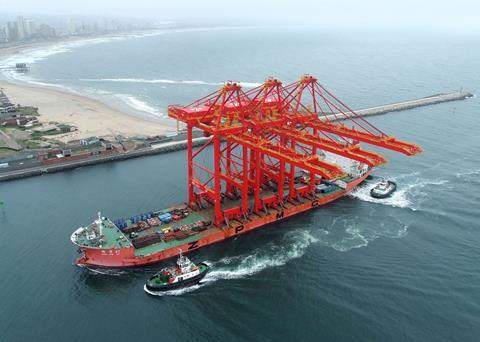
ZPMC is without doubt the world's leading manufacturer of both quayside and rubber-tyred gantry cranes, but is there room for a further increase in market share going forward?
Song HaiLiang, China Communications Construction Company vice president, ZPMC chairman secretary of the party committee, is certain there is.
He tells Port Strategy that the Shanghai-based producer has a 70% share of the market for ship-to-shore cranes and a 50% share for RTGs. These figures are expected to further increase to 73% and 55% respectively for the current year.
Last year, the company built 166 STS cranes and 266 RTGs/RMGs, which compares with 182 and 398 respectively for the previous year. However, Mr. Song predicts that 180 quayside gantry cranes will be built in 2014 and 300 yard cranes.
“The way to boost sales is, firstly, through developing new technology and products by investing in research & development. Our specialist team works alongside a renowned university in China to do this,” he says in an exclusive interview with PS.
“Secondly, we have to continue providing good service to existing customers so that they remain satisfied. And, thirdly, we are also exploring new markets, focusing on sales to Africa and Latin America.”
Overseas arms
In respect of the second point, he notes that subsidiaries have been set up in the Netherlands, Germany, the Mediterranean, Sri Lanka and Singapore, among others, while ZPMC is also planning to set up eight regional overseas centres and 36 network stations over the next three years. With the support of the Shanghai headquarter, these subsidiaries will start exploring business in new products delivery, after-sales services, product modification, spare parts, ZPMC’s own electrical system, ZPMC shipping, and ZPMC on-shore products and off-shore products. Meanwhile, these subsidiaries will further improve the value-added service and spare parts business ability in a more systematic, professional way worldwide.
But the expectations on these subsidiaries do not stop there, says Mr Song. “We shouldn’t count on these overseas offices for after-sales only; more responsibilities should be granted to these offices, such as in committed after-sales service, marketing and sales, localisations and value-add.” In a more detailed explanation, he explains that these offices should be responsible for equipment hand-over, after-sales service, spare parts services, equipment updates and improvement, logistics and supply chain, sales and marketing, turn-key projects and even investment and financing.
Despite its dominance in the port sector, Mr Song stresses that ZPMC does not simply produce cranes for the ports sector; as part of a diversification strategy it is also moving into areas such as offshore platforms, providing equipment for specialist vessels and into sectors that require certain types of steel structures.
Large and small
Asked about the company's philosophy regarding the sort of clients that it seeks in the ports market, Mr Song notes that ZPMC has the ability to customise product to meet most requirements.
“We not only have a good relationship with lots of big groups of terminal operators, but also with other, independent clients. In fact, we are interested in doing business with all potential clients,” he says.
Production of all ZPMC cranes takes place in China, where workers' salaries, concedes Mr Song, are on the increase. As a result, the company has investigated ways of improving the efficiency of the manufacturing process, including the possible introduction of more automated equipment.
“We have also set up network stations to make more use of local resources to reduce service costs. By doing that, we calculate that we have achieved at least a 30% reduction in this area,” he says.
Research respect
Despite its market dominance, ZPMC really does appreciate the need to continue investing in research & development, says Mr Song.
“Investment in this area is ongoing, with important collaborations taking place not only with a top ranked Chinese university, but also with other international companies, since, as a global player, we understand that the world is changing. We are a mass producer of cranes, so we have to improve our products and also consider what it is that terminals will want from us in the future.”
Another interesting development within ZPMC is its decision to produce its own drives, reducers, spreaders and elevators, all of which are now widely used around the world. Mr Song calculates that around 75% of the cranes that it now builds incorporate these Chinese-built components, especially those bound for terminals in Europe.
“In terms of functionality, they are exactly the same as components from specialist providers. In fact, in some cases, I would say ZPMC components are even better. However, ours are cheaper, which is what makes them popular. As the advantages of using ZPMC parts become more widely appreciated, we expect to see even more all-ZPMC cranes being stipulated by the market,” says Mr Song.
Such a large order book and expectations of continued growth in demand do not, however, mean that ZPMC is unable to quickly react to market changes. Average lead time for cranes is 12 months, claims Mr Song, although cranes can be out-shipped in six months, if necessary.
“We market our products globally and pride ourselves on being able to deliver these ourselves. To do so, the company has acquired no fewer than 22 transport vehicles.”
Top three
In 2013, Konecranes was the third leading supplier of RTGs, second in terms of RMGs and fourth for ship-to-shore cranes. “The market outlook for 2014 is following very closely the general economic landscape,” says Tuomas Saastamoinen, sales & marketing director for port cranes.
Konecranes maintains manufacturing bases in both Europe and Asia. However, Mr Saastamoinen stresses that it isn't where the crane is built that is important; rather the main parameters are the cost of the entire logistics chain and the delivery time. Konecranes' China facilities build cranes for Asia-Pacific.
Although Mr Saastamoinen insists that the company is globally competitive, he notes that certain customers seem to focus more on the initial purchase costs, while others want more reliability and support. “Our goal is to grow further and continue to be successful in the segment, which appreciates productivity, uptime and safety,” he says.
Given that salaries and other manufacturing costs are increasing rapidly in China, global operating companies, he says, are constantly monitoring the total cost of delivery and considering alternative manufacturing regions. “I don't believe Chinese companies could transfer their manufacturing operations to other countries, at least in the short term. In general, this is because, currently, they lack the necessary skills for international operations. There is also strong political pressure to keep domestic factories running and people employed,” he says.
Diverse base
Konecranes' container handling business is managed from Finland, but multinational teams undertake all its activities, including R&D. Members of those teams can come from such diverse locations at the US and China, says Mr Saastamoinen, pointing out that “with today's IT tools, the geographical location doesn't count much where knowledge is concerned".
So, could there ever be a 100% Chinese built and designed Konecranes' ship-to-shore crane? Maybe, but it would depend on obtaining a thorough validation process, quality assurance of the localised parts and components, and an attractive end cost (taking into account logistics), he says.
“At present, we are not doing all of the above 100% in China, but this applies to any other country, too.”