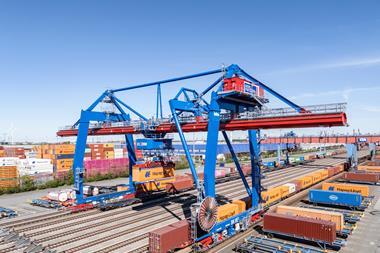
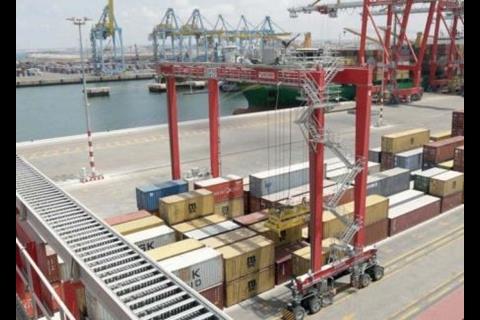
John Bensalhia assesses the rubber tyred gantry sector identifying positive demand and ongoing design innovation including for what can be dubbed “conventional units”.
Leading manufacturers are reporting consistent demand for rubber tyred gantries (RTGs). “There has been good demand in North America, Southern Europe and West Africa,” says Svend Videbaek, Marketing Specialist, Konecranes.
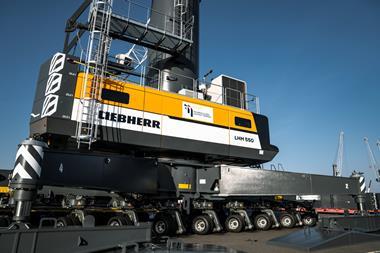
Liebherr is also seeing strong interest in its RTGs and has taken orders for over 70 machines in the past three years reports Trevor O’Donoghue, Marketing Manager, Liebherr Container Cranes Ltd: “The majority of these orders have been for conventional machines. They are a mixture of diesel, electric, and hybrid powered machines, with both cable reel and busbar power. The machines are for both green and brownfield sites and demand is from across the globe.”
This year, Liebherr has supplied 20 variable speed diesel RTGs to King Abdullah Port in Saudi Arabia. “These latest RTGs bring the number of Liebherr RTGs at the port to 68 units. King Abdullah Port is one of the world’s fastest growing ports and a fleet of modern, productive and reliable RTGs is a key component in driving the port’s productivity and growth,” O’Donoghue states
“MARKET IS THERE,” IRRESPECTIVE OF COVID-19
Marko Rasinen, Product Manager, RTGs, Kalmar, says that the market for conventional RTGs is there – despite the COVID-19 pandemic. “Of course activity is being affected by the COVID-19, but the market is still there. The share of new technologies, such as hybrid RTGs and automated RTGs is increasing, but there is demand for conventional manual units as well,” he explains.
Rasinen says that Kalmar has seen good activity in the port sector – especially in North America, Europe and Africa. By comparison, activity is low in South East Asia. He further notes that Kalmar has recently concluded an agreement to supply Marsa Maroc with a total of three RTGs for use at its TC3 container terminal, in Casablanca, Morocco. “The order, which,” he explains, “includes an option for an additional two cranes, was booked in Cargotec’s Q3 order intake. Delivery is scheduled for Q2 2021. The three new Kalmar RTGs will join 11 other units delivered to Marsa Maroc in 2016 and 2018.”
Four Kalmar SmartPower RTGs have also been selected as part of a capacity expansion in Cambodia at the Phnom Penh Autonomous Port (PPAP) LM17 Container Terminal. The order, booked in Cargotec’s Q3 2020 order intake, is scheduled for Q3 2021. “The four new Kalmar RTGs to be delivered at LM17 are part of the terminal’s infrastructure expansion programme, which aims to support the company’s growth plans helping them double terminal capacity,” says Rasinen.
Due for delivery in Q1 2021 are six RTG cranes for Dar es Salaam port in Tanzania. “The Kalmar RTG combines the best of diesel and electric technology for fuel savings, low emissions and easy maintenance,” claims Rasinen.
CONTINUOUS IMPROVEMENT
Conventional RTGs are the subject of ongoing design enhancements spanning diverse aspects from safety to environmental efficiency. O’Donoghue, cites a number of design aspects as evidence of this commencing with the eightrope reeving arrangement all Liebherr RTGs now employ.
“This effectively eliminates sway, provides load stability, faster positioning, exceptional productivity, responsiveness and safety,” states O’Donoghue. “Simultaneous drive motion and productivity aids,” he elaborates, “further boost productivity and safety on conventional machines."
He says: "With the compact arrangement of eight rope reeving, it allows the driver’s cabin to be in the optimum position relative to the load. Strength and stability are inherent in the Liebherr portal design and the cabin design and location ensures maximum operator visibility. A series of cameras, sensors and monitors increase safety in the operational area."
O’Donoghue identifies auto-steering, guided via RTG ground transponders together with anti-collision features and a truck anti-lift system, as key productivity and safety features included in a recent order of 10 wide RTGs for the port of Montevideo, Uruguay.
He continues: “Mains powered RTGs offer an Active Front End (AFE) allowing regeneration of power and eliminating emissions while reducing noise. Busbar configurations are also available and were supplied on a recent order of 10 RTGs for Montreal. Embedded fibre optics and Liebherr’s open architecture ensure efficient communications and future proof the RTGs,” he underlines.
For driver safety and visibility, the introduction of remote control and/or automation to port operations is a popular choice, as Rasinen highlights: “They improve safety by moving the crane operators away from the yard into the office environment. With conventional designs: “Visibility improvements are being introduced on manually controlled cranes by adding more and more cameras to improve driver’s visibility into places where visibility is normally very limited,” he states.
Videbaek highlights how smart features are becoming standard in all Konecranes’ RTG deliveries including autosteering, Truck Lift Prevention and Gantry Collision Prevention. Also, he states more customers want the Stack Profiling smart feature. And adds: “Our remote operation capability with RTGs is an important step towards full automation, and interest in it is growing. More and more customers are considering manual RTGs with a cabin and Remote Operating Station as a first step towards automated RTG operation.”
ECO-EFFICIENCY EMPHASIS
Videbaek notes that another interesting development is that around 50 per cent of RTG deliveries from Konecranes are now either fully electric RTGs (busbar, cable reel) or hybrid RTGs. “This is an excellent development in the area of ecoefficiency, and it shows that our Ecolifting philosophy is becoming accepted,” he says.
The environmental side of RTG development is seen in three ways according to Rasinen: “First, in the field of electric-powered RTGs becoming more and more popular, second, hybrid technologies becoming popular, and third, diesel engines becoming greener due to the increasing emission classes."
He elaborates: "For example, in Europe, at the moment, Stage 5 engines are used on RTGs and the emissions of these engines are lower compared with the engines in use a few years ago.”
And he makes the general point: “Before we start thinking about which RTG driveline is the optimal choice in terms of eco-efficient operations, there are several other design details that can help to achieve big gains in fuel efficiency. Kalmar RTG design principles,” he explains, “favour reliable, simple designs with less components. This – together with carefully chosen and tested components – ensure the long lifespan of the crane and its parts contributing to less material usage."
SMART SOLUTIONS
Kalmar has a selection of process automation solutions that reportedly facilitate more efficient container movement with reduced negative environmental impact. “Solutions of the SmartPort product family track containers and container handling equipment all the way from gate to the quay," states Rasinen. "Productivity, equipment utilisation rate and eco-efficiency are increased by optimising travel paths and waiting times by triggering dispatching and job instructions based on the location of container handling equipment.”
On energy efficiency, he says: “The relatively low energy efficiency of conventional RTGs often results from the need for the diesel engine to be running even when the requirement for power is very low. For example, in an RTG operation there are moments when the actual power consumption is only about 10kW, but the large diesel engine (on conventional RTGs the engine output is typically around 400kW or so) has to be running, as there is no energy storage from where the power could be taken.”
Rasinen explains that a smart hybrid RTG in this operational scenario is very different. “All the power needed for the RTG operation comes from the lithium-ion batteries. The diesel engine is running only when the batteries need to be charged. And once charging, all the power that the engine produces is converted into electricity and supplied into the batteries. So the categorical “engine idling” which is the number one reason for inefficiency on conventional RTGs can be eliminated completely, when choosing the smart hybrid technology.”
Related Companies
- Previous
- Next