
Container volumes are rising and the Port of Dar es Salaam is investing, reports Felicity Landon
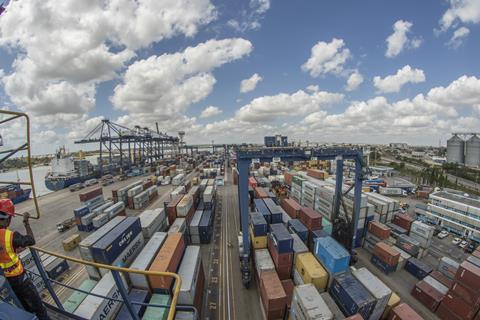
Records were broken again last year at Hutchison Ports’ Tanzania International Container Terminal Services (TICTS). The terminal in Dar es Salaam handled 592,000 teu, an increase of 18% on 2017.
The higher throughput can be attributed to operational improvements which increased efficiency at the port, infrastructure developments in Tanzania, and a rise in exports of copper and agricultural products, said a spokesman for TICTS.
Overall, the Port of Dar es Salaam handles up to 90% of Tanzania’s trade; it is considered the gateway not only to Tanzania, but also to eastern, central and southern Africa, serving the landlocked countries of Zambia, the DRC, Malawi, Rwanda, Burundi and Uganda.
A major advantage for TICTS is being the only specialised container terminal operator in Tanzania, said the spokesman.
Last year also featured a monthly record for TICTS — August’s throughput was 54,447 teu. Announcing this, chief executive Jared Zerbe said: “Landlocked countries have been driving growth for TICTS as a result of significant increases in global commodity prices and the Tanzanian government’s removal of VAT on ancillary services for transit cargo.”
The terminal’s modern equipment and standards of excellence helped it to handle the volume increase, said Mr Zerbe. However, he warned that space constraints represented an acute challenge. Transit containers could not be transferred outside the port for storage prior to clearance, and this was leading to very high or maximum yard density at peak times.
TICTS was working with the government to locate alternative storage areas for transit containers. It had been appealing to the government to allow some transit cargo to be sent outside the port to inland container depots, to find more space within the port, to allow TICTS to buy or rent more space nearby or to adjust downward the grace period for transit countries to expedite cargo clearance, said Mr Zerbe.
Space allocations
There have been some developments since then, said the spokesman. Tanzania Port Authority (TPA) has provided additional space within the port and at its inland container depot at Ubungo, where TICTS transfers overstayed cargo. TPA is also developing a dry port at Ruvu, which is aiming to provide additional storage for transit cargo.
And major port infrastructure upgrades are under way. The Dar es Salaam Maritime Gateway Project, funded by a World Bank loan of $345m, will enable the port to handle post-Panamax-plus vessels and is designed to double overall throughput capacity, reduce vessel waiting time and increase operational productivity.
The first phase includes deepening and widening the entrance channel and turning basin to 15.5 metres, strengthening Berths 1 to 7 and deepening them to 14.5 metres, and building a new ro-ro/multipurpose berth at Gerezani Creek.
There are also plans to improve the rail links and facilities at the port, and then strengthen and deepen Berths 8 to 11.
A World Bank report says: “Since approximately 90% of Tanzania’s international transactions transit through the Port of Dar es Salaam, and 35% of the total throughput of the port is intended for the landlocked countries of the interior, improving the efficiency of the maritime gateway is a key element in the regional transport network.”
The development work at the port has started with the ro-ro berth at Gerezani Creek and Berth no. 1, said the TICTS spokesman.
There are no particularly notable investments to report relating to the roads to the six countries being served, he said. “All the countries are linked with tarmac or all-weather roads which are currently in good condition,” he said. “TAZARA and TRC, which provide the rail network, have not undergone major changes, with the exception of the TRC project on SGR which will link with the local networks in its first phase.”
TICTS set up an office in Rwanda, and the activities there are now being jointly coordinated with TPA, which has also opened an office in Kigali. TICTS also co-ordinates with the port authority’s regional offices in Zambia, DRC, Burundi and Uganda.
TPA is also investing at the Port of Mtwara in the far south of the country, where a new general cargo berth is being built. The 300-metre quay, with 13 metres water depth, will increase the port’s capacity by the end of 2020, says TPA.