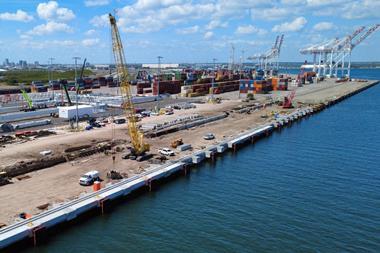

Striking dockers and cargo diverted to other ports. It has been a tough July and August for the Port of Montreal. But with returning workers, AJ Keyes asks if any lasting damage has been done.
One individual close to the Montreal Port Authority, who wished not to be named, said that recent events at the port were “a complete mess.” With a striking workforce and cargo diverted to competing ports, he may indeed have a valid point.
A dispute between terminal operators and the Local 375 of the Canadian Union of Public Employees (CUPE) erupted in July. There has been no contract in force since the end of December 2018, when the previous collective bargaining agreement expired, and a deal could not be reached.
Initial stoppages for four days occurred in late July 2019, which impacted import and export container handling. These were followed by further action between August 3rd and August 7th that closed the Termont Terminal. The situation worsened with an indefinite strike commencing from August 10th stopping all container cargo handling and mooring services being provided by longshoremen.
COLLECTIVE BARGAINING
Despite the obvious impasse and inability to resolve it, the Federal Government in Canada has consistently refused to intervene. Instead, it simply placed the onus of resolving the matter directly on to the parties involved.
Filomena Tassi, Canada’s Minister of Labour, made the Federal Government stance very clear, stating: “Our government has faith in the collective bargaining process, as we know the best deals are made at the table.”
However, the Minister did subsequently add that Transport Minister Marc Garneau and the Ministry of Labour had “reached out” to all parties involved, stressing that there was a Federal Government “expectation” to focus all efforts on finding an agreement.
The pressure must have worked because on August 24th, the striking workers agreed a seven-month truce with employers while a new collective bargaining agreement is negotiated, hopefully by March 2021.
While negotiations are ongoing, there will be no lockouts or strikes. Montreal Port Authority estimates indicate that at the time of workers agreeing to return to work, 15 container ships had been re-routed, meaning around 90,000TEU was either diverted or idling, including 18,000TEU still on the ground.
Media sources additionally confirmed that the HapagLloyd/OOCL/Mediterranean Shipping Co vessel, the 4,872TEU MSC Leigh, deployed on GEX1/Montreal Express/AT1 service, was still due to divert from its usual Montreal call to the Ceres Terminal in Halifax.
POSITIVE IMPACT
The positive impact of the end of the strike was, however, immediately confirmed by the Montreal Port Authority. In the week after the return to work it notes that: “Seven container ships called at our terminals. Thousands of trucks and about 10 trains picked up the slack to move goods to importers in Quebec, Ontario and the U.S. Midwest.”
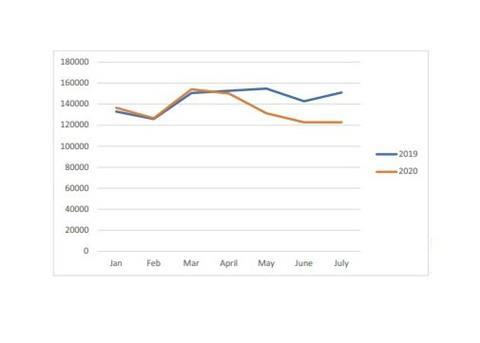
Like all ports on a global basis, Montreal is continuing to feel the impact of the COVID-19 pandemic. Figure 1 compares the January to July position for total container volumes for 2019 and 2020.
The drop in activity in April and May due to COVID-19 is easy to see. Overall, the seven-month 2020 period of 945,000 TEU compares to just over 1.01 million TEU for the comparable 2019 timeframe and confirming a drop for 2020 of 6.5 per cent.
The combination of COVID-19 and the strike action comes at a time when Montreal is still investing and planning for new capacity. In 2016, it opened the new VIAU terminal and is raising capacity to 600,000TEU per annum at this facility.
Additional long-standing plans to develop 1.15 million TEU annual capacity at a new container terminal at the site at Contrecoeur on the St. Lawrence River, where it retains 468ha of land and 4km of shoreline, is still on target according to Port Authority sources.
CLEARING THE BACKLOG
With the extensive backlog that built-up during the strike, it is estimated that it will take between two and four weeks before shippers have caught up and operations are back to normal, according to container line Hapag-Lloyd.
“It will take some weeks to clear the backlog of vessels and cargo in the terminals which were impacted because of this interruption. Both Railroads will need to re-adjust their networks to reinstate normal operations in Montreal while at the same time clear the backlogs in both Saint John and Halifax,” the shipping operator stated.
The resolution to the strike may itself have arrived just-in-time. In the short-term for Montreal’s local shippers and consumers who have had to wait longer for cargo to arrive recently.
For the Port Authority, resolution could not have been quick enough to stay on track to deliver long-term objectives particularly in connection with the Contrecoeur project.