

Rob Ward investigates the impact of the strike by truckers in Chile that ended in September 2020.
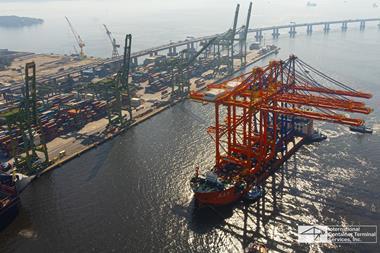
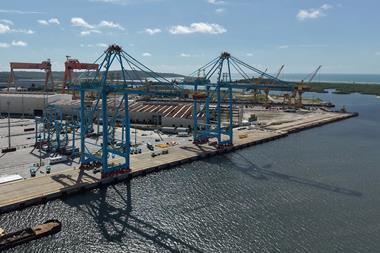
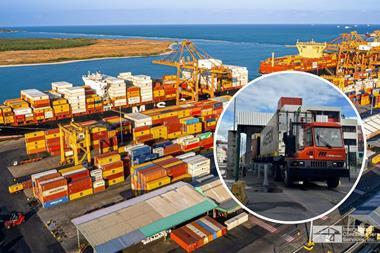
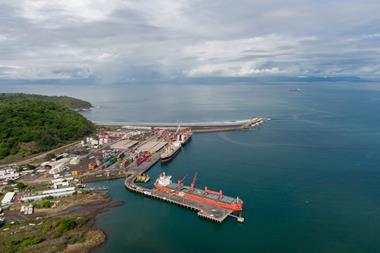
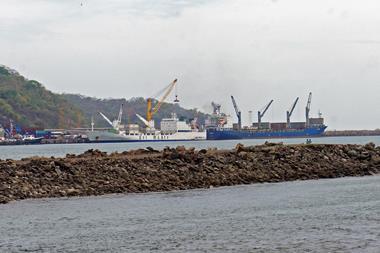
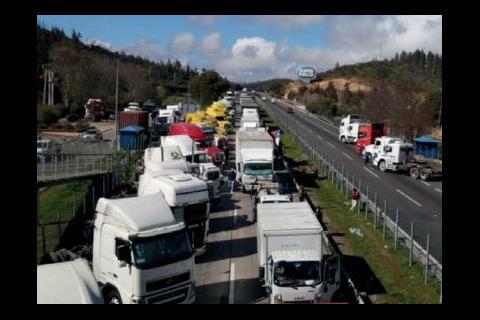
Owing to a long, drawn-out blockade by truck drivers, most of the leading ports in Chile have been finding themselves overflowing with containers and other cargoes as merchandise – apart from essential medical and food items – could neither exit nor enter terminal gates.
The Chilean blockades never quite hit the levels of the Brazilian tuckers dispute (back in May 2018), which brought that South American country to a complete standstill.
Yet in early September 2020 it was feared – right up until the government in Santiago issued a new Lei de Seguro del Estado (A Special Security Law of the State) aimed at beefing up security for truckers and doing more to punish law breakers - that the Chilean version was heading in that direction, with supermarkets running out of stock and gas stations low in fuel reserves.
FAILURE TO KEEP PROMISES MEANS MORE STRIKES
Jose Villagran, vice president of the National Confederation of Chilean Cargo Transport (CNTC), which represents the tens of thousands of truck drivers that went on strike, and was keeping the key container ports of Valparaiso and San Antonio, among others, blockaded for more than a week, said that the truckers will go on strike again if the government of President Sebastien Pinera failed to keep its promises.
“We will be very attentive that what has been agreed [with the government] is fulfilled because if it is not, we will return to the roads,” stated Villagran, who is also president of the Federation of Truck Drivers in the south of Chile (or Fedesur). Yet he was also in conciliatory mood, when he added: “We are going to go back to all the supermarkets to supply what is lacking. And we will be telling all those people that if we have done any harm, we ask for their forgiveness.”
The Chilean National Association of Fruit Exporters (Asoex) is breathing a sigh of relief for its members as several thousand container loads of perishables – namely kiwi fruit, pomegranates and citrus fruits - piled up at San Antonio and Valparaiso. Port managers in both ports assured Port Strategy that no calls were skipped but admitted a lot of cargo was rolled over.
A shooting incident, allegedly, involving sympathisers to the Mapuche Indian cause (trying to regain rights to lost ancestral lands, and more autonomy for the Region IX government in Araucania) that led to an innocent nine-yearold daughter of a truck driver being shot and going to hospital was the final incident for the Chilean truck drivers, of which there are around 200,000 in the country.
ROOTS OF DISPUTE GOES BACK DECADES
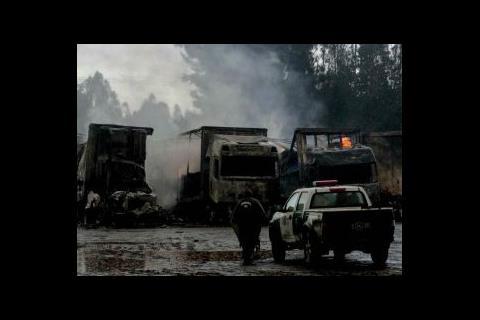
The roots of the dispute, however, go back decades, but have been exacerbated in recent years and some 500 trucks have been burnt and/or damaged in Chile since 2010 predominantly in the Araucania region.
Chile in general suffered a series of riots and social disturbances in October 2019 after bus and metro fare increases of a few Pesos, but that, again, was a step too far (of growing dissatisfaction with the ruling elites and growing inequalities, along with falling average standards of living), and it ended up with 19 dead and 2,600 injured.
In 2018 another incident in southern Chile saw 16 trucks and diggers burnt out after 10 masked attackers entered a gravel factory, threatened the caretaker and fired weapons before setting light to 12 trucks and four earthmovers. The governor of the Araucania region, Governor Luis Mayol, said at the time, “This is pure terrorism.”
Many middle-class Chileans fear that successive governments have been too lenient towards the “undemocratic and violent insurgencies” especially, but not only, in the Mapuche territories in the south. There have also been some, so far unsubstantiated, reports that narcotics gangs, displaced from Colombia, are starting to operate in these mountainous areas.
“We need some powerful actions to stop such reckless acts of violence that the truckers have suffered, and we all suffered back in October 2019,” one shipping consultant told Port Strategy. “When the police did get tough back then they were condemned by the Opposition parties and human rights organisations for being excessive,” he opined.
For decades, Chile has been a beacon of calm in often chaotic, unstable South America, but in recent years discontent has been building. “As a long, narrow country we need to keep our roads and transport arteries for geopolitical as well as logistical and economic reasons,” the shipping consultant explained.
GOVERNMENT PRESSURE TO RETURN TO WORK
Francesco Schiaffino, a Santiago based port consultant, told Port Strategy that the government applied a lot of pressure on the truckers to go back to work. “They had to apply pressure because the economy cannot move forward if the ports are blocked,” he explained. “Violence in Chile is a deep-seated problem nowadays and many people say this is the effect of major societal changes. Hopefully the new law will ease the problem.”
The blockade was finally lifted on September 2, 2020, and Simon MacKenzie, the President of Asonave (the Chilean National Ship Agents’ Association), said that it would probably take from five to seven working days to clear the backlog.
One container terminal manager in San Antonio said he thought everything would be “back to normal” by September 13 or 14, 2020. “Vessels commenced calling as per normal, but by the end of this first week they could not pick up exports because the imports were filling all the space and the trucks were not bringing in more exports. We have been over-loaded with offloaded import boxes,” MacKenzie confirmed.
The Empresa Porturaia Valparaiso (EPV, or Valparaiso port authority) said it had serious problems finding space for containers and had to add “emergency areas” to its Logistics Support extension Zone (ore Zeal) to accommodate the extra containers “with nowhere to go” during the blockade.
“The biggest problems were in the Zeal, which were blocked by trucks, preventing their passage, either to bring export cargo or to remove import cargoes,” said EPV logistics manager Juan Marcos Mancilla.
“The key port terminals are now getting cargoes moving again and the bottlenecks caused by the strike are gone,” said MacKenzie, who is also a director of Ian Taylor SA, the Santiago based shipping agency which employs more than 200 in Chile (where it represents CMA CGM in all ports) and another 300 in Peru, Ecuador, Colombia and Bolivia.
He also explained the stance of the government. “It issued a strong statement that it will push through some new laws regarding the prosecution of perpetrators of damages and attacks on truck drivers and increased penalties.”
During the blockade (which was concentrated in the south and central regions), local reports indicated that ships were diverting some of their cargoes to the north Chilean ports of Iquique and Arica for onward travel, and even as far north as Callao, in Peru, some 1540 miles from Santiago, the Chilean capital (with 5.2 million inhabitants out of Chile’s 18.75 million) and main destination for imports.
Latest figures released by Camport (The Chilean Association of Shipping and Port Agents) show that Chile handled 2326,163 TEU during the first six months of this year, a fall of 11.6 per cent compared to the first half of 2019. June was the worst month, down 22 per cent, with February (up by 3.2 per cent ) the best month. The slide was worse during the second quarter (-12.7 per cent) than in the first quarter (-9.7%), as the COVID-19 pandemic also took hold.
The key Centro region (that includes San Antonio – STI, which is owned and operated by leading Chilean stevedoring outfit SAAM as well as Porto Central, which is owned by DP World Chile - and Valparaiso, where MSC-backed Terminal Pacifico Sul (TPS) operates nearly all containers) handled 1.13million TEU during the first six months of this year, representing -14.8 per cent on H1 2019.
The Centro South region (including San Vicente Terminal International, also operated by SAAM, Puerto Lirquen - DP World - and Puerto Coronel) handled 613,255 TEU, equal to -5.1 per cent over the same period in 2019.
GRAVE COVID-19 IMPACT
After a relatively effective start in dealing with COVID-19, Chile has witnessed massive and grave increases in reported cases and deaths from the deadly virus. On May 21 confirmed cases were 49,579 and deaths were 509, but less than a month later, by June 14, cases were 175,000 and deaths rose to 3,323 (official government figures).
During the first two weeks of September Chile’s number of infections has continued to rise, with the number of deaths now standing at 12,013 (up from 11,321 at the start of September) which is high for the population.
Port authorities and terminal operators say they are still ramping up testing and cleansing practises to protect their staff and keep all facilities open.
The last thing Chile needs is the recurrence of trucking issues. For the moment, a much-welcomed peace is holding, though for how long is simply not known.