


Partnerships underpin Mayson’s Port Strategy
Dave Macintyre talks to Tauranga’s Jon Mayson about his passionate commitment to strategic cooperation and much else of value to publicly-owned ports and their prospective partners.

It would not seem immediately logical for a man who has piloted a port with probably New Zealand’s most independent spirit to say that to be successful, it is essential to partner with others. After all, the Port of Tauranga over the past 15 years has followed a progressive business strategy that has seen it evolve from a predominantly log and breakbulk port into a major container player.
While maintaining its breakbulk base with forestry product cargoes, dairy and fruit, it launched the first inland port operation of its kind in New Zealand, when it acquired the Auckland cargo distribution requirements of Australia-New Zealand Direct Line (ANZDL) in June 1999 and launched MetroPort. Utilising rail shuttles to meet specific ship calls at the marine terminal of Tauranga, MetroPort created a beachhead in south Auckland’s industrial zone about 130km away and put Tauranga into head-on competition with the established container port of Auckland.
Tauranga during that time has also dropped the traditional landlord-only port model to pursue direct involvement in, and joint venture participations with, stevedoring and marshalling. It has also pioneered joint venture operations in two other ports in New Zealand – Northland and Marlborough.
It would seem a very individualistic strategic approach, but retiring chief executive Jon Mayson espouses the viewpoint that “doing your own thing” is not an option for any port, in New Zealand at least. His viewpoint is that business partnerships are becoming ever more essential in New Zealand transportation.
“There are very few businesses and certainly none that I know of among the New Zealand ports, that can succeed by going it alone. For deregulated port companies like the Port of Tauranga, there must a strategy to generate new investment and seek opportunities and synergies nationally and internationally.
“Cooperation with other ports and other transport operators is necessary and is not necessarily anti-competitive. With other ports for example, there is no reason not to work cooperatively in those discreet areas where we do not compete. Infrastructural investment is an extremely long-run business. It requires a degree of risk management and minimum certainty that we cannot achieve on our own, ” he says.
Mayson’s viewpoints on strategic cooperation put him on something of a collision course with the NZ Commerce Commission, which has tended to enforce a strict dogma against the concepts of port rationalisation, fearing takeovers or mergers would reduce competition.
Mayson’s response: “It’s not a question of how many ports there are, it’s whether or not each port can justify its existence. Are the owners achieving the value they seek through cargo volumes relevant to their hinterland – cargo that would not be better off going through other ports?”
The sticking point, he says, is that the Commerce Commission views ports rationalising resources between themselves with a jaundiced eye: “To them, it looks uncomfortably like collusion.”
Mayson says that until there is full and complete private ownership of ports, the restrictions imposed by public ownership on truly commercial operations must be balanced by some leeway in the Commerce Commission’s expectations. “A fully competitive environment will take care of duplication in a more rapid – and possibly more ruthless – rationalisation. Until that time, it is important that capital resources are not wasted in duplicating facilities that can expect a short lifespan. And that means a realistic understanding from the Commission of the wider context.
“It is in the long-term national interest that New Zealand’s port industry remains the world leader it is today. Competition within New Zealand is developing and evolving. It must be assisted, not dogmatically enforced.”
Extending Boundaries?
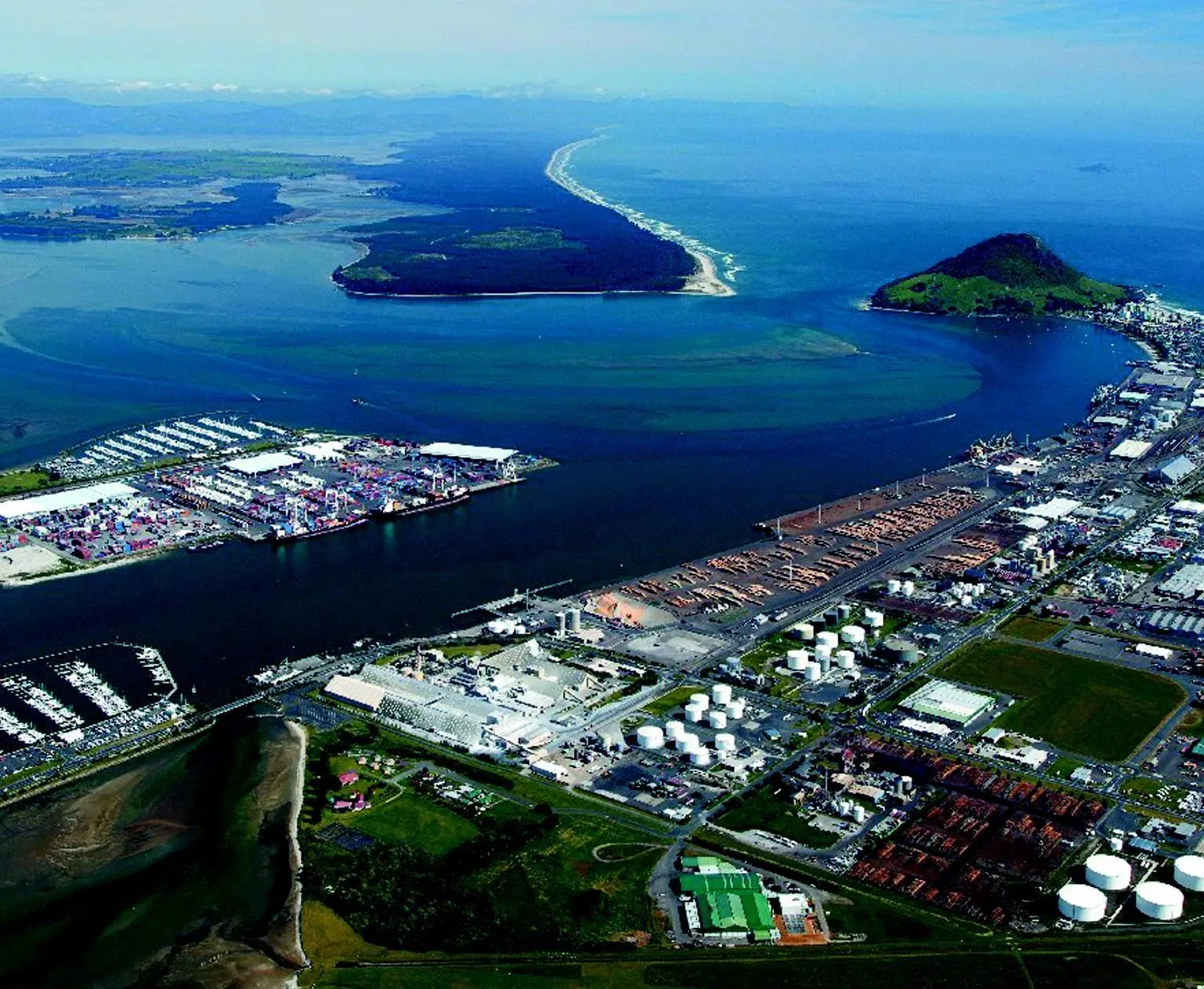
Mayson has put his doctrine of co-operative ventures into practice at Tauranga, extending its boundaries so it is not dependent only on “mature” market sectors such as forestry. Over the last few years, it began by competing for contestable business in containerised cargo from South Auckland via MetroPort, and then it broke new ground by investing in the new port at Marsden Point, Whangarei, in partnership with another port (Northland) and bringing in a shipper – Carter Holt Harvey (CHH) – as a committed stakeholder.
This was a supreme example of a forward-thinking exporter who was prepared to embrace strategic co-operation with ports. CHH did so because the venture assured its own supply chain gateway – Northland as a forestry region is second only to the Central North Island Plateau and CHH is the major forest owner in the region.
However, when the idea of this forestry port came up, the calculations indicated US$47.50m would be needed for the development and it would be marginal by accepted investment criteria. Without an appropriate return on investment the Port of Tauranga would not invest, the existing alternative Port Whangarei would close due to siltation, and the potential of Northland could not be realised.
In-depth discussions between Tauranga, Northland and CHH – which Mayson says were initially tense – eventually produced a close and trusting relationship in which CHH has a one third shareholding in the operating company. CHH oversees all land-based activities at the new port including marshalling, log scaling, stevedoring, receipt and delivery, storage, chip-handling and loading facilities.
Another co-operative deal with a fellow port was struck with Marlborough, where Sean Bolt, the container manager at Tauranga’s Sulphur Point container terminal, was appointed chief executive, Mayson joined the board and Tauranga assumed a management services contract.
Then Tauranga exploited its knowledge in log traffic by buying into Owens Services Bay of Plenty Ltd (latterly The Owens Cargo Company) which gives a national exposure to log marshalling.
Late last year this evolved still further, with a joint venture between it and Toll Holdings seeing the formation of Toll Owens Ltd.
The new operation offers an integrated marshalling and stevedoring service at 12 ports throughout New Zealand, namely Northport, Auckland, Tauranga, Gisborne, Napier, Nelson, Picton, Lyttelton, Port Chalmers, Timaru and Bluff.
Mayson says the purpose of launching the joint venture was to create a vertically-integrated service organisation to efficiently handle the marshalling and stowing of cargo. “Our objective is to take costs out of the supply chain, which will benefit our competitive position and the cost-effectiveness of the services that we offer to our customers, ” he explains.
The joint venture will be involved in Tauranga’s 15-year contract for the import of 1m tonnes of coal a year. This involves a capital investment of US$23.4m to set up the appropriate environmentallyfriendly cargo-handling infrastructure.
Related Articles
 WORLD
WORLD
 PORT & TERMINAL NEWS
 PORT & TERMINAL NEWS