

Onshore power reduces impact
In this article Susan Dutt, manager of sustainability at the Port of Gothenburg, investigates the possibilties of decreasing environmental impact through the use of onshore power.

The Port of Gothenburg was one of the first ports in the world to offer high voltage onshore power to commercial vessels, a technology that reduces local air pollutants, greenhouse gas emissions and noise to a minimum when using environmentally labeled energy. In total, one in every three vessels that calls at the Port of Gothenburg can now turn off its diesel engines at the quayside and use onshore power supply instead. In November 2011 the port received the Energy Globe Award for its achievements.
So, here is an update on the state of onshore power supply activities and achievements within Port of Gothenburg, as well as a look back in time to some major milestones.
How did it all start?
As early as 1989 the first two of Stena Lines ferries were adapted to onshore power supply with low voltage, they were Stena Germanica and Stena Scandinavica operating to German ports. Since then the technology has developed and the first ship connected to a high-voltage onshore power supply (OPS) in Port of Gothenburg was in January 2000 and it has since then become a major success.
The big difference between low and high voltage is that the number of cables can be reduced from 10 to one and that the connection time is also reduced from around 20 minutes to five minutes at the most.
Stora Enso, one of the world’s leading pulp and paper companies, was a prime mover in Port of Gothenburg’s onshore power supply investments with high voltage in the late 90s. The company wanted to be environmentally-adjusted in all the links of its supply chain for its paper transport from Sweden to the rest of Europe. Gothenburg was one of the ports competing for Stora Ensos business, and it was determined to put together the greenest and most environmentally-smart offer.
Per Lindeberg, the port’s chief electrical engineer at that time had already been looking at the feasibility of supplying vessels in the port with electricity from a land-based source, instead of running the ships auxiliary engines. He reasoned that this would cut ships emissions radically and also reduce the noise – which would benefit both the surrounding environment and also improve the working conditions at the port. Everyone was in favour of the idea – so the challenge was to find a solution that would work.
A creative cooperation was developed between the shipowners, Cobelfret and Wagenborg Shipping, and electrical equipment supplier, ABB. The Swedish government also contributed some funding.
Some Important milestones are highlighted here:
2000 – The inauguration of the world’s first high voltage OPS installation
The inauguration of the first high voltage installation of onshore power for commercial vessels started in the ro-ro terminal. When the port started its investment in the technology in 2000, most European ports had low interest in the technology and Gothenburg was one of the few ports talking about onshore power supply as an interesting solution. Today, 10 years later, the situation is the opposite and it is a technology that many ports and shipping companies are considering.
2004 & 2008 – Environmental awards
The port receives the European Union Commissions new environmental prize, the Clean Marine Award in 2004 and Lloyd’s Lists Clean Seas Award in 2008 for its work with onshore power.
2008 – Stena Line invests heavily in OPS
Stena Line announces that the majority of its vessels in the Scandinavian ports will be equipped for OPS before 2010/2011.
2008 – Climate investment grant
Another important milestone was when the port received a climate investment grant from the Swedish Environmental Agency to supply electricity at all berths at the ro-ro terminal covering 30% of the investment cost.
2010 – The launch of OPS website
The launch of the onshore power supply website www.onshorepowersupply.org as well as the publishing of results from the international survey on the current status and future plans regarding OPS took place. Gothenburg developed the website together with the Port of Antwerp. Amsterdam, Hamburg and IAPH Europe contributed within the World Ports Climate Initiative (WPCI). http://wpci.iaphworldports.org
2011 – Europe’s second OPS facility and first 50/60Hertz frequency converter
In January 2011 a new onshore power supply facility was inaugurated for the Stena Lines ferries operating between Gothenburg and Kiel. The unique thing about the new facility is its ability to transform 50Hz, the standard frequency for alternating current in Europe, to 60Hz, which is the system frequency used on the majority of vessels. The new onshore power supply facility is the result of a joint investment initiative by Stena Line and the Port of Gothenburg, with a total cost of €1.4m. With the commissioning of the new facility all five Stena Lines passenger and freight ferries are now connected to onshore power supply when at berth.
2011 – 98% cut in tax charged for onshore power
After six years of lobbying for tax exemption on electricity for onshore power supply, an important victory was achieved. Since 1 November 2011, the Swedish government is allowed by Brussels to reduce the tax from SEK 0.28 (Euro 0.028)/kWh to a symbolic SEK 0.005. The tax reduction on electricity for vessels using onshore power supply will radically increase the incentives for shipping companies to invest in the technology, an important step towards an increase in the use of OPS.
2011 – Port of Gothenburg wins the Energy Globe Award
In November 2011 the port is announced the winner of the Energy Globe Award for its achievements within the field of onshore power supply.The Port of Gothenburg was proud and happy to receive the environmental “oscar” for its intensive work on reducing local air pollutants, greenhouse gas emissions and noise. The Energy Globe Awards aims at promoting clean, renewable energy sources and are awarded in five categories: earth, fire, water, air and youth. The awards have been presented since 1999 and are now one of the Worlds most prestigious environmental awards. The port was the winner in the category air.
The current status
Today, in the Port of Gothenburg, around 10 vessels are equipped for the technology and five quays are offering an onshore power supply. The power is supplied by environmentally labeled electricity like wind power. The shipping lines using the technology are Stena Line, Cobelfret and Transatlantic.
The five quays that offer OPS in the Port of Gothenburg:
1. Quay 24, Masthugget, Stena Line: Gothenburg – Denmark. OPS for passenger fast ferry – Stena Carisma, 50Hz & low-voltage, 400V, one installation.
2. Quay 28-32, Masthugget, Stena Line: Gothenburg – Denmark. OPS for ro-pax vessels Stena Jutlandica & Stena Danica, 50Hz & high-voltage, 11kV, three installations.
3. Quay 46-49 Majnabbe, Stena Line: Gothenburg – Germany. OPS for ro-pax vessels Stena Scandinavica & Stena Germanica, 60Hz & high-voltage, frequency converter, 11kV, one installation, prepared for 50Hz.
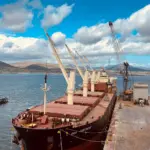
4. Quay 700, ro-ro terminal, Gothenburg – Finland, England, Belgium. OPS for ro-ro-vessels Transtimber, Transpaper, Transpulp, Schieborg, Slingeborg & Spaarneborg, 50Hz & high-voltage, 6kV, one installation.
5. Quay 712 ro-ro terminal – no vessels are equipped at the moment. However, OPS for ro-ro vessels exists, 50Hz & high voltage, 11kV, one installation.
Next steps
A feasibility study has recently been conducted in the Port of Gothenburg to examine the environmental, technical and economic aspects on introducing the technology for all terminals and vessels in the port. The results will soon be available on www.portgot.se.
The port has the ambition to become the first ro-ro terminal in the world to offer OPS for all of its visiting vessels. And there are promising signs that this could soon turn into reality, fingers crossed.
Since 2011 the port is leading the work about onshore power supply within the international project called Clean North Sea Shipping project (CNSS), www.cnss.no. The result will hopefully be an important contribution beside what has already been done within the World Ports Climate Initiative. The aim is to provide recommendations, exchange of experiences and discuss how to stimulate as many ports, terminal operators and shipping companies to use/offer OPS. Learning from already existing experience – ups and downs – as well as introducing the technology in the port of Bergen for cruise vessels in Norway, are some examples of what the project will cover.
Related Articles
 ALTERNATIVE FUELS GREENPORT
 ENERGY & TECHNOLOGY GREENPORT
 ENERGY & TECHNOLOGY GREENPORT