





Chile: onwards and upwards
AJ Keyes looks at developments in Chile’s leading ports and asks if any change to the status quo is anticipated in this important Latin American location
Chile is an integral part of the wider South American container port market and contributes almost 15% towards the estimated 28 million TEU handled in 2024. There are around 50 designated port facilities along the country’s 4,000-mile coastline, but container activity is limited to only a few.
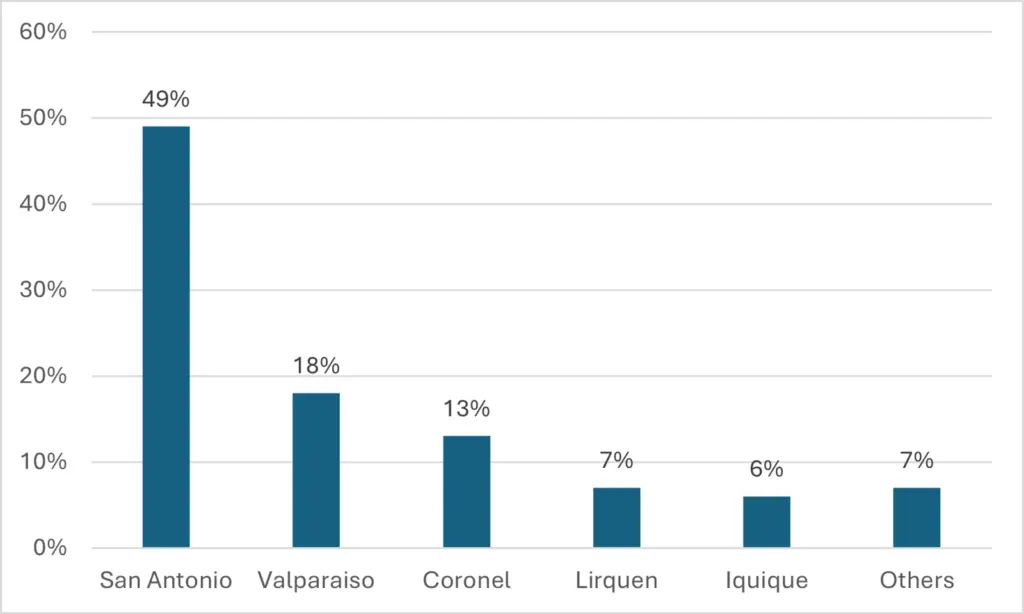
Integral to Chile is the country’s Central Region, which is where the two largest volume ports of Valparaiso and San Antonio are located. Both facilities serve the Santiago Metropolitan Region of seven million inhabitants (35% of the national total), and this is reflected in the share of national container traffic (shown in Figure 1).
CAPACITY PLANNED
Empresa Portuaria San Antonio (EPSA) has confirmed that Chile’s San Antonio Terminal Internacional (STI), a joint-venture between Seattle (WA)-based SSA Marine and SAAM Ports (acquired by Hapag Lloyd in 2023), has met the investment conditions set out in 2020 and has subsequently been awarded an extension to its concession, running to January 1, 2030.
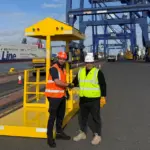
Andrés Albertini, General Manager, STI, elaborates: “In recent years we have implemented an intensive capex plan, investing US$66m, of which US$47m was to extend the concession. This not only lets us continue to operate the port, but also to continue delivering excellent, safe service for foreign trade, positioning STI as the most efficient, most important port in Chile and one of the leading ports in the Southern Cone.”
STI is the largest single terminal facility in Chile and consistently handles over 1 million TEU annually. The increase in capacity to 1.6 million TEU per annum (and which triggered the contract extension) means current estimated utilisation is 65%, leaving some capacity for further growth.
State-owned port operator, Empresa Portuaria Valparaíso, wants to expand the Port of Valparaíso by raising cargo capacity and modernising the current infrastructure, as part of a US$600 million investment.
The plans consist of generating 2.3 million TEU and over three million tons of breakbulk cargo. In addition, the ability to cater for two cruise ships simultaneously is planned. The terminal will allow breakbulk cargo operations when cruise ships are not in service, with cruise operations given priority.
Longer-term, Chile has largescale expansion plans. In 2018, the government announced the Outer Harbour Project, a new facility adjacent to the south end of the existing San Antonio facilities. The plans include 2 x 3 million TEU per annum capacity terminals and will be developed in phases. The first vessel is currently scheduled for arrival in 2035 and construction will continue until 2050.
TARGETTING CHINESE INVESTMENT
Another ongoing major development for Chile’s port industry is the desire to attract Chinese backing for the US$4.5bn Arica port expansion plan.
International investment in the country’s ports is a common process, with global terminal operator, DP World, acquiring the PCE terminal operation in San Antonio in 2019. Likewise, SSA Marine is also operating in San Antonio, while in Valparaiso, the TPS facility is owned by MSC (40%), in conjunction with Chilean port operator, Neltume Ports (60%).
A group of officials from Chile’s Arica and Parinacota region visited China to pitch a proposal to transform the small port, currently handling a cargo throughput of 6m tonnes, into a mega port with at least 100m tonnes of capacity.
LARGE HINTERLAND
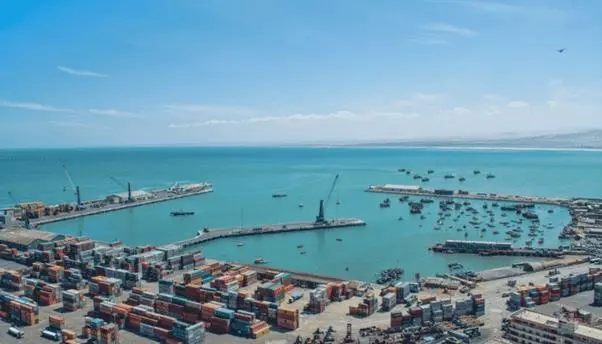
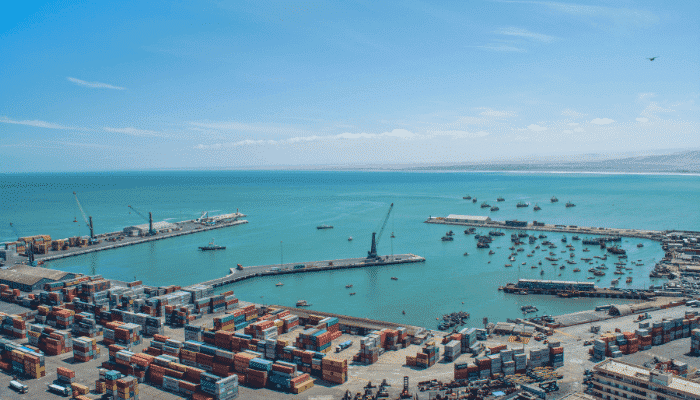
Located on the northern coast of Chile, the port of Arica is a gateway for trade between South America and the Pacific Rim, while also connecting the landlocked countries of Bolivia, parts of Brazil and Paraguay to international markets.
This geographical location has the potential to serve a population of 300m in the future, as Juan Pablo Godoy Aguilera, Vice-President of the Territorial Development Corporation (part of the Regional Government of Arica and Parinacota explains: “Arica’s exports currently go mainly to Asia, and future exports, especially minerals, will likely continue heading to this region. This is why they are actively seeking Asian investors for the port expansion.”
The ability to serve Bolivia is a key aim for Chile. Official data from Bolivia claims it is one of the world’s largest providers of lithium, with estimates of 20-25 million tons of reserves. Indeed, according to reported US Geological Survey information, the region comprising north-west Argentina, western Bolivia and northern Chile is home to 60% of the current known global lithium resources.
With CBC, a Chinese-led consortium that includes battery provider CATL, is investing US1bn in two lithium extraction plants after signing a deal with Bolivian state-owned company, YLB. These new plants are slated to commence exporting lithium in 2025, so access to a port to support its operations is needed.
The authorities in Chile expect construction of the US $4.5bn port project to begin in the next five years.
Related Articles
 PORT & TERMINAL NEWS
 PORT & TERMINAL NEWS
 PORT & TERMINAL NEWS