Meeting swelling electrical demand at today''s ''greener'' ports can be challenging, as Dave and Iain MacIntyre report
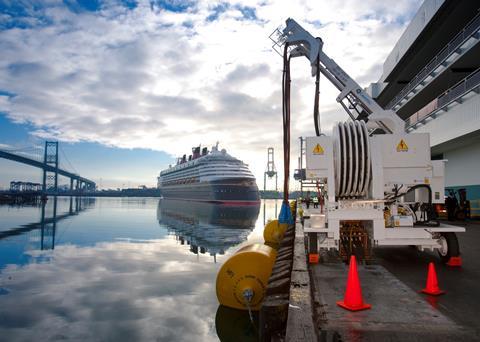
Ports are huge energy consumers and their dependence on reliable power supplies has become even more important with the advent of cold ironing and the environmental demands for reduced pollution.
Consequently, port managers are grappling not just with the “here and now” of energy provision but with the need to widen their future supply and back-up options.
How great is the demand profile on ports is exemplified by the Port of Long Beach. Chief harbor engineer Al Moro says that over the next 15 to 20 years the port’s electricity demand will increase from approximately 50 MW to 240 MW.
“This large load growth is a result of many of the clean air initiatives being implemented at the port. These include electrification of terminal container yard equipment and shore-to-ship power that allows the large container vessels to turn off their on-board auxiliary diesel-driven generators eliminating emissions while at berth.
“Challenges are to build the electrical infrastructure in a timely manner to transmit and distribute the electric power from primary Southern California Edison (the electricity utility company) substations to the points of use.
“This involves coordination with SCE planners and engineers to make sure SCE has adequate grid power in the area as well as the electric distribution infrastructure within the port. All this construction must be done in a way to minimise the impacts to working cargo terminals.”
Network maintenance can also pose a challenge.
At nearby Port of Los Angeles, the port’s utility provider is LADWP, a sister agency that can produce well over the highest demand ever recorded and distribute to the port area with no major issues.
But LA’s senior building electrical engineer Vahik Haddadian adds: “Some of the routine challenges are the natural ageing of the transmission equipment and wiring (circuits) … As the power demand increases, the need for additional new lines and newer protection equipment will also increase.”
Mr Haddadian says the load demand of the container terminals and cargo-moving equipment is so high that there is no cost-effective method to “back up” the operations.
“The best scenario is to ensure each facility has enough back-up generation capability to provide power to circuits providing power for minimum life and safety loads such as security systems, access control systems, critical data systems, etc.
“The port’s green initiatives in total require a small percentage of the overall power demand of the port operations and would not be capable to provide the necessary supply in the event of grid power unavailability.”
What is driving the increase in demand for power? Undoubtedly, “cold ironing” is one reason. Los Angeles for example began providing Alternative Maritime Power (AMP) at the China Shipping terminal in 2004. Currently, the port has three containership AMP berths and three cruise ship AMP berths. By 2014, there will be a total of 24 AMP berths.
The California Air Resources Board adopted a shore power regulation in 2009 requiring that all cruise, container, and reefer vessels that meet call criteria to California ports must plug into shore power. Starting in 2014, regulated vessels must plug into shore power for 50% calls and achieve 50% emission reductions, increasing to 80% by 2020.
Elsewhere in the world, other ports have reviewed the trend to shore-based power and decided it is not necessary.
Rotterdam in its Port Vision 2030 states that cold ironing is a viable option for ferries that visit very frequently, or in specific local situations close to residential areas. That, however, is to reduce noise rather than reduce power demand.
Says Rotterdam spokesperson Tie Schellekens: “The port investigated shore-connected power for seaships as well … We concluded that at this moment the time is not ripe to invest.”
Rotterdam will however equip the new quays of Maasvlakte2 with necessary facilities to keep the shore-based power open.
Another factor driving power demand in ports is stricter requirements needed to export to the US after 9/11.
Luiz Antonio Trotta Miranda of DCDN (Distribuidora Cummins do Nordeste), a Cummins Power Generation distributor responsible for installation, operation and maintenance of natural gas generator sets at the Port of Pecem in Brazil, explains that the International Ship and Port Facility Code contains requirements for ports shipping goods the US.
“The port must have an alternative source of power other than an electrical utility … The port demand varies during the week and year, and the port must have a system that is designed for a peak demand, i.e. much higher than the average annual demand.”
Fortunately, Brazil benefits from SIN (the Sistema Interligado Nacional), an integrated transmission system, making it possible for power produced in one region of the country to be available to support demand in any other region.
As for an emergency power system, DCDN has specific teams for operation and maintenance to ensure natural gas generators start immediately in case of power interruption.
“Natural gas generator sets are also used for peak time application where the energy cost is ten times more expensive,” says Mr Trotta Miranda.
So, where are ports turning, to increase their power generation?
DCDN’s Mr Trotta Miranda says in his region there are many studies for wind turbines in parallel with the utility; “however, it will be complementary due to being wind-dependent and having a low capacity. The same for solar energy.”
At Long Beach, the port has plans for renewable energy at its marine terminals.
Says Mr Moro: “For new terminal developments, our Green Leases require the installation of solar carports and roof-top solar energy arrays. The tenants can meet that requirement by installing solar panels as their own capital project, or entering into a power purchase agreement (PPA) with a third party.
“Older terminals, with short lease terms, are problematic for PPA arrangements. We have found that most PPA providers will not enter into a contract of less than 15 or 20 years. One of our challenges, therefore, is helping the marine terminal operators find a cost-effective way to implement renewable energy. We are currently embarking upon a vertical-axis wind turbine pilot project to determine whether this can be cost effective.”
Mr Moro says that where practical, Long Beach plans to build electrical infrastructure with “redundant systems” so that, if there is a grid failure in one area of the port, power may be fed to an affected terminal from a secondary route.
For critical operations, such as the administration building and the Security and Command Center, the port has back-up power provided by on-site generators. Cargo terminals also have back-up power.
Long Beach also has programmes underway to substitute electricity for diesel in cargo-handling operations.
At Los Angeles, initiatives include the installation of a solar power generation system on select projects including a 1MW solar installation on its cruise terminal passenger building rooftop.
Utility provider LADWP will install, operate and maintain up to 9MW of solar power generation installations on various port-owned properties. Additionally, the port is looking into the feasibility of harnessing power from sustainable sources such as wind, wave and tides to supplant traditional energy supplies.
These projects are still in the conceptual stage and more advanced feasibility studies need to be performed.