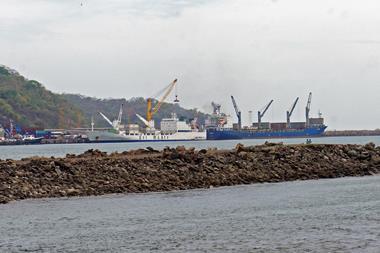

Porto Itapoa, the container terminal partly owned by Maersk Line, has leapt into third position in the Brazilian box hierarchy, as Rob Ward discovers.
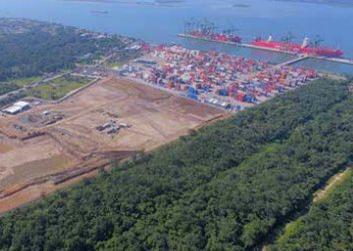
It has been a great past year for Port Itapoa, leap-frogging both local rival Navegantes and Rio Grande, who were previously in third and fourth spots.
During 2019 the Porto Itapoa box terminal, located on the north coast of the southern state of Santa Catarina, handled 735,139 TEU, up 14 per cent over the previous year, according to the recently published Annual Yearbook from the Brazilian National Authority for Ports and Waterways (Antaq).
By comparison, Navegantes-based Portonave (now 100% owned by MSC) handled 709,346 TEU during 2019, up slightly up from its 2018 figure, while Tecon Rio Grande (TRG), operated by Wilson, Sons, saw throughput slide more than 10 per cent to 679,911 TEU, after losing several deepsea calls.
However, with the addition of River Plate bound cargo now being unloaded at Rio Grande for transhipment to Argentina and Uruguay, TRG is expected to make a throughput comeback this year.
Porto Itapoa was a long-term project put together by Alianca Navegacao, the Hamburg Sud Brazilian flag subsidiary now owned by Maersk group, and local companies LOGZ Investment Fund and Grupo PortoSul.
METEORIC RISE
The President of Porto Itapoá, Cássio Schreiner, emphasises that the rise has been meteoric and the numbers for 2019 need to be celebrated as the result of intense and professional work.
“Porto Itapoá was born from scratch just eight years ago in a municipality that embraced us from the beginning,” stated Schreiner. “It was necessary to invest in infrastructure, train people and establish a logistical and entrepreneurial culture. With all these challenges, it is extremely gratifying to see this result and to see this effort turning Porto Itapoa into the largest port in Santa Catarina for containers, and the third largest in Brazil, in such a short space of time.”
The small town of Itapoá is located on Babitonga Bay, just 50 miles from the industrial city of Joinville and Araquari, where BMW has a production facility. It is also around 50 nautical miles from the Itajai port complex (hosting Portonave and APMT Itajai) and a mere eight miles from the mainly breakbulk and dry bulk port of Sao Francisco do Sul. The hinterland for Porto Itapoa includes some of the biggest chicken exporters in the world, such as BRF Foods and Marfrig.
Since opening for business in June 2012 (with the berthing of the Hamburg Sud vessel Cap San Lorenzo), Porto Itapoa has grown its throughput much faster than expected and two years ago increased its capacity from 500,000 TEU per annum up to 1.2million TEU per annum, with the addition of two more STS gantry cranes. It also has 2,892 reefer plugs to cope with the burgeoning export of refrigerated cargoes.
Alberto Machado, a commercial manager for Porto Itapoa, told Port Strategy that the large increases were boosted by a 25 per cent rise in imports and 46 per cent increase in transhipment boxes.
In first place in Brazil, as ever, is Santos, the biggest port for containers in South America, with 4 million TEU handled last year (up 5 per cent), according to the Antaq figures. It has been the number one volume port in Brazil for containers for many decades and contains the two leading individual terminals in Brazil, namely Santos Brasil (1,680,369 TEU in 2019) and Brasil Terminal Portuaria (BTP, which handled 1,654,436 TEU last year).
The third terminal – DP World Santos - gained volumes after the closure of Libra Terminais in early 2019. It takes up sixth position overall in Brazil, with 717,186 TEU handled last year, if considered as a standalone, private terminal.
The second biggest port for containers in Brazil – hosting the second largest terminal operator – is Paranagua and Terminal de Conteineres de Paranagua (TCP), which handled 865,110 TEU during 2019, an increase of 11% over 2018.
Boosted by significant increases in reefer exports – especially chicken and pork to China in the wake of that country’s trade war with the US and well-known problems with swine fever – Porto Itapoa has also seen exports increase to further cement its position as a leading port in the country.
Porto Itapoa Details
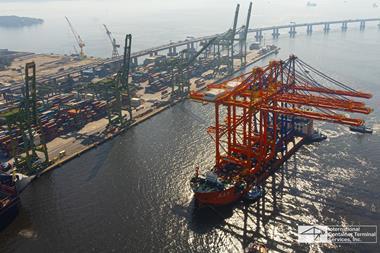
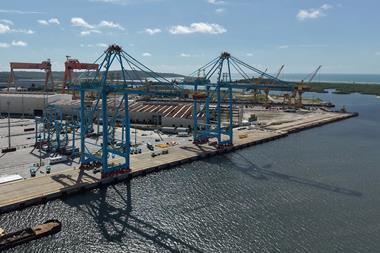
Porto Itapoa has been operating with an 800m quay (two berths), deploying six Super Post Panamax gantry cranes, 17 RTGs and two reach stackers.
There is a depth alongside of 16m, with vessels restricted to 12.5m draft only by the entrance channel.
Around 10 shipping lines use Porto Itapoa, via nine different services - three to Asia, two to the Mediterranean, one to East Coast of North America, one to Northern Europe, one to US Gulf and the ABAC/Conosur service to West Coast South America.