John Bensalhia takes a look at today''s container scanning system innovations and developments.
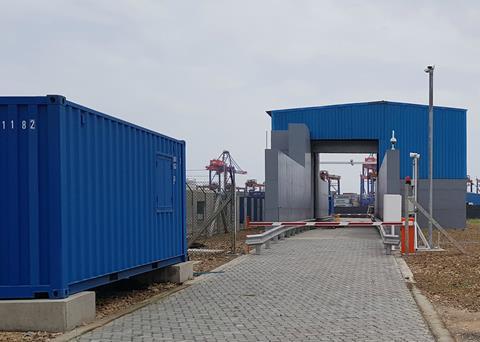
Welcoming the arrival of cargo at ports is complicated by the risk of potentially illegal or dangerous items. Illegally imported goods, drugs, guns, even explosive threats... ports must be ready when it comes to items that can compromise safety and security levels.
Container scanning systems are solving this problem, ensuring consistent levels of safety, with the added bonus of providing high throughput and productivity rates. What used to be a time-consuming process has become faster and more efficient.
Recent changes at Maher Terminals in the Port of New York/New Jersey have taken this notion on board with the introduction of a new system in July 2019 (in conjunction with US Customs & Border Protection). The new system involves a straddle carrier passing through two stacks of containers, on which a radiation portal monitor is mounted. It has the ability to scan the cargo without a pause from the vessel to the rail terminal – resulting in faster speed and creating greater space in the terminal which would have otherwise been used to scan the containers.
While there have not been many new recent regulatory requirements, more ports are required to increase the scanning inspection percentage of the import and export cargo. Nuctech explains that this is because many ports in Europe are facing increasing challenges of illegal goods coming from other continents – especially drugs.
“In addition, more customs authorities and border forces now prefer dual view scanning technology instead of single view technology,” says Nuctech. “With dual view images, the customs officers can obtain much more information and obtain more efficient assistance enabling them to identify illegal cargoes hidden in containers.”
In terms of meeting different requirements for container scanning systems, APM Terminals Pipavav MD, Jakob Friis Sorensen, says that the regulatory norms are very stringent with regular safety audits and routine maintenance procedures. “Entry is restricted to only trained personnel into the radiation machine zone. In addition, there is concrete walled office building facing the scanner area, and two AERB certified radiation safety officers. All staff working with Thermoluminiscent Dosimeter (TLD) badges, radiation exclusion zone, safe zone for pedestrians, safety audits by AERB are mandatory.”
“Our systems are designed to comply with applicable rules and regulations globally,” says Nuctech. “Hence, we can easily meet any regulatory requirements worldwide. We are always ready to offer customised products and services to our customers and work with them to understand their needs and develop the best possible solutions, in compliance with the applicable rules and regulations.”
One of the most popular modern container scanning innovations is the drive-through portal. The introduction of this concept has brought a number of benefits to ports, as Jakob Friis Sorensen explains.
“The drive-through container scanner has increased the speed of customs inspection and enhanced the efficiency of the entire logistic chain. This has reduced the dwell time and led to quick turnaround of cargo at the port. A step towards providing a seamless experience and promoting ease of doing business.”
Besides increasing security and safety of the port, Sorensen says that the container scanner enhances the terminal’s overall performance whilst reducing the service time and aid in providing a boost to the import-export process.
“The drive-through scanner is capable of handling twin 20’ containers at the same time on a single trailer. Designed scanning throughput is 70 transactions per hour.
The main goal is the prevention of wrong declaration, concealed smuggling, and provision of better security.”
To save time and boost productivity, the drive-through container scanner is a popular choice for ports. Visakhapatnam Port recently implemented a drive-through scanner and the Indian Port Association installed four new mobile drive-through scanners at each of the four terminals of Jawahar Lal Nehru Port. Reducing the time taken to scan the containers, the portal can scan 100 containers per hour.
Nuctech says that there are significant innovations and developments regarding throughput increases and improved efficiencies. “Our company has developed the world’s first and only dual view drive-through systems, deployed in the port of Maasvlakte and operated by Dutch Customs. With a single scan, it will able to inspect 5 x 40 foot or 10 x 20 foot containers and provide high quality dual view and dual energy images to the inspectors.”
In terms of hourly throughput, the dual view drive scans approximately 150 containers per hour. “This is 10 times more than traditional cargo scanners and also with an additional top view image.”
Increased throughput rates and system strength are chief considerations of modern container scanning at ports. In June 2019, Smiths Detection was contracted by Meridian Port Services Ltd to provide cargo inspection technology for Ghana-based Tema Port's expansion project.
The technology selected was four lots of SD HCVPZ60 scanning portals, which can keep up a throughput of up to 100 tracks per hour. The portals are also capable of penetrating steel from nine to 11.8 inches thick.
Leidos systems encompass high throughput rates. The VACIS M6500 Mobile Inspection System can scan around 150 vehicles an hour – this figure applies to the automatic scans of cargo-laden driving vehicles that pass through without a pause. In the case of stationary vehicles, the M6500 can scan 60 of these per hour. The M6500 can also specifically scan cargo containers. Another Leidos offering, the IP6500 Full Scan System, is designed to scan large amounts of containers in regular traffic flow at the port gates or other checkpoints.
Nuctech adds that modern AI technology also greatly assists customs inspections. “We worked on a project with China customs on developing automatic detection on the scanned image. The result is very good and nowadays, greatly assists China Customs inspections. With the help of AI, Customs Authorities save manpower and increase the inspection percentage. We are now also developing AI in our European subsidiary, Nuctech Netherlands and are looking forward to working together with Customs Authorities in Europe and worldwide in a joint effort to improve the technology and create a safer world.”
While container scanning systems help ports achieve high throughput and productivity levels, a chief issue is that of safety.
To ensure safe use, manufacturers are coming up with low-level radiation systems. Wi-Ltd's WG Container and Cargo X-Ray Scanning Portal features low radiation dose technology along with safety systems to ensure safe use for everyone involved in the process – drivers, operating staff, and bystanders.
The Leidos VACIS M6500 uses a low radiation dose to do the job, which, while increasing throughput, enhances safety. The Leidos VACIS IP6500 Full Scan system also utilises a low radiation dose while detecting the presence of heavily shielded Special Nuclear Material.
In September 2019, two fixed portal X-ray machines were installed at the Port of Manila as a means of detecting the presence of smuggled goods and contraband. Installed by the Bureau of Customs and ordered from Astrophysics Inc, the machines can scan at least 120 containers per hour. However, these machines are designed to give off lower radiation levels as a means of ensuring the safety of both port staff and the public present at the port.
With respect to container terminal scanning safety at APM Terminals Pipavav, Jakob Friis Sorensen says that the system is of proven international standards. “The set-up is double fenced and built with robust thick concrete walls to prevent leakage. Further in-built multiple levels of safety systems to prevent accidental transmission of X-rays until the trailer cabin passes the radiation emission point include trailer speed radars, OCR, manual emergency stops, and various auto-cut-offs to prevent inadvertent emissions if safe operating procedures are not adhered.”
For drive-through systems, Sorensen explains that it is highly essential that the X-rays should be energised only when the driver cabin has passed, and the container is facing the primary beam region. “To achieve this functionality, one of the safety systems is the laser gap profiler, which allows the actuation of X-rays if, and only when the vehicle carrying the container has a gap between the driver cabin and container passing through the scanning area. X-rays are energised only after the passing of the driver cabin.”
“In addition to the inbuilt safety systems, the role of the trained and qualified operator is very important to prevent any potential exposure situations. Further study on design and operational aspects including human error is recommended for the accelerator-based container scanner system, which will be helpful to identify the area for improvements in the design and operation.”
“From the design of the container scanner, we have comprehensively considered the safety for both operators and the public in the overall safety of the system and especially radiation safety,” says Nuctech. “Radiation safety is always the top item we need to ensure for the system. We always measure the operational site and use professional radiation calculation software operated by radiation experts thereby ensuring at all times compliance with the rules and regulations of all local radiation authorities.”
Nothing can be taken at face value when receiving containerised cargo, but modern container scanning systems mean cargo inspection is streamlined, faster and safer.