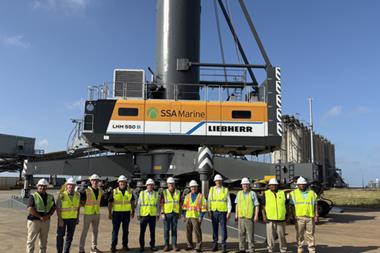
New concepts in STS container crane design have been introduced recently but the main emphasis in design is on refining existing elements to promote efficiency and sustainability. Mike Mundy reviews the initiatives
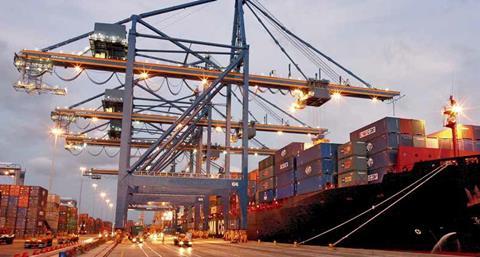
Design priorities at the top end of the ship-to-shore container crane market have a strong focus on making improvements to the crane systems in service today.
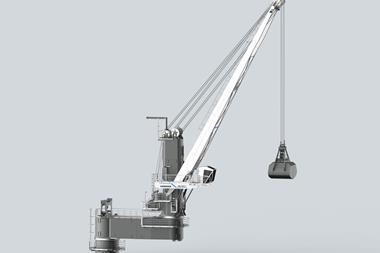
There are entirely new ship-to-shore (STS) crane designs and concepts on the drawing board – for example the Balance Crane design developed by Liftech Consultants of California in conjunction with ZPMC, the Shanghai headquartered crane manufacturer, and Kone’s multi-trolley crane concept which facilitates vessel working from both sides of a ship in an indented berth. In the main, however, design innovation is proceeding within the framework of established STS crane design parameters. Trevor O’ Donoghue, Marketing Manager, Liebherr Container Cranes, puts the spotlight on these when he identifies key design drivers today as “…automation, digitalisation, sustainability, safety, matching vessel size, improving productivity and responding to client specific requirements.”
The crane size issue is an interesting one, with the perennial question hanging over it of how much further can you go? As O’ Donoghue notes: “To-date many of the Liebherr STS produced have outreaches well in excess of 70m and feature a lift height of 54m or more.”
Current top-of-the-range STS container crane configurations are proven to be able to efficiently serve vessels with a capacity of up to 24,000TEU – Evergreen’s recently commissioned Ever Alot has a capacity of 24,004TEU. There has been talk of even larger vessels, 25,000TEU to 30,000TEU but while acknowledging that such designs are technically feasible the general feedback from the shipping sector is that they offer little merit economically, not much gain in terms of reduced slot cost, pose challenges in terms of achieving a high level of slot utilisation and most significantly would likely generate a prohibitive level of investment requirement on the landside.
It is thus within the existing top-end parameters of STS container crane design that innovation looks set to proceed, with the current weighty container vessel order book confirming this.
AUTOMATION INTEREST
Interest in harnessing the powers of automation continues to build in high income economies, where labour costs are high, and to an increasing extent in upper middle-income economies. According to Simo Mustalammi, Director, STS Cranes, Konecranes, as regards the specific aspect of automating for remote operation there is building interest but as yet selective take-up.
One example, however, of the steadily widening interest in remote operation and automation in the operating cycle is the specification of four high-capacity STS container cranes in a package order, which includes, 12 rubber tyred gantries (RTGs) recently placed by the Port of Duqm, Oman with Liebherr Container Cranes.
Each of the Duqm STS Cranes will possess an outreach of 71m, a back-reach of 18m, a lift height over the rail of 50m and have a safe working load of 65 tonnes under a twin-lift spreader. They will be supplied without a cabin and operated utilising a combination of remote control and automation. Automation will take care of the majority of the cycle with operator intervention only required when operating below a predefined safe height. Each Liebherr STS will be connected to its own dedicated Remote Operator Station (ROS).
The centrally located remote operation facility will also host the ROS for control of the automated RTGs. The cabinless RTGs feature automation over the stack with remote control only required for container pick or place from the truck trailers, or for exceptional handling circumstances. Four ROS operators will operate the twelve RTGs.
Paceco Corp, another well-known manufacturer, further confirms the steadily growing interest in automation for handling functions with US-based Troy Collard, General Sales Manager, Paceco, noting that the company is building upon its existing semi-automated capability with full automation now under development.
Where there is plainly great interest in capitalising on the powers of automation is in conjunction with what can broadly be called support or safety functions. Typically, for instance, Liebherr points out that its STS crane design incorporates a remote crane management system allowing for remote assistance, service and diagnostics. Plus, the design, “…features a traffic light system for controlled traffic flow, laser and mechanical crane to crane anti-collision systems, ultrasonic anti-collision systems for gantry travel as well as laser boom to vessel anti-collision and sill beam protection systems.”
Konecranes also underlines the importance of such features highlighting the importance of its predictive maintenance system coupled with its TRUECONNECT remote monitoring service, as well as diverse features which serve to promote operator efficiency. In the same vein, O’ Donoghue points out that while Liebherr’s STS cranes have benefited from a mechanical anti-sway system, “that is a favourite among crane operators for many years, electronic anti-sway is also now available and is supplied as a component of many of our automation sub systems.”
SUSTAINABILITY SEARCH
In crane design and in their manufacturing and business activities considerable emphasis is now being placed by key crane manufacturers on sustainable arrangements. On the design side electric power is a key factor including the feedback of generated electricity to the grid. LED lighting is a factor as is the better overall control of the handling process and crane movement through systems such as anti-sway and anti-skew.
At the individual company level, there is also great attention to achieving sustainability in-house. O’ Donoghue notes that Liebherr has recently been awarded a gold medal for sustainability from sustainability ratings supplier EcoVadis. Konecranes points out that in December 2020 it signed the Science Based Targets Initiative and earlier this year it published its new climate targets which it says, “have been validated as being in line with the ambition to limit global warming to 1.5degC.”
STRUCTURAL INNOVATION
Innovation in the area of STS crane structural design has been quite notable in a macro context recently – ZPMC is centre stage with this, originating in conjunction with Liftech, the new generation Balance crane design (see box story) and also a new light-weight STS crane that employs ‘spiral pipe’ in its construction. Reportedly, this pipe is originated by rolling strip at a helical angle and then welding.
At a more micro level, there is also evidence of crane structural component innovation with Liebherr reporting a recent crane design for Alicante which can be used on both an older and new quay. The design was accomplished, notes the company, without any compromises. Generally, it also points out that the lattice type crane structure employed in its STS container crane design, together with the use of high tensile steel, ensures a low centre of gravity and consequently lower wheel loads. Both Konecranes and Paceco also report the proven ability to lower wheel loads with Paceco further pointing out that its monobox boom and the use of a self-propelled trolley are a lighter arrangement than a twin girder crane thereby inherently reducing wheel loadings.
CONTINUOUS PROCESS
Design refinement in the STS container crane sector is a continuous process with this closely allied to meeting new user requirements, many dictated by container system upgrades. It is interesting that ZPMC has recently originated two new crane designs – it begs the question does the competitive cost basis of Chinese production facilitate such innovation?
In this context and generally it will be interesting to see what follows Kalmar’s withdrawal from the heavy crane sector and its parent Cargotec’s transfer of related intellectual properties and assets to RIC in China – see Equipment News. One thing is for sure, the sector is very market responsive, a positive achievement in a business climate where the Cargotec relinquishment of its heavy cranes portfolio, including STS units, signals tough competition and squeezed margins.