![PortStrategy[GreenPort]](https://www.portstrategy.com/wp-content/uploads/2026/09/PortStrategyGreenPort.svg)





DIRECT NEGOTIATIONS, PLENTY OF PITFALLS
If you choose not to offer a tender for a port concession and to engage in direct negotiations witha specific party instead are you doing the right thing?
It may be hard to resist if the entity you are being approached by has arrived at your door as the result of one government’s overtures to another and/or if the suitor is recognised as financially powerful and possessing considerable influence.
At the port level, there may be recognition that someone higher up in government ‘wants this to happen’ and as a result the suitor has to be taken seriously. Or it may just be that the ‘pitch’ put to senior port officials sounds too tempting not to take the opportunity seriously – and at first sight it may have the added benefit of short circuiting the considerable body of work involved in preparing and running a bid process.
What may at the outset seem a simpler course of action does not, however, necessarily prove to be the case. There is plenty of experience to suggest that negotiating for a concession on a one to one basis, as opposed to taking the tried and tested public tender route utilising the best practices of public procurement, is a short-sighted strategy. The current port Nouakchott project certainly seems to confirm this.
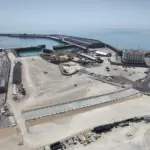
At the port of Nouakchott, Mauritania the FrancoSingaporean joint venture Arise is developing the port’s new container terminal but since the beginning of the year has experienced a rapidly deteriorating relationship with management at the Port Autonome de Nouakchott.
It has been expelled from its temporary offices by port management and project works are reported to be experiencing delays. Specifically, this has come about since the January appointment of Sid’ Ahmed Ould Raiss as General Manager of the port which followed on from a change of the country’s President in late 2019.
Regime change is in fact a common cause of problems with negotiated deals – the ‘new guard’ often taking issue with deals struck by their predecessors. Where it ends in Nouakchott remains to be seen with the port Nouakchott concession one of a number of deals facing investigation by a committee, set up by the Economic Affairs Committee in Mauritania’s Parliament, to investigate files and deals concluded under the reign of former President Mohammed Ould Abdel Aziz that are suspected of being corrupt.
LOSING OUT
It is not just the parties awarded the concession for the container terminal in port Nouakchott that are losing out – Arise Mauritania and Meridiam the French Investment fund (with AP Moller Capital having recently acquired a 43 per cent stake in Arise Ports & Logistics, ARISE P&L, the holding structure for ARISE’s ports and logistics operations across Africa) – but also the economy and country of Mauritania as a whole as development work slows in the face of the ongoing controversy.
Indeed, while every port project is important it is possible to contend that the more important the project – in Mauritania’s case the establishment of the first deep-water container facility – the more important it is that such critical projects are offered to the private sector via a comprehensive and transparent public tender process which draws on the expertise of advisors who can guide government to achieve the best result for the host country overall, without problems arising from warring political interests, corruption and so on.
Port project delays invariably have a negative impact that extend into the wider economy and which are generally injurious to efficient international trade.
THE DEVIL IS IN THE DETAIL
In a wider context, it also has to be said that while concession contracts have many standard features the idea of government officials sitting down for the first time and negotiating such a contract with an experienced port developer/operator is almost frightening!
Developers, many of whom have built up experience over decades, know all the paths via which to maximise their influence in a concession agreement and given the opportunity it is only natural that they will seek to gain advantage in critical areas such as exclusivity, tariffs, concession fees and so on.
The combined effect of this detailed knowledge on the one hand and lack of knowledge on the other can quite easily lead to what can politely be called an unbalanced concession agreement – favouring one party more than the other.
It is possible, therefore, to view situations such as the current one in Bangladesh with some concern. Here two parties – PSA and Red Sea Gateway Terminals (RSGT) – are reported, via direct negotiations, to be frontrunners in seeking to secure the development and operation of the Bay Terminal, a planned 12-metre draught facility near Chittagong port.
Equally, the same applies to Bangladesh’s Patenga Container Terminal project, now under construction, in conjunction with which RSGT and DP World are understood to be in talks with government.
History tells us that the most successful route for the award of port concessions is via an open public tender process drawing on best practices in public procurement. The advantage of hindsight is great and it can be costly in more ways than one to ignore the lessons of history.
Related Articles
 INSIGHT & OPINION
 INSIGHT & OPINION
 INSIGHT & OPINION