

Oil recycling goes full circle
The circular economy is playing an increasingly important role in the decarbonisation agenda for ports and Ecoslops is a driving force, writes Rebecca Jeffrey.
Responsible waste handling and recycling remans a challenge for ports aiming to meet ambitious sustainability agendas and dealing with oil waste is no exception. French cleantech company Ecoslops aims to contribute to the energy transition by collecting and regenerating marine fuel oil residues or ‘slops’, into new fuels. This enables it to offer an “economic, ecological, traceable and transparent solution” for ports, shipowners and waste collection companies.
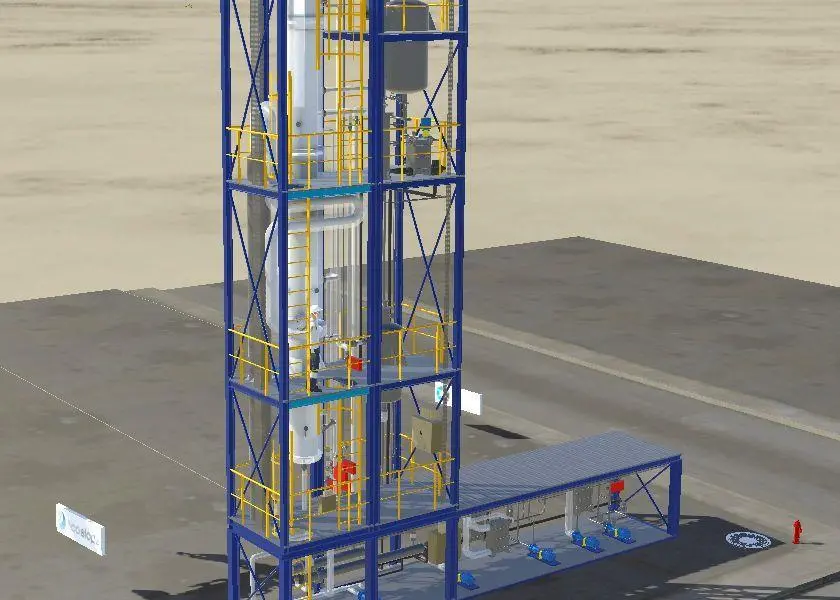
P2R vacuum distillation
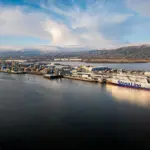
Ecoslops’ first Petroleum Residue Recycling (P2R) micro-refining unit has been installed at the Port of Sines in Portugal since 2015. Built, owned, operated and financed by Ecoslops, the P2R has a treatment capacity of more than 30,000t of hydrocarbon fraction per year.
After waste is collected, the hydrocarbons are separated from water and sediments. The water contained in the slops, as well as waste waters from the Port of Sines, are then treated and released back into the natural environment.
The P2R column has a hydrocarbon fraction treatment capacity of 100t per day. It works by heating petroleum slops to 400°C. It then uses a unique vacuum distillation technique which enables most hydrocarbons to vaporise and the production of fuels, including gasoil for the transport industry and light bitumen for waterproofing, which are then sold.
This gasoil is produced or blended to be compliant with the IMO (International Maritime Organization) 2020 Low Sulphur Regulation. Theoretically it could be recycled again. However, 1t of gasoil generates only a few kilos (0.1%) of waste, so the process is efficient at utilising and eliminating waste.
“It is still the only plant in the world able to regenerate waste into new products,” says Vincent Favier, CEO of Paris-headquartered Ecoslops. He explains the technology offers a measurable reduction of CO2: “We are producing 1t of fuel, with two thirds of savings in terms of C02 compared to a normal refinery. This is because we operate on a short loop basis, collecting and producing waste and selling the product locally.”
Accountability and transparency remain a challenge for waste handling, says Mr Favier. The International Convention for the Prevention of Pollution from Ships (MARPOL) is solid legislation, but decades on there isn’t enough scrutiny of waste once it has left the port, he stresses. Ecoslops is tackling this issue with its localised technology and processing.
Stable investment
The Port of Sines’ P2R unit serves as a case study for other ports, and Sines has received visits from other ports and port reception facility companies to observe how the unit operates. “That’s good for the reputation and ecosystem of the port,” points out Mr Favier. This also helps break through the conservatism of the maritime industry. “It takes years to convince ports or private companies to adopt new technology,” emphasis Mr Favier.
In addition to providing an oil recycling solution, the unit provides a stable investment for the Port of Sines for the next 10-15 years. “The port needs to have a port reception facility but if it’s not an interesting proposition for companies, companies will not apply, the port will need to pay out,” points out Mr Favier.
In March, Ecoslops renewed of its Port of Sinès operating license, comprising an extended storage license and an environmental license. This means it can now store and process more waste.
Technology roll-out
Ecoslops is now making a profit on the unit, a milestone which is key to attracting investment in the businèss and roll out of the technology at other ports. A P2R unit is currently being developed by Ecoslops in La Mède, near Marseilles, France. Total will provide services and utilities at the unit, which is anticipated to help make the oil residue collection industry in the Port of Marseilles more commercially attractive. The COVID-19 pandemic has delayed construction, but only by approximately three months. “We will open the plant at the end of April instead of December,” explains Mr Favier.
Plans are also in place to install a 60,000t per year minimum capacity P2R unit at the site of ATPC, a subsidiary of VTTI group, in the Port of Antwerp, and a unit in the Suez Canal region in Egypt, to contribute to increasing the competitiveness of the Suez Canal and Egyptian ports. “The very big ports are suitable for P2R. We are now looking at ports in Asia, including Singapore,” reveals Mr Favier.
Ecoslops also has a second business line that offers the modular and easy to install mini P2R, now named Scarabox. It has a hydrocarbon fraction treatment capacity of 3-6,000t per year and is designed for smaller ports. The equipment is sold and installed by Ecoslops, which also provides training, but does not operate the units.
The Scarabox treats slops and sludges, and used lube oil from cars, trucks and buses, the disposal of which is a growing concern in developing countries, where Scarabox units have recently been sold. “We have signed the first plant in Kribi. It will be commissioned before the end of the year,” says Mr Favier.
In March, Ecoslops signed a first sales contract with Cameroon-based Valtech Energy for the operation of a Scarabox unit at the Port of Kribi in Cameroon, following the signing of a letter of intent in June 2020. Marine Bunker Ltd. (MBL) is also due to operate a Scarabox unit at Ghana’s Port of Terma, following the signing of a letter of intent in February.
Last year, Ecoslops signed a letter of intent with Aqua Flore for a Scarabox unit at the Port of Agadir in Morocco, plus a letter of intent for a Scarabox at the Société Anonyme de Raffinerie aux Antilles (SARA) oil refinery, next to Fort-de-France port on Martinique, in the Caribbean. The latter unit will be operated by SARA and commissioning is planned for the second half of 2021.
Evolution challenge
As decarbonisation efforts see marine fuel become cleaner, Ecoslops is aware that the oil waste handling needs of ports will change. “That’s why we want to concentrate on big ports, where we know there will be enough slops and sludge for the next 20 years ago,” says Mr Favier. “But clean fuel and new sources of energy will be a good thing, even if it’s not a good thing for us.”
Ecoslops is already expanding its remit to meet new industry needs. As well as treating used lube oil with the Scarabox, it sees big potential in the plastics market and is working on distilling pyrolysis oil from solid plastic waste with a dedicated treatment as an end goal. “This could open, another, much bigger market for us as solid plastic is everywhere,” says Mr Favier. “It is difficult to find an economical and profitable way to regenerate plastic.”
Commercial viability is crucial and will ensure stakeholders proactively engage in plastics recycling, rather than simply forcing plastic producers to pay for treatment. “If you can increase the commercial value, you can make a profitable business,” Mr Favier adds.
Ports are now taking a more practical look at what is happening in the circular economy and this will elevate standards, predicts Mr Favier. “They are at the stage now of looking at funding, taking risks, or becoming a partner to some companies. They will be able to better understand innovation.” Ports placing more value on innovation in the circular economy could well serve to accelerate clean fuel investment.
Related Articles
 ALTERNATIVE FUELS GREENPORT
 ENERGY & TECHNOLOGY GREENPORT
 ENERGY & TECHNOLOGY GREENPORT