![PortStrategy[GreenPort]](https://www.portstrategy.com/wp-content/uploads/2026/09/PortStrategyGreenPort.svg)






OZ COAL: NEW ‘DANCE’ PARTNERS
The unofficial ban by China on Australian coal imports is resulting in a structural shift in seaborne coal trading patterns.
The ban, applied in 2020, followed increasing political tension between the two countries with the trigger point reportedly being the Australian Government’s early and strong calls for an independent investigation into the origins of the Covid-19 Pandemic.
In many ways, however, this was the final straw for China with earlier friction points including the increasingly tight investment rules imposed by Canberra, new foreign interference laws and its ban on the Chinese telco Huawei participating in Australia’s 5G network.
The ‘ban’ came suddenly and the immediate impact of this was a raft of vessels anchored off China waiting to offload coal from China. As of early March, it was estimated that approximately 40 vessels remained but with the number steadily reducing as alternative coal purchasers are found.
The coal onboard is largely metallurgical (coking) coal for use in steel production with a resurgent Chinese economy generating increased demand for this commodity – albeit that China is looking elsewhere to secure this product.
CHANGING TRADE PATTERNS
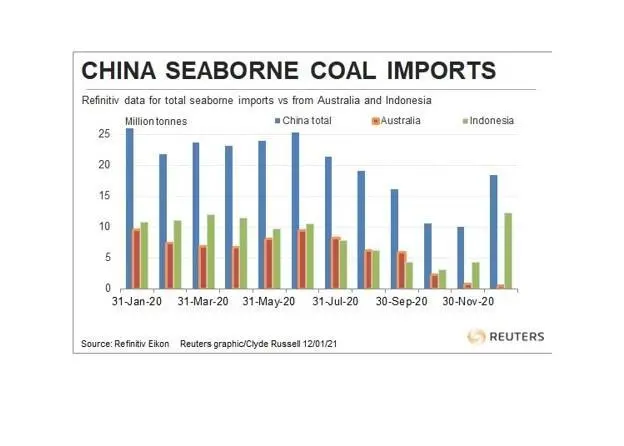
China’s ongoing dispute with Australia is an influential factor behind a distinct shift in seaborne coal trading patterns. Australia has moved quickly to compensate for the loss of Chinese business – highlighted clearly in Figure 1.
There has been no sustained dip in export activity overall with the country significantly upping coal export activity in the Asia-Pacific region. Indeed, there has been something of a reshuffling of purchaser activity between the principal coal suppliers.
Indonesia and Australia dominate the global seaborne coal trade, with the Southeast Asian nation holding the number one spot in thermal coal, used mainly in power plants, while Australia is the biggest shipper of coking coal, and the number two in thermal coal.
Traditionally, Indonesia has filled the role of being the second largest supplier of coal to China but as Australian imports have dropped to virtually zero Indonesia has quickly ascended to the position of its number one ranked supplier.
Activity in December 2020 proves the point – China’s imports from Australia accounted for just 447,523 tonnes, reportedly the lowest since January 2015; down hugely from the 2020 pinnacle of 9.64 million tonnes in June.
Conversely, China’s imports from Indonesia climbed to 12.19 million tonnes in December, soaring past the previous record of 10.47 million in April 2019, and up almost three times more than the 4.3 million tonnes achieved in November.
In the process of this change, however, Indonesia has seen Australia make significant inroads into supplying coal to India, a market where Indonesia has long been strong.
Coal imports from Australia to India achieved the record figure of 6.75 million tonnes in January, according to analyst Refinitiv. This was up from 6.32 million tonnes in December, 5.06 million in November and 5.49 million in October.
Overall, the four months to end of January 2020 were the strongest for Indian imports of Australian coal since Refinitiv commenced recording these in January 2015. The volumes reportedly include higher levels of thermal coal – exports to India traditionally comprising mainly coking coal.
India imported 5.42 million tonnes from Indonesia in January, down from 5.74 million in December, 5.82 million tonnes in November and 6.75 million in October, confirming a distinct see-saw effect in terms of supply activity.
There is also a twist in the tale of China blocking Australian imports of coal; diverse market analysts report that the bill for doing this is markedly higher than it would be if it were to continue using Australian imports. This reality covers suppliers other than Indonesia and applies to countries such as South Africa, Colombia and Russia which have all seen increased demand from China.
OTHER MARKETS
Alongside India, Australia is also recording increased coal exports to Vietnam and to a lesser extent Pakistan and Middle East countries – all of which is robustly helping to fill the gap in demand from China.
Such is the progress being made that at the beginning of March Asia Pacific Thermal Coal Research projected that overall Australian exports in January and February will be higher than in both 2020 and 2019.
And underpinning this positive assumption lingers the fundamental question, will China be able to sustain its block on Australian coal imports? There are those who believe that ultimately it may be compelled to take a step back from this unwritten policy.
Related Articles
 INSIGHT & OPINION
 INSIGHT & OPINION
 INSIGHT & OPINION