


Eggs in one basket
US East Coast ports have staked everything on the blessings of the Panama Canal, says Martin Rushmere
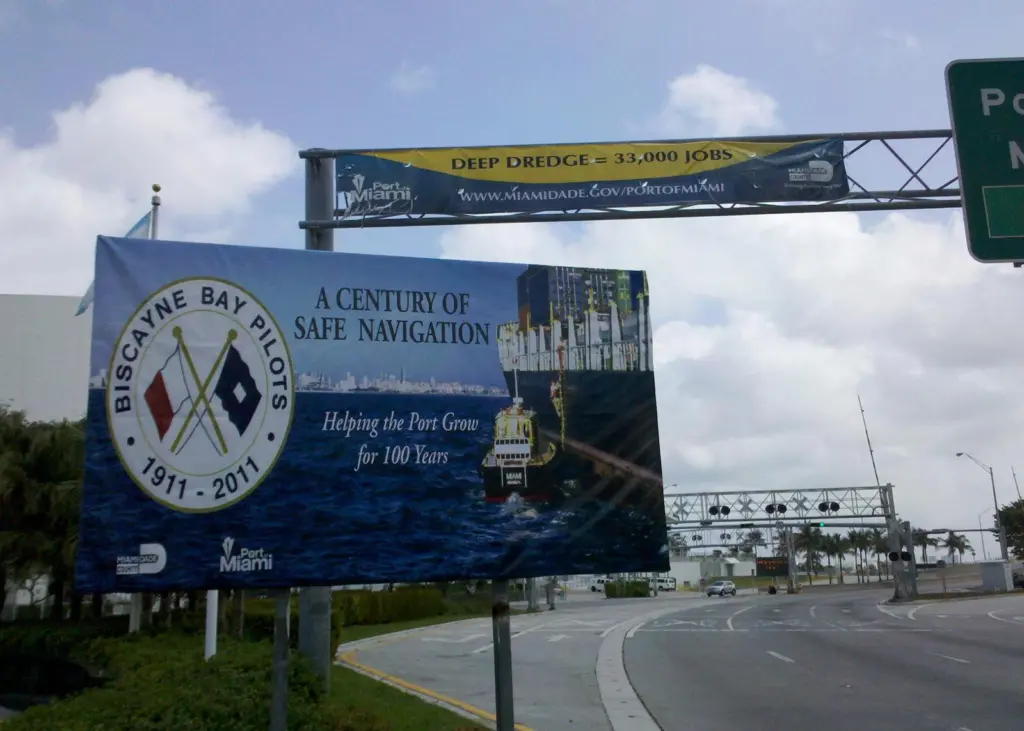
Dredging and transhipment are bumping heads in the heady rush along the East Coast to capitalise on the supposed bounty of the Panama Canal after 2014. Ports are clamouring and competing for 14.6 and 15.2 metres main channel drafts for 13,000 teu vessels while the canal is talking of transhipment, probably in the 6,000-8,000 teu range.
One indication is the construction of the new terminal at Colon (PCCP), at the Atlantic end of the canal, with a capacity of 2m teu a year. John Carver, of Jones Lang LaSalle, the development advisor, says: “Too many seaports do not currently, and may never, have the harbour depth required to take advantage of the trend towards post and super-post panamax vessels.” He sees the terminal as “further enhancing Panama’s already strategic designation as one of the world’s primary global transshipment hubs.
“We expect transhipment terminals such as PCCP to play an integral role in the long-term success of the Panama Canal,” says Ricardo Quijano, Panama’s Minister of Commerce and Industry.
Contrast this with East Coast expansion:
- Global at Bayonne, New Jersey building a terminal capable of handling 1.7m teu a year, with a 50 foot draft.
- The Port Authority of New York/New Jersey is raising the height of the Bayonne Bridge to cope with super post-panamax vessels.
- Ports America has deepened its Baltimore terminal berth to 15.2 metres, while the port’s main channel is also 15.2 metres.
- Charleston is determined to go down to 50 feet.
- Savannah is being dredged to 47 feet (down from the 48 feet originally wanted), and is in a vicious political fight with neighbour Charleston, In turn, Charleston is engaged in its own political infighting, with the governor pushing for the state to help pay for a joint terminal project with Savannah, while state leaders are vehemently opposed.
- Miami is going deeper to 15.2 metres and aiming to double container capacity within the next few years.
Canal effect
All this planning centres on bigger vessels calling via the canal and that transhipment will be minimal. Without exception, port officials refer to the “expanded canal” in citing the reasons for projects. Even factoring in a generous increase in Atlantic traffic of 3% a year, the planners are clearly putting their money on benefiting from the canal.
A considerable amount it is too, although exact numbers are hard to quantify. The main reason is uncertainty about how much state and federal funds will contribute, but there are also conflicting estimates of the cost of dredging. As an example, Miami reckons that its dredging will cost $170m – but independent estimates have put the bill at close to $230m. Charleston-Savannah deepening costs vary widely, depending on which vested interest is speaking. Charleston says the cost of just dredging its own harbour will be more than $320m, but is cheaper than Savannah’s project. Miami says it’s cheaper than both, implying that it should get more federal dollars.
Together, the dredging projects either already completed or in the process are costing about $800m. Terminal construction prices will come in at least triple that amount. Excluded from this is Virginia’s 700-acre Craney Island project, expected to cost at least $2bn, which will be in operation only in 2020.
Some cost cutting in dredging can be expected from the Army Corps of Engineers, which oversees project execution of projects. Already, Savannah’s proposed depth has been reduced by 10 centimetres following a cost-benefit analysis by the army.
Terminal plans are just the opposite. Global’s Bayonne scheme is heavy on innovation and new design. Taking up 43 acres, the new terminal will increase capacity to 1.7m teu a year and will feature slanted stacking and a wind farm to power rail-mounted gantries. Four super-post panamax cranes will do the lifting.
Spending pays
Ports America has spent more than $400m at its Seagirt terminal at Baltimore in equipment improvements and environmental controls. The port has come off in a year in which it recorded a 15% increase in business, the best in the country. Says port spokesman Richard Scher: “The port is known for having outstanding labour. Our container terminal averages 37 container moves per hour per crane, the highest rate on the US East Coast.
“Our ILA (International Longshoremen’s Association) labour is one of the main reasons why the Port of Baltimore had the largest percentage growth of cargo among all major US ports in 2011.”
All major ports along the seaboard are expecting traffic to increase and to keep doing so after 2014. A New York/New Jersey official says: “In 2011, the Port Authority reported record cargo volumes at our port. The 5.5m teu handled in 2011 represented a nearly 4% increase over 2010 volumes. Over the past 11 years, our container business has grown at a rate of approximately 4% a year. We look forward to continuing similar growth in the future.”
The chief executive of Ports America Chesapeake, Mark Montgomery, responds: “Volumes are projected to grow at 3%-5% over the next ten years.”
Not everyone is so sure that the volume of traffic will swell. The American Association of Port Authorities talks of the canal acting as a “safety valve” for trans-Pacific cargo, particularly during peak season.
Join the party
If over-ambition is the case, the East Coast has persuaded carriers to join the party and is taking out insurance at the same time by securing Minimum Annual Guarantees from lines and terminal operators. New York/New Jersey will only finish raising the roadway on the Bayonne Bridge in 2016, but a spokesman says, “we are confident that the Port will remain competitive during this period. For example, last June, the Port Authority secured Mediterranean Shipping Company, as an anchor tenant at Port Newark.” MSC seems to be equally confident, extending its lease to 2050, investing $500m and pledging to increase the box throughput from 414,000 teu to 1.1m teu by 2030.
Differences in draft depths along the East Coast could mean changes in port call patterns over the next five years, says Paul Bingham, economics practice leader of consultants CDM Smith. “This could perhaps lead to more container lines making New York or Norfolk (or even Baltimore at 50 ft) the first or last ports of call on the coastal range where the vessels will be at their maximum sailing draft.
“Service revisions, before or after the opening of the Panama Canal expansion, won’t mean carriers will have incentives to stop providing services to Savannah or Charleston where substantial Southeastern regional supply chain and distribution center activity will still make sense to serve through those ports instead of via rail or longer-distance truck from further away.”
Left out of ports’ calculations and hopes over the benefits of the canal are the new toll fees that might be charged. Observers say that a balance has to be achieved to maximise revenue to pay off the debts for the expansion costs, while making sure that carriers do not opt for the West Coast and/or Suez.
“It’s quite possible that the authority will plump for high tariffs to start with, banking on bigger vessels going through anyway, and then reduce them if the complaints get loud enough,” says one industry insider.
While the ‘Canal effect’ could turn out to be less of a boon than expected, one longstanding bugbear is proving less of a threat. Economics is limiting the power of the International Longshoremen’s Association to prevent the relentless march of automation. The ports are now a much more important source of revenue and jobs than 15 years ago and a backlash will swiftly develop, from public and politicians, should union militancy drive traffic away.
The union will probably have to continue to compromise, accepting a loss of jobs while insisting that only its members run certain operations. As Baltimore and Bayonne have shown, terminal gates will be automated, optical character reading will be the norm and yard stacking will become increasingly remote controlled.
Related Articles
 PORT & TERMINAL NEWS
 OPERATIONS
 PORT & TERMINAL NEWS