


Shale gas spillover
US Gulf ports welcome a breakbulk and project cargo handling boom. Alex Hughes reports
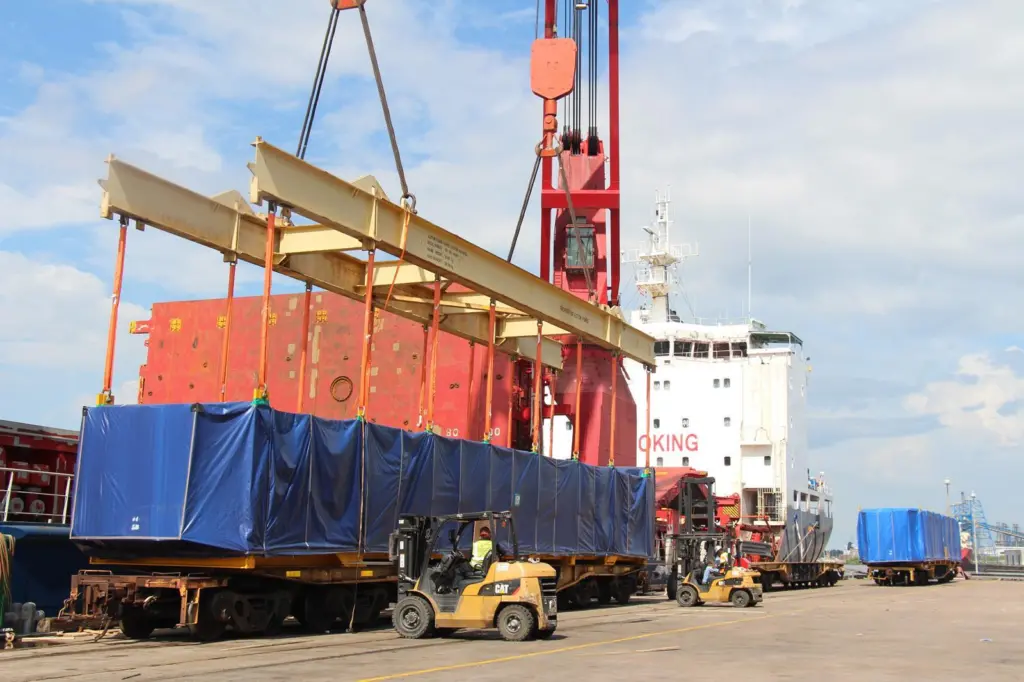
The shale gas boom in the US has driven growth in the breakbulk sector with export terminals springing up all along the Gulf Coast.
The Texan Port of Beaumont is one of many that has benefited from the shale drive: breakbulk traffic in the half year to the end of June amounted to 359,672 tons, up 5% from 342,246 tons in the comparable 2014 period. Here, breakbulk cargo is handled at the Harbor Island Marine Terminal, which has 1,719 metres of linear quay and alongside draft of 12 metres, serving a 14,000 square metre transit shed.
“The wharf was designed for conventional breakbulk vessels, side-loading ro-ro ships, heavy lifts and containers,” said John Roby, director of corporate affairs at the port authority. “However, the port is currently enjoying a boom in breakbulk cargo due to the approximately $100bn expansion taking place in the energy and chemical industry on the Gulf Coast.” Beaumont has seen a spike in project cargo, which includes components required by the energy and chemical plants being constructed in Beaumont itself, not to mention in Southeast Texas, too, and also along the entire Gulf Coast.
“The shale boom has made the US the lowest-cost chemical producer outside the Middle East. US fuel refiners and chemical producers are therefore revving up and expanding to take advantage of the vast supplies of cheap natural gas this has unleashed, which is in turn driving up the Port of Beaumont’s breakbulk cargo traffic,” says Mr Roby. Vessels calling at the port for this new trade come from Asia, South America and Europe, discharging pressure vessels, modules, structural steel, pipe and other key components used in the construction of the new chemical plants and refineries.
Slow starter
Mr Roby notes that it took a couple of years from the start of the shale drilling and petrochemical expansion in Texas for the project cargo boom to be felt at ports. But now it’s in full flow, the construction boom is expected to last for “several years at least”.
Beaumont did not have to expand to specifically accommodate the uptick in breakbulk cargo; it’s been developing facilities to handle this type of cargo as part of its strategic planning for the last three decades, and has taken an active role in several past ramp ups in the area petrochemical sector.
In addition, the port has also been a major hub for the import and export of wind energy equipment for many years, including blades, nacelles and towers. Texas is the largest user of wind energy in the US, and the Port of Beaumont is well-located geographically to handle this cargo, whether it is manufactured in South America, Asia or Europe.
“Transportation of wind components from the port to the ultimate job site is critical to the economies of the industry, and the port is well-served by three Class 1 railroads and several major highways,” said Mr Roby, adding that heavy-lift cranes are also available to handle the loading of this type of cargo onto railcars and trucks.
Pick and choose
Further south, at the Port of Galveston, the shale boom has yet to have any significant impact on breakbulk traffic. Unlike booming Houston, which is located some 50 miles east, the public port at Galveston has not benefited from the growth in this vibrant sector.
However, an adjacent private port, Texas International Terminals (TIT), is very active in this sector.
“The difference is that TIT has a direct rail connection, which you must have to be in the shale gas market, while Galveston’s oil storage facility on Pelican Island doesn’t. We are looking into this, but, realistically, it is unlikely that tracks will get there in the next five to seven years,” says Galveston port director Michael Mierzwa.
Nevertheless, Galveston is seeing significant growth in its breakbulk business, albeit from an entirely different market all together: that of refrigerated fruit traffic, which continues to grow in importance, following major upgrades at the Del Monte fruit terminal.
Mr Mierzwa explains that this renaissance in the handling of bananas and melons is a direct result of the rebuilding that took place following the devastating impact Hurricane Ike had in 2008, when three quarters of Galveston and Pelican islands were covered by about one metre of water.
The disaster enabled the port to call upon regeneration grants made available by the US Economic Development Administration, which resulted in $7m being set aside for infrastructure redevelopment, much of which directly benefited the Del Monte fruit terminal. In addition, the port authority provided a further $3m in matching funding, while terminal operator Del Monte stumped up an additional $12m of its own cash.
The port authority and federal government money, recalls Mr Mierzwa, enabled the existing wharf apron used by Del Monte to be both widened by 40 feet (12 metres) to 85 feet (24 metres) and also strengthened. Additionally, brand new fenders and mooring bollards were installed.
“This allowed Del Monte to bring in a mobile harbour crane, thereby boosting quayside productivity, since prior to that point, on board containers and palletised cargo had been offloaded using ship’s gear. The MHC is, at least, three times faster,” he says.
For its part, Del Monte improved terminal refrigeration provision, increased the available number of reefer plugs and racks, and also totally enclosed the truck loading areas. This latter move has been particularly significant, since it enables all banana handling to take place in an entirely climate-controlled environment, thereby decreasing the possibility that fruit will become spoiled. Fruit traffic has since boomed.
Organic growth
From what the port authority is able to determine, the subsequent growth has been organic in nature, although some vessels may have been diverted from the multinational’s other operations in the US. While Galveston is the hub for shipments bound for consumers in the central area of the country, Port Manatee, in Florida, is used to serve the eastern seaboard and Port Hueneme, in California, the US west coast.
“But it should be pointed out that, with the new facilities, Del Monte’s Galveston operation effectively has more capacity and better handling facilities, which has resulted in less spoilage, thus giving every incentive to call here,” says Mr Mierzwa.
The actual service operated by Del Monte involves just two vessels plying between Guatemala and Galveston, on what is no more than a three day journey. While one ship is docked in the US, the other is taking fruit on board in Guatemala, the two then pass in the Yucatan Channel. These combi-vessels carry palletised cargo in the refrigerated holds and around 200 reefer boxes on deck.
There is also a return cargo: paper reels are imported into Guatemala by Del Monte to be turned into cardboard boxes, which will in turn carry consignments of bananas back into the US aboard the same ships, but going in the opposite direction. The only other cargo carried are empty reefer boxes.
Fruit volumes take a sweet turn
Fruit handling figures for the Port of Galveston paint an interesting picture.
“If we compare the amount of fruit handled in 2012 to that handled by Del Monte in 2014, there was a 50% increase, while port revenue derived mainly from this melon and banana traffic grew by 28%,” says port director Michael Mierzwa. “We consider this a major success story.”
Indeed, in the first six months of 2015, Galveston saw fruit traffic continuing to rise, by 3.5% from 263,599 tons to 272,879 tons.
However, on the face of it, the first half of the current year wasn’t a good one for fruit since palletised shipments amounted to just 139,000 tons, down 9% over the previous year. However, burgeoning box reefer traffic indicates that Del Monte is leveraging its new mobile harbour crane to bring ever greater amounts of bananas into the US in reefer containers at the expense of palletised shipments.
“This is a direct result of better terminal facilities and the availability of a much more productive mobile harbour crane,” says Mr Mierzwa, who stresses that Galveston is not a container port as such since there is no dedicated handling facility. All box traffic is generated by the Del Monte terminal. Despite this, container tonnage for the half year was up 21%, following a trend established four years ago.
Related Articles
 PORT & TERMINAL NEWS
 OPERATIONS
 PORT & TERMINAL NEWS