

As ports face mounting pressure to decarbonise while continuing to enable global trade, their role in the energy transition is becoming increasingly complex.
In the run-up to 2025, ports are expected not only to reduce their own emissions, but also to facilitate the transition of shipping, inland transport and energy supply chains simultaneously.
Few individuals sit as squarely at the precipice of this step change as Edvard Molitor, head of international public affairs & sustainability at the Port of Gothenburg and chair of the IAPH Climate and Energy Technical Committee.
Speaking to GreenPort exclusively, Mr Molitor offers a candid assessment of where ports currently stand, where expectations may be misaligned with reality and what must change if the sector is to move from pilots and promises to scaled implementation.
Acknowledging variation
Mr Molitor is clear that the starting point for any discussion about port readiness is acknowledging the wide variation across the sector.
“There is a large variation, no doubt, and there’s a handful of ports that are very proactive and are far ahead,” he explains, while also noting that “there are also a large amount of ports that are falling a bit behind.”
This divergence, he argues, is shaping the pace and direction of the energy transition far more than headline commitments or declarations.
In outlining how ports are approaching decarbonisation, Mr Molitor frames the transition around two fundamentally different yet interconnected responsibilities.
“There’s really two sides emerging when it comes to the energy transition and it’s on the one hand, the bunkering of the vessels and the fuels that we need for the vessels and on the other hand, the handling of the products as such, because we see in the future that we’re likely going to have a larger amount of ports handling energy products than what we have today.”
This distinction, he suggests, is often overlooked in broader industry debates.
Reassessment of role
While much attention has been placed on vessel fuels, Mr Molitor stresses that ports must think beyond the quayside.
The energy transition, he argues, requires ports to reassess their role within wider logistics and energy systems, rather than viewing decarbonisation as a series of isolated technical projects.
From a regulatory and procedural standpoint, Mr Molitor believes ports are more prepared than is sometimes assumed.
He notes that much of the groundwork for alternative fuel bunkering has already been laid.
However, regulatory readiness does not equate to operational reality.
While ports may be technically capable of bunkering new fuels, access to fuel supply and suitable vessels remains a significant bottleneck.
“It takes more time to build up the access to the fuel, to build the production line and also to build the vessels that can use the new fuels. That will take longer than getting the ports in line to service them,” Mr Molitor explains.
Impact on investment
This imbalance has important implications for investment decisions of course.
Ports risk overbuilding infrastructure for fuels that may not materialise at scale, while shipowners hesitate to commit without assurance of fuel availability and competitive operating costs.
Mr Molitor says there is a gap between ambition and delivery in recent international initiatives - this reinforces a recurring challenge across the energy transition.
“To try out new initiatives works well, but to scale up is really difficult,” he says, noting that without alignment between fuel supply, vessel capability, regulation and cost, many initiatives remain stuck in demonstration mode.
The price gap
When discussing barriers to progress, Mr Molitor repeatedly returns to what he describes as the real issue facing shipping and ports alike: The price gap between conventional fuels and low-or zero-carbon alternatives.
“What we talk about today is not really the chicken and egg anymore. We always talk about the price gap instead,” he says.
While capital funding for vessels and infrastructure is often available, operating costs remain prohibitive.
“There’s no chance you’re going to operate on a new type of fuel because that’s going to be too expensive,” Mr Molitor explains, adding that promised operating support mechanisms have not yet materialised.
This economic reality, he argues, undermines otherwise well-prepared projects. Ports may be technically ready and shipowners willing, but without financial mechanisms to bridge the price gap, uptake of new fuels will remain limited.
On the positive side, Mr Molitor argues that the handling side of alternative energy products may be less disruptive than commonly perceived.
“To a large extent it’s just another product,” he says, pointing to existing experience with methanol, ammonia and CO2. “We’re really good at handling chemicals and oil in a lot of ports.”
The challenge, he suggests, lies not in technical capability but in knowledge transfer, as more ports enter energy product handling without the experience historically concentrated in major energy hubs.
Uncertainty, standardisation and infrastructure risk
One of Mr Molitor’s most consistent concerns relates to uncertainty and its impact on infrastructure decisions.
Slow-moving regulation creates hesitation and fragmentation. “The uncertainty comes back to everybody sort of betting on a different solution,” he warns, noting that this often leads to inefficient custom-made infrastructure.
He cites onshore power supply projects as an example. “We have done way too many custom-made solutions,” he says. “You end up with something that cannot be replicated somewhere else and therefore it’s difficult to scale up.”
Customisation may of course be necessary in early pilots, Mr Molitor acknowledges, but it cannot form the basis of large-scale deployment. Without standardisation, costs remain high and flexibility is lost.
Despite these challenges, Mr Molitor remains optimistic about the strategic opportunity the transition presents for ports.
“This is a huge opportunity for ports to take part in the transition and drive the transition,” he said, particularly given the public ownership structures of many ports.
He also highlights the unique chance ports have to plan deliberately.
“This time we actually do have the opportunity and the possibility of sitting down beforehand and to plan ahead and do it right,” he says, contrasting today’s transition with earlier, more fragmented shifts in energy use.
Gothenburg as a testbed
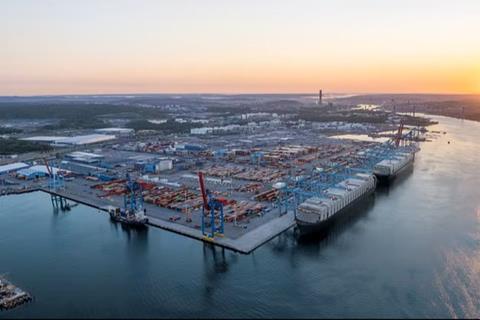
At the Port of Gothenburg, these principles are being applied across sea and land operations.
Mr Molitor describes a broad portfolio of initiatives, including onshore power supply for multiple vessel types, grid reinforcement, offshore wind investment, electrified trucking corridors, hydrogen refuelling infrastructure and long-established rail solutions.
“We are working more or less on every area of the transition,” Mr Molitor says, emphasising that incremental improvements across the transport chain can collectively deliver significant emissions reductions.
For smaller ports, his advice is clear.
“Remember that you have a lot of friends in the port sector,” he said, urging ports to collaborate and learn from others rather than reinventing solutions.
Active participation in organisations such as ESPO and IAPH, he notes, has been central to Gothenburg’s progress.
Looking ahead, Mr Molitor sees the role of IAPH as both practical and political: Providing tools, guidelines and readiness frameworks, while strengthening the collective voice of ports towards regulators.
At the same time, he cautions against taking too narrow a focus.
“We must be able to have a lot of agenda items at the same time,” he says, stressing that sustainability requires addressing climate mitigation, adaptation, safety, digitalisation and efficiency together at the same time.
For ports navigating the road towards the energy transition, Mr Molitor’s message is both pragmatic and honest: Readiness is improving, but only coordinated action, standardisation and commercial reality will turn ambition into reality.
Listen to more chat with Mr Molitor on how ports are at the heart of the energy transition