

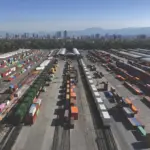




Weak early 2023 port volumes in abundance
While many ports do not report monthly traffic volumes, the data from the ports that do…
While many ports do not report monthly traffic volumes, the data from the ports that do, as well as the data from Cosco Shipping Ports, the only large terminal operating company that publishes monthly container volume data for all its terminals, clearly shows volumes are weak and generally below 2022 levels.
The large US West Coast ports of Los Angeles and Long Beach have both seen very substantial (>30 per cent) declines for the first two months of 2023. In Europe, Valencia’s data for January 2023 also shows a significant decline (>20 per cent) of volumes compared to 2022.
Cosco Shipping’s Ports volumes for its entire portfolio of terminals also show declining volumes, with an average decline of around six per cent for the first two months of 2023. The company’s terminals in China witnessed, on average, a drop of around eight per cent. In Northern Europe, Cosco’s terminal participations in Antwerp and Rotterdam reported a decrease of more than 10 per cent, as did Cosco’s East Mediterranean hub in Piraeus. All of this should not come as a surprise, given the frequently occurring blank sailings and shipping lines regularly announcing a reduction of services.
As far as I can tell, there is no single straightforward explanation for the weak start to 2023. On the US West Coast, strikes were a key factor, but this issue was not widely manifest elsewhere, Hamburg being a notable exception. One could have thought that China’s decision to ease COVID-19 restrictions end of 2022 would have provided a boost for export volumes but at least so far, that does not seem to have happened. The global container volume forecasts for 2023 by UNCTAD and Clarkson’s (both predict around two per cent annual growth) were modest from a historical perspective, but now seem optimistic, also in view of the bleak prospects for an end to the war in Ukraine and the ongoing ‘cost-of-living’ problems in many advanced economies.
For all parties involved in making long term decisions in assets in container freight transport, the question whether the current weak volumes are due to ‘temporary conditions’ or they indicate a structural decoupling between the overall economy and container freight volumes seems as relevant as ever.
Related Articles
 INSIGHT & OPINION
 INSIGHT & OPINION
 INSIGHT & OPINION