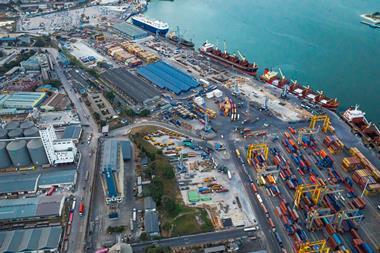

Once clearly streets ahead as a regional port, Jebel Ali took a hit in the economic downturn, with decline in origin and destination cargo being more pronounced in Dubai than in other Emirates ports.

Nevertheless, while traffic fell 6% last year, it still amounted to 11.12m teu, confirming the port’s position as leading regional transhipment hub, says Mohammed Al Muallem, DP World’s senior vice president and managing director, UAE region.
First half growth of 3% in 2010 resulted in throughput of 5.5m teu, which Mr Al Muallem describes as “encouraging”. Citing IMF and World Bank sources, he suggests that emerging markets, such as the Middle East, are recovering more quickly than developed markets in the West.
Interestingly, despite the widely publicised problems with the economy in Dubai, he says there has been no change in the balance between transhipment and origin/destination cargo. “Our strategy and business model therefore haven’t changed. During the downturn we have focused strongly on cost containment and on improving efficiencies, which benefit our customers both in the short term and in the longer term as volumes recover.”
It should be noted that whilst global container volumes fell 10%, the UAE only lost 6% of its volume, which Mr Al Muallem says reflects the resilience of Dubai and surrounding economies.
When asked what policy has been adopted by Dubai in respect of staffing levels, given a backdrop of falling traffic, he notes that all DP World’s terminals operate with a mix of permanent and casual labour. “In the UAE region, even before the downturn occurred, we moved to ensure we had the flexibility to match resources to demand in our operations,” he says. “While this meant that some positions became redundant, overall the size of the workforce at Jebel Ali hardly changed. During the downturn, globally, we reduced headcount by around 5%; at Jebel Ali, that figure was more like 10%. Overall, productivity has improved as we have focused on efficiency and cost containment.”
Another successful policy adopted by Jebel Ali was to maintain tariffs at 2008 levels to help shipping line customers who were seeing record losses. Extra free storage days were also introduced to help traders who predominately use the terminal to store boxes.