![PortStrategy[GreenPort]](https://www.portstrategy.com/wp-content/uploads/2026/09/PortStrategyGreenPort.svg)





2023 statistical decoupling
The industry thought the covid pandemic resulted in chaotic macro-economic and port statistics. It seems the period since the pandemic remains equally complex in Europe. J-P Verschuure* looks at changes in the forces driving the market.
Geopolitical conflicts, volatile commodity prices and adverse macro-economic parameters result in new dynamics ports and terminals need to carefully review. Making sense out of the port statistics and the GDP-trade relationship is becoming more complex.
Looking at recent container throughput statistics in North-West Europe all indicators point to lower volumes than in 2022. The Port of Rotterdam started the year with a drop in volumes, largely as a result of the Ukraine-Russia conflict which started in late February 2022. In the course of 2023 volumes recovered to quarterly year-on-year (y-o-y) growth rates of -4.6% and 5.6% in Q2 and Q3 respectively. Hamburg followed a similar track albeit with -16.9% in Q1 and -6.4% y-o-y in Q1 and Q2 and went a bit deeper in the red. The port of Antwerp-Bruges however managed to keep the loss in container volume limited in Q1 with a minus of ‘only’ -5.7%, which was however followed by a -4.7% and ~ -10% in Q2 and Q3 of this year, respectively. The Port of Antwerp-Bruges is down 6.8% over the first nine months of 2023, while Rotterdam is down 7.2% down for the year (in terms of TEUs). The stories behind the figures, however, tells an entirely different tale.
In its Q3 press release Port of Antwerp-Bruges states that these developments will still result in a market share gain of roughly a full per cent. This means that they see an overall decline in the market in the first nine months of the year of an astonishing 9.9%. In mid-October, the port of Le Havre indicated the port is expecting a minus of 15% for 2023 after it saw a decline in demand of 16.7% in the first half year (in containerised tonnage) giving up the growth resulting from volumes rerouted during the pandemic. Also, the northern major German ports are probably coming in just under this overall market decline. This would bring North-West European container volumes roughly back to the 2015-2017 levels. The exit of Russian volumes from the range was, to a large extent, built into the 2022 figures (except Q1) So, what is actually happening?
GDP – TRADE RELATIONSHIP
Over longer periods the GDP-trade multiplier is working well to forecast container demand, as acknowledged across the industry. Looking at the GDP growth over the past few quarters reported by North-West European countries, the decline is nothing like as steep. It seems that Germany is struggling with the poorest GDP performance this year, but it is expected to record only a marginal overall contraction. For other North-West European countries small economic growth may materialise by the end of 2023.
Overall, the GDP-trade relationship does not tell the full story for 2023.
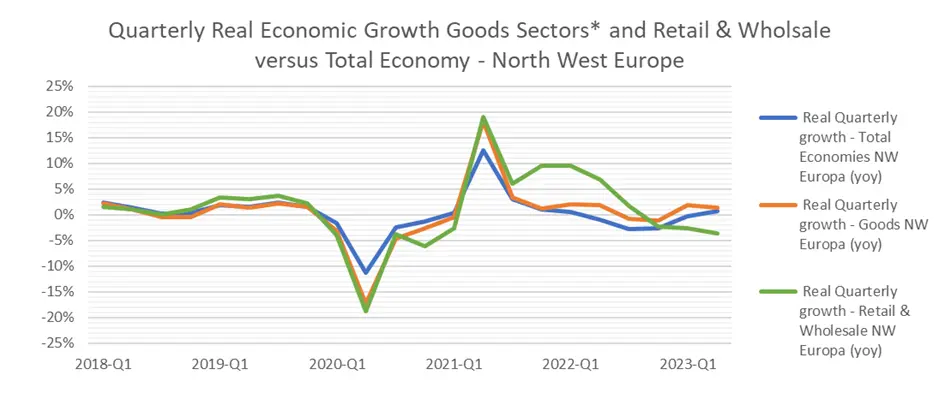
When filtering out the goods related segments of the economy (primary manufacturing, retail & wholesale, construction, and industry) from the overall economic performance it is apparent that this sector has been outperforming the overall economy since the beginning of 2022 (see chart below). Rising interest rates did affect in particular the financial and real estate sectors. As a consequence, the headline economic growth rate is not currently reflecting the reality in the sectors driving demand in the container sector.
However, the decline in demand in the past few quarters is more clearly visible when zooming in on the retail and wholesale sector in North West Europe – i.e., consumer demand. Going forward the outperformance of the retail and wholesale sector in 2021 and 2022 will result in underperformance throughout 2024. Overall, it can be concluded from Figure 1, below, that pre-Covid the goods related economic sectors are performing in sync with overall economic activity, but that since 2020 there are large variations between segments of the economy. This makes understanding the GDP headlines and the implications for the container segment not as straightforward as in pre-Covid times.
CHANGES IN INVENTORY
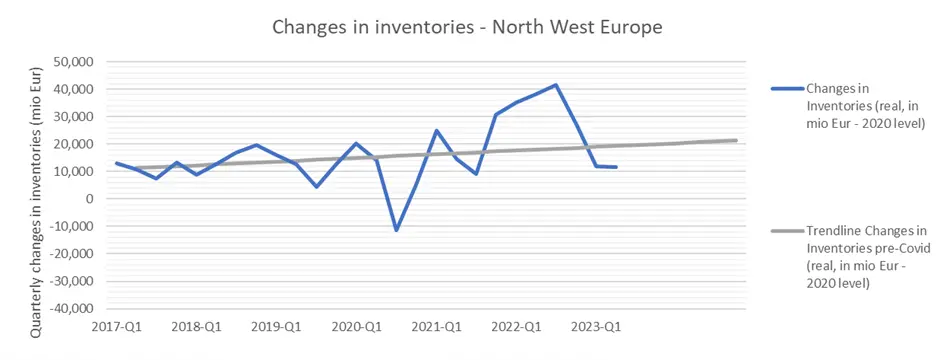
As recently as a year ago full container yards, packed warehouses, and panic amongst shippers to ensure their containers would arrive in time were events all over the news. As a result, inventory levels went up to ensure demand could be served despite supply chain disruptions. While this was going on demand softened causing a further tranche of goods to pile up in the warehouses. In Figure 2 this can be seen clearly when the total inflation adjusted inventory levels of North West Europe (Germany, France, Netherlands, Belgium and Luxembourg) are plotted by quarter.
After the initial shock following from the covid outbreak, there was a strong rebound in inventory levels in the second half of 2020. In Q1 and Q2 of 2021 inventories were then partially emptied when lockdowns re-emerged. Uncertainty about the new Covid measures and supply chain problems saw 2022 inventory levels keep rising.
The Ukraine-Russian conflict came as a surprise with this leading to an increase in inventory levels in Q2 of 2022. With demand softening over the summer of 2022 inventory levels went up a bit further, before tapering off when shippers started to realise supply chains were stabilising and end demand started to soften.
Inventories are typically growing in line with economic activity. More activity means larger inventories to meet demand and hence a stable increase in total volumes. This is indicated by the orange line which shows the pre-Covid trendline in inventories. Any deviation too far away from this trendline will be corrected by a move in the opposite direction, roughly equal in size, to balance the inventories with the actual demand. When considering the deviation from the trendline in 2022 the surge in volumes and current drop in inventories (and hence in port demand) can be easily understood.
When taking into account the strong reduction in inventory levels in the first two quarters of 2023 this represents a rebalancing of the excessive inventory build-up witnessed from late 2021. If the lower build-up in inventories experienced in Q1 and Q2 2023 versus the trendline is extended into the future, the areas above and below the trendline will be in balance from Q3 2024 again.
The total area in 2022 between the inventories and the trendline is estimated to represent roughly 1.5 million TEU (assuming 70% of is container inventories, 50,000 EUR/TEU and 30% additional return empties). The estimated 2023 TEU figures will come in over 5 million TEU lower, of which ~ 1.5 m TEU (handled twice as transshipment moves) are sanctioned Russian containers. This puts the full warehouses of 2022 in perspective. When inventories are rebalanced in the second half of 2024, volume growth will pick up once again to match end consumer demand.
LESSONS FOR INVESTMENT
The analysis of the sectoral GDP developments and changes in inventories indicate the complexity in the current market and the combination of effects in play. Therefore, careful consideration is needed when reading the headlines as what was analysed pre-Covid may not be sufficient for the next set of quarters. Or conversely when stock levels adjust and the spending spree is balanced, volumes will likely pick up again to the more usual longer-term relationship. When considering port and terminal investment a very careful teasing-out of these factors is clearly necessary. Short term differences will have a far-reaching impact on longer-term demand. And everyone developing and managing port assets knows it should be a business with a long-term focus.
*Johan Paul Verschurre is a Director of Netherlands-based Rebel Consultancy and is well-known as a port specialist and expert in market analysis/financial and economic matters
Related Articles
 EQUIPMENT
 OPERATIONS
 OPERATIONS