![PortStrategy[GreenPort]](https://www.portstrategy.com/wp-content/uploads/2026/09/PortStrategyGreenPort.svg)




Cambodia climbs the ladder
With the manufacturing shift out of China continuing, AJ Keyes assesses how Cambodia is developing as an option, especially in the garments and apparel business, and what it means for the country’s ports
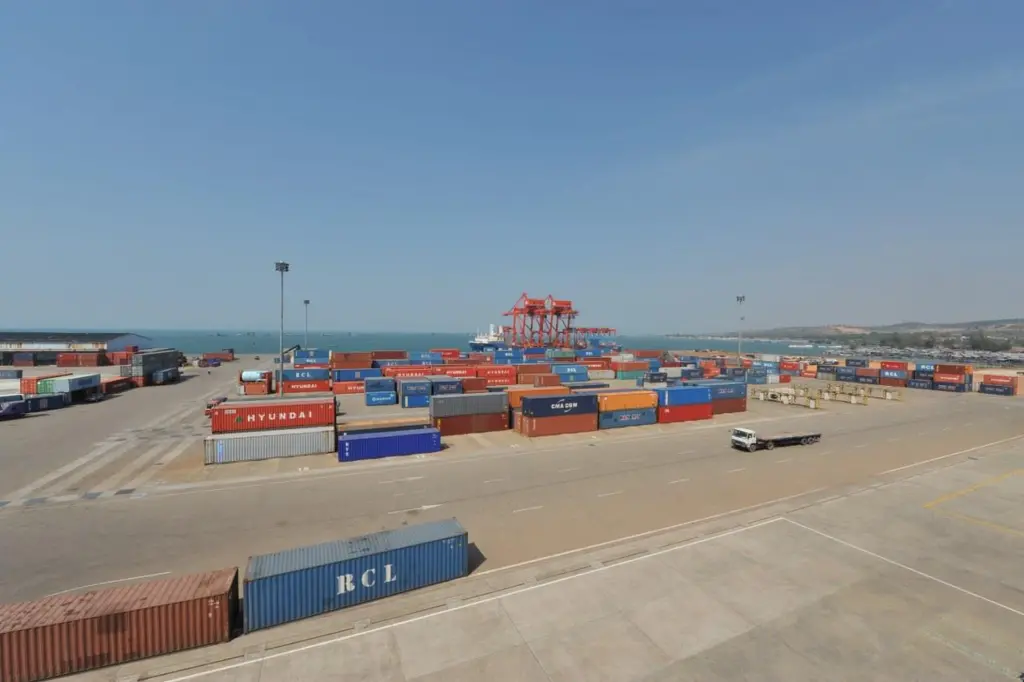
Outsourcing to East Asia is continuing as the cost competitiveness of China continues to be eroded and political pressure intensify. Cambodia is targeting infrastructure investment to become a more viable alternative, especially in the garments and apparel business. This is following a model now being achieved in Vietnam, where the reliance on transshipment is being replaced by direct deepsea calls – but does Cambodia have the critical mass of cargo demand and port facilities to be successful?
KEY FACTOR IN THE MANUFACTURING EQUATION
Low labour costs have been a key factor that helped establish China as a major manufacturing powerhouse, supported by low land costs, favourable tax legislation, good (port) infrastructure and an available labour workforce.
However, as China has developed its dominant manufacturing role, its cost competitiveness has been eroded. For example, according to specialist information provider, Data&, the average cost of wages per unit of output has risen by more than 280 per cent during the past 20 years in the country. On this basis, it is no surprise that many companies are looking to lower production costs without compromising on the quality of the manufactured products by seeking East Asian alternatives to China. So, where in the manufacturing development process is Cambodia, especially in relation to Vietnam, which offers an operating model to be replicated?
Table 1 represents a summary of the garment/textile industry between Vietnam and Cambodia for 2021/2022 and it can be seen that while the industry is sizeable in Cambodia, the country still lags behind Vietnam in terms of market development and manufacturing production.
| Indicators | Vietnam | Cambodia |
|---|---|---|
| Copyright© 2012-2023 Dr. Sheng Lu, Associate Professor, Department of Fashion & Apparel Studies, University of Delaware / Asia Garment Hub (2023) | ||
|
Garment/textile workers |
2.5 million (75% women) |
671,000 (82% women) |
|
Number of garment/textile factories |
10,000 |
718 |
|
Garment/textile exports – value |
US$44bn |
US$11bn |
|
Garment/textile exports – % of total exports |
12% |
64% |
|
Largest export market – share of value |
US (41.3%) |
US (39.9%) |
THE GREAT SUPPLY CHAIN MIGRATION
The Ministry of Economy and Finance in Cambodia is targeting new investment to build the infrastructure necessary to drive further growth and expand its industrial base. The government quotes research provided by Toronto-based financial services company TMX, entitled “The great supply chain migration – breaking down the cost of doing business in Asia,” which named Cambodia as the country with the lowest “average total operating cost” for manufacturing enterprises. Here, Cambodia was cheaper than other low-cost competitors from the Association of Southeast Asian Nations: Vietnam, Myanmar, and the Philippines.
However, the TMX report, which was first released at the end of 2021 but clearly remains valid, cautions that Cambodia currently resides at the bottom rung of what it defines as the “three stages of the manufacturing value chain,” or in more simple terms, it manufactures products on only basic assembly lines. The situation in mid-2023 has changed radically in favour of the potential role of Cambodia as the search for China alternatives has intensified.
The developing nation still needs to show growth in “developing supply chains” and “early automation” to be an attractive option for complex products. Its strength is in the textile and garment industries.
There are projects underway to ensure ports help support the burgeoning supply-chains in Cambodia. A five-year National Strategic Development Plan (NSDP) 2019-2023 outlines the government’s vision on key policy areas including bottlenecks in productivity and competitiveness and taking advantage of its strategic geographic location in Southeast Asia. At the same time, it is preparing a Masterplan for Multimodal Transport and Logistics to accelerate integration and increase the investment budget across all areas of transport, including ports. In conjunction with NSDP, the Minister of Public Work and Transport (MPWT) has also developed a Transport and Logistics Master Plan 2022–2030, supported by Chinese development partners. It cites 330 different infrastructure projects totalling US$50bn, including:
- Phase I of a new container terminal at the Sihanoukville Port, to be completed by 2025.
- A Phnom Penh Logistics Centre.
- Improvements in waterway transport, including a link from the capital to the Kep Coastal Port via the Tonle Bassac River.
“CLOSE TO CAPACITY”
The busiest container ports are Phnom Penh and Sihanoukville, which both serve as national gateways, albeit served by feeder vessels primarily from Singapore.
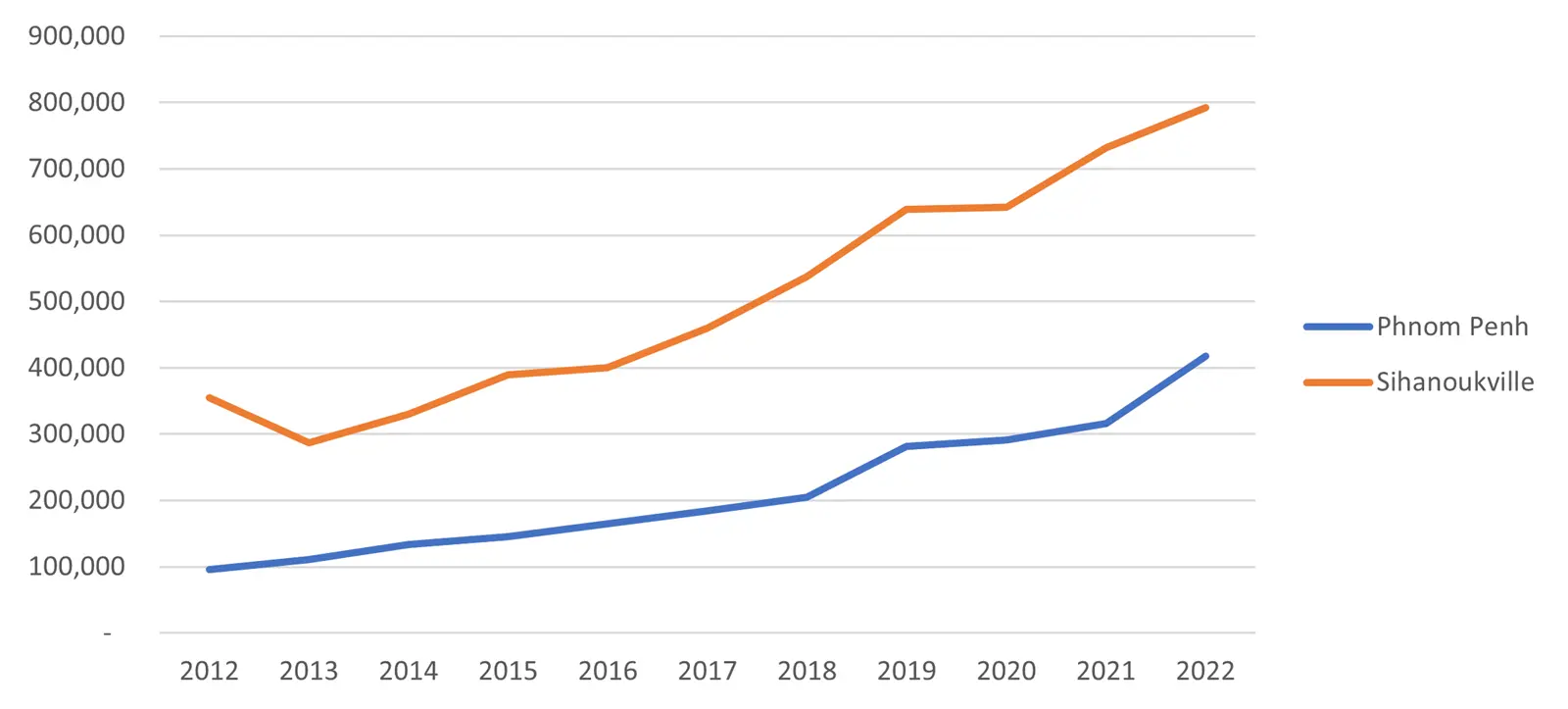
As Figure 1 confirms, there has been continued growth at both facilities, with Phnom Penh generating increases of 17.3 per cent per annum as its throughput rose from 95,333TEU in 2012 to 417,696TEU by the end of 2022. By comparison, growth at Sihanoukville was lower at 9.3 per cent per annum, but volumes are much higher rising from 355,380TEU in 2012 to an estimated 792,728 for 2022.
Due to this growth, the government in Cambodia states that both ports are operating “close to capacity.” There are plans to rectify this position.
At a groundbreaking ceremony at the start of May 2023, Samdech Techo Hun Sen, Prime Minister of Cambodia, announced that a new container terminal at Sihanoukville Autonomous Port will transform this feeder port into a hub port by 2029, in response to economic growth and rising international trade demand involving Cambodia: “The expansion project will allow large container ships to dock at the port and significantly reduce ocean freight costs for Cambodia. It will help attract investors and accelerate our economic development.”
At the same event, Sun Chanthol, Minister of Public Works and Transport, confirmed that the new terminal will involve three phases of development:
- Phase I – construction of an onshore general cargo terminal and a 350m container berth, with water depth of 14.5m able to handle ships of up to 4000 TEU in size. The cost is US$275 million and due for completion by 2026.
- Phase II – construction to start in 2025 and finish in 2028.
- Phase III – work will begin in 2016 and end by 2029.
- Phase II and Phase III expected to cost US$698 million.
The existing Sihanoukville Autonomous Port facilities have a confirmed capacity of 700,000TEU per annum, but the new project will deliver container capabilities to handle 1.4 million TEU per annum in 2026, subsequently rising to 2.58 million TEU per annum when finished in 2029.
COMPLEMENTING SIHANOUKVILLE
Expanding Sihanoukville is not the only port project underway. Construction has commenced on a new multipurpose port in the Kampot province of Cambodia, with funding supplied from the private sector.
Phase I of the project is due to be operational during 2025 and will offer a capacity of 300,000TEU per annum, with a second phase doubling the space to 600,000TEU per annum by 2030. A water depth of 15m is envisaged, allowing larger ships than the current small feeders only able to call in Cambodia.
In addition to being able to receive larger ships, there is a need to combine water, road and rail connectivity with the country’s capital city, Phnom Penh, plus other provinces via the Phnom Penh-Sihanoukville Expressway.
The importance here is that it will better link the port with key locations where manufacturing activities are being further developed, which is part of the government’s current policy of industrial development in the country by 2025. As part of this master plan initiative, Sihanoukville will become a special economic zone.
This push for the further development of Cambodia’s ports and wider infrastructure follows the signing of free trade agreements with China and South Korea, which the government is hoping will lead to a significant boost in both internal and external trade.
MORE TO COME – FOR BIGGER SHIPS
Based on the government of Cambodia’s aims, a further port is anticipated that can offer a water depth of 17.5m in a bid to see direct calls from ships to/from the US and Europe.
There is clearly a need for success here, as Chanthol openly admitted: “Now, due to the shallow water, Cambodia has to transport goods to Singapore or to Hong Kong to transfer goods to the big ship, which is not cost-effective.”
Based on current shipping line calls to Cambodia, less than 20 per cent of container ships working in the Asia Pacific region can access ports in the country, so an improvement is essential.
The move to larger ships is needed, based on current ship sizes calling to ports in country. For example, according to Alphaliner ships calling to Sihanoukville during week commencing August 7, 2023, ranged between 1,114 TEU and 2,038 TEU, with the previous / next port of call in the rotation consisting of Singapore and Hong Kong. This endorses Cambodia’s role remains part of regional feeder services.
The ability to target bigger ships will lower the reliance on transshipment activities via hub ports like Singapore and target potential direct calls – a similar strategy is underway at ports in Vietnam – and, of course, a natural progression in the region. Growth in manufacturing will be crucial in providing cargo demand, but ports need to ensure the infrastructure is available too.
Related Articles
 EQUIPMENT
 OPERATIONS
 OPERATIONS